Onchain Options Explained: Derive, Paradex, Rysk and More
12 mins


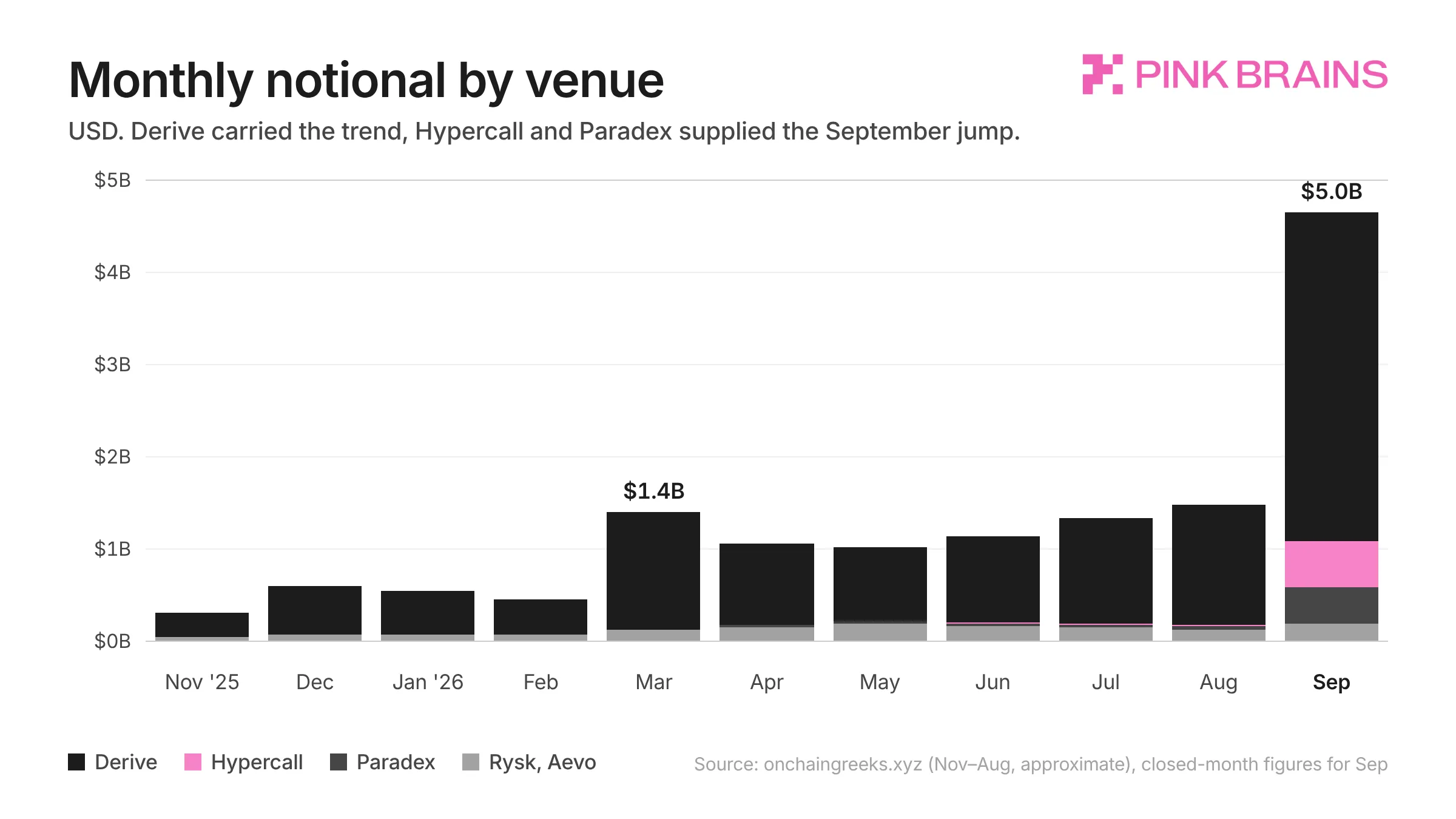
Onchain options traded between $4.8B and $5.6B of notional in September 2026. The month before, the figure was about $1.9B.
Premium, the cash that actually changed hands for those contracts, rose by a third to $85M.
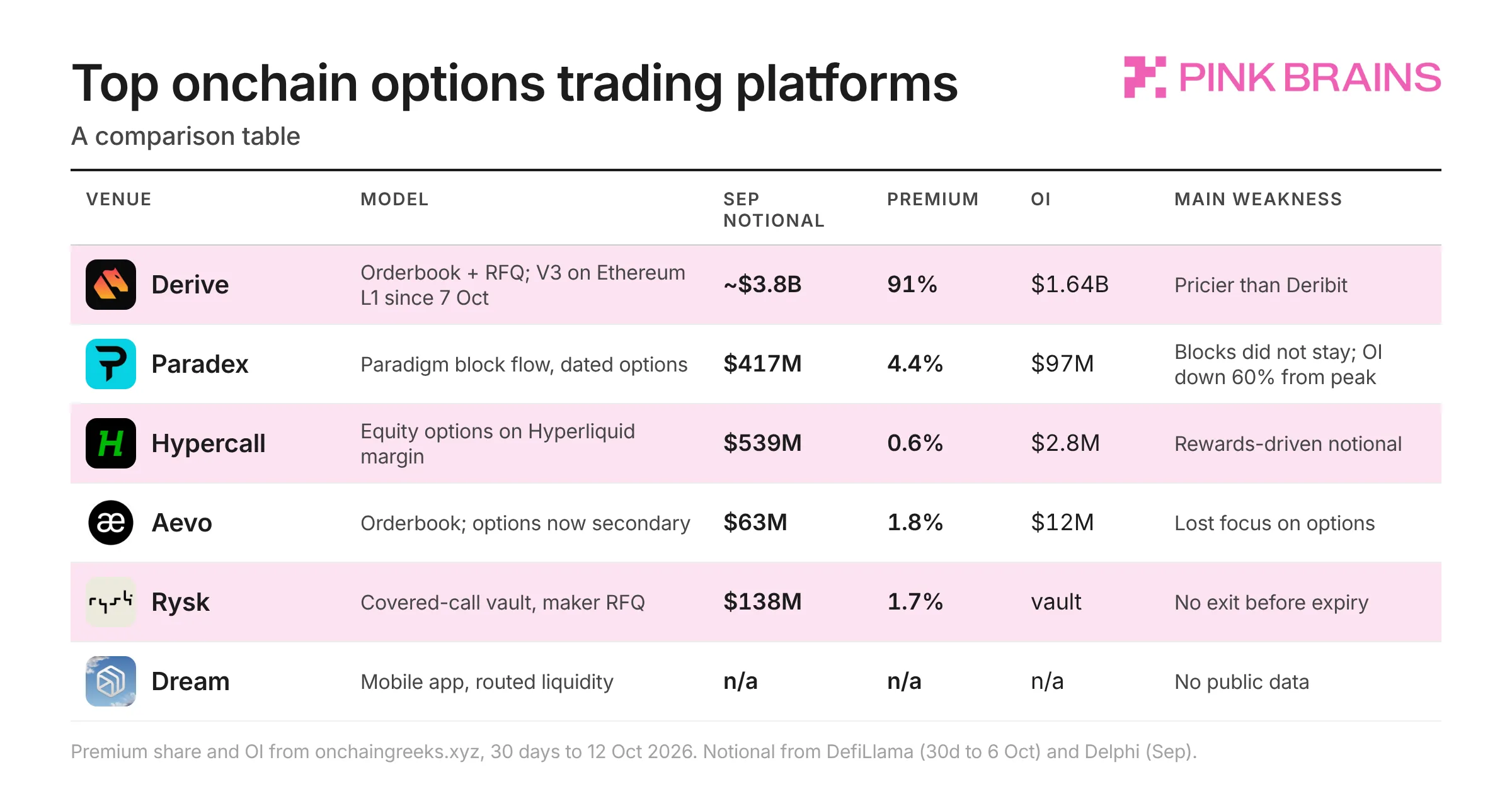
Open interest peaked near $2.5B at the end of September and sat at about $1.75B by 12 October, with over 90% of it in one venue.
Remember how Hyperliquid owned onchain perps at over a 70% share in mid-2025, then watched Aster and Lighter cut that to under 40% within 4 months once HYPE’s market cap passed $15B? Onchain options may be coming to this situation soon.
For most of this cycle, onchain options were the derivative everyone agreed should exist, but no one did it right until Derive. Onchain perps make around $21B in volume a day. Options, in their record month, ran at under 1% of that.
In this piece, we explain how onchain options work today, why volume's picking up in 2026, and what top options trading platforms are. We close with what still needs fixing, and a few simple trades for newcomers to try.
The platforms covered are Derive, Paradex, Hypercall, Rysk Finance, Aevo and Dreaming.
How an onchain option works
An option gives you the right, not the obligation, to buy (a call) or sell (a put) an asset at a fixed price on a fixed date. You pay a premium for that right. Whoever sold it to you keeps the premium and takes on the obligation.
If you are the buyer, the premium is the most you can lose. A 20% drawdown on the way to being right does not liquidate you. That is the whole appeal over a perp.
Types of onchain options trading platforms:
The first is an exchange. Market makers post bids and offers on an order book, and if your trade is big or has several legs, you send a request for quote and a few makers compete to fill the whole thing at once. Matching happens offchain for speed; the money, margin, and liquidations stay onchain. Derive, Paradex, Hypercall, and Aevo work this way.
The second is a vault. You deposit an asset, pick a strike above today's price, and sell a call against it. A market maker or a protocol-owned pool buys that call and hedges it. You get the premium in dollars today; at expiry you either keep the asset or hand it over at the strike. Rysk works this way, and you are always the seller.
The third is an app. It shows you up or down and a size, buys the call or put for you, and hides the strike and expiry. Dream is providing this.
Where to track onchain options trading data?
We recommend onchaingreeks.xyz. 3 figures matter for every venue: notional (the face value of contracts traded), premium (the cash that changed hands), and open interest (positions still open).
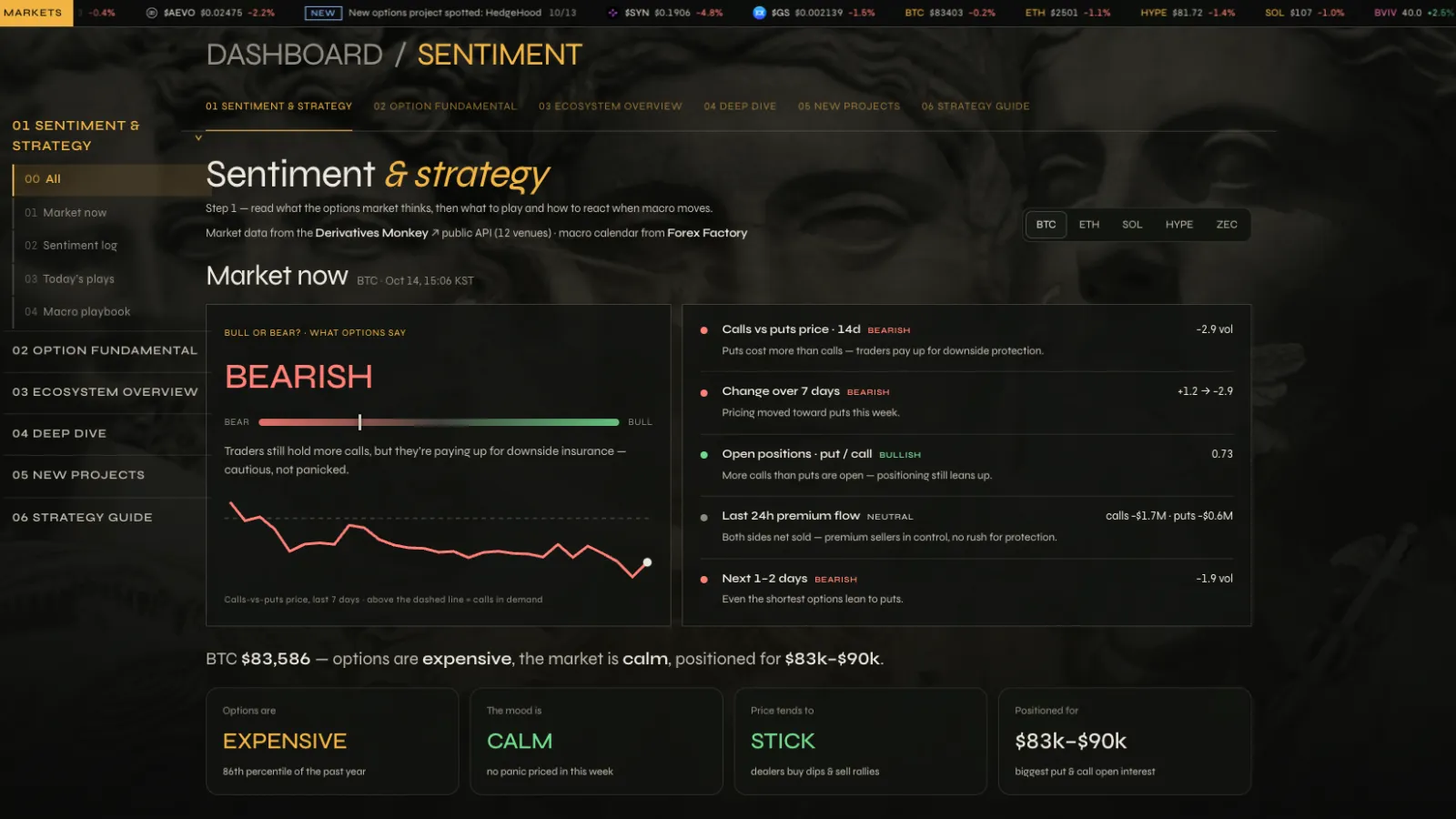
Another good site for keeping track of the onchain options space: opshnz.com
It’s built and updated daily by one Korean dev, and it’s one of the easiest ways in if you’re new to options.
What you can do on it:
- See ~40 options projects on one map, grouped by chain, with live prices and which ones are still pre-token
- Filter by what you want to do: earn yield, bet on a price simply, or trade like a pro
- Get a quick playbook for what to do around CPI, FOMC or a liquidation cascade, and which venues fit each move
- Track points programs and new projects as they get added each week
Why volume is picking up in 2026
Bringing options onchain is not a new idea, but designs back in 2021-2022 failed for several reasons.
AMM-style options pools forced liquidity providers to hold volatility risk they could not hedge. Every strike and expiry was its own illiquid market. Market makers had to re-quote hundreds of contracts after every price move, paying gas each time. Nobody offered portfolio margin, so a hedged position tied up as much collateral as a naked one.
Tech has evolved, and the tailwinds are here.
- Appchains and rollups made offchain matching with onchain settlement cheap enough to run a real orderbook.
- Market makers showed up and got paid to stay. FalconX has quoted on Derive since October 2025, and Derive's rewards program pays makers to keep quoting.
- Portfolio margin arrived, so a call, a short perp and spot can sit in one account with the risk netted.
- The signal from institutions for a decentralized exchange. Coinbase bought Deribit. Derive and FalconX both say Asian desks started looking for a neutral venue after that, and Derive's book stayed up through the 10 October 2025 crash. Paradex plugged Paradigm's RFQ network, which handles roughly 27% of Deribit's block flow, into its chain recently; options open interest went from near zero to over $250 million in 3 weeks.
Top onchain options trading platforms
1. Derive (@derivexyz)
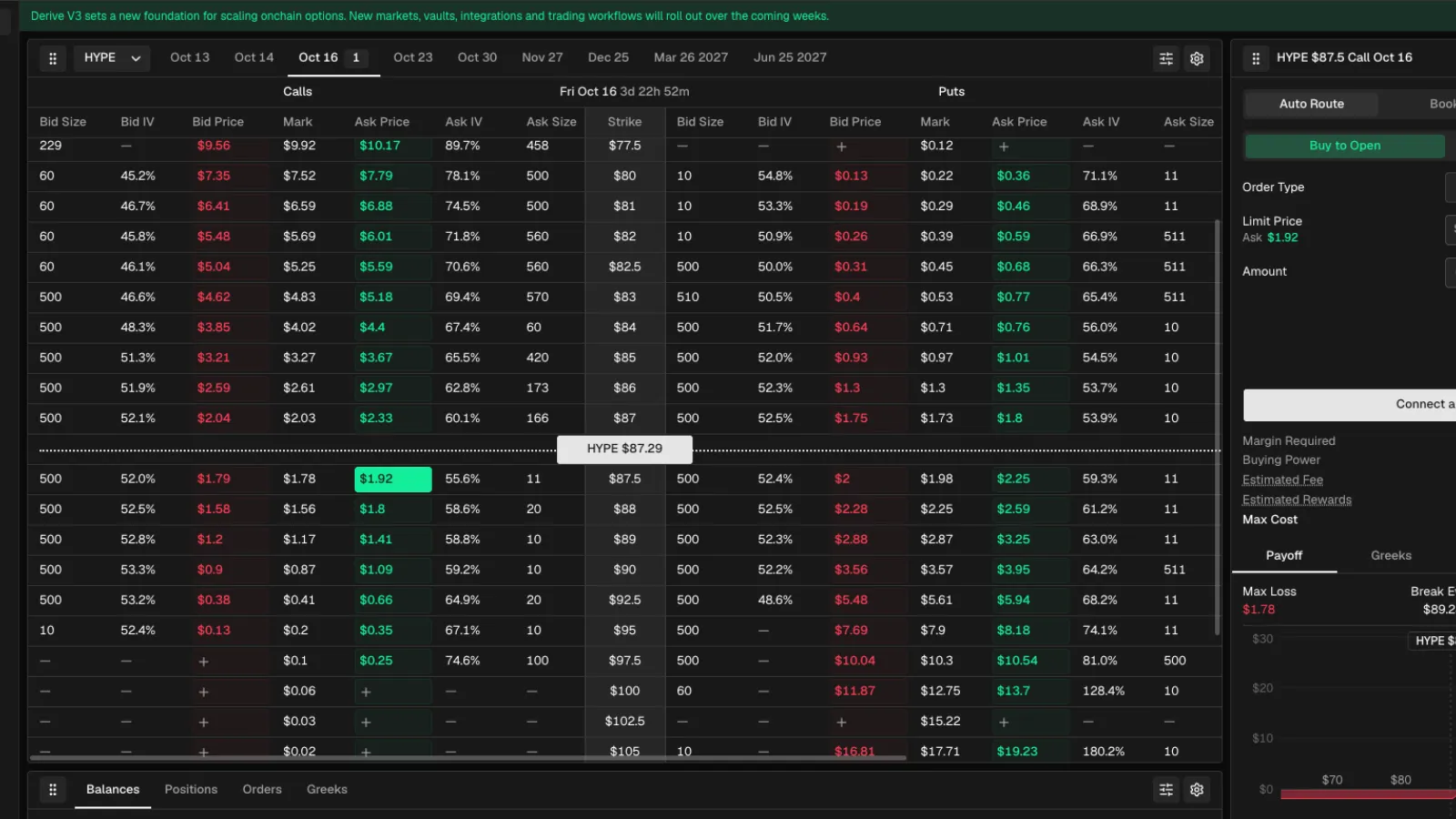
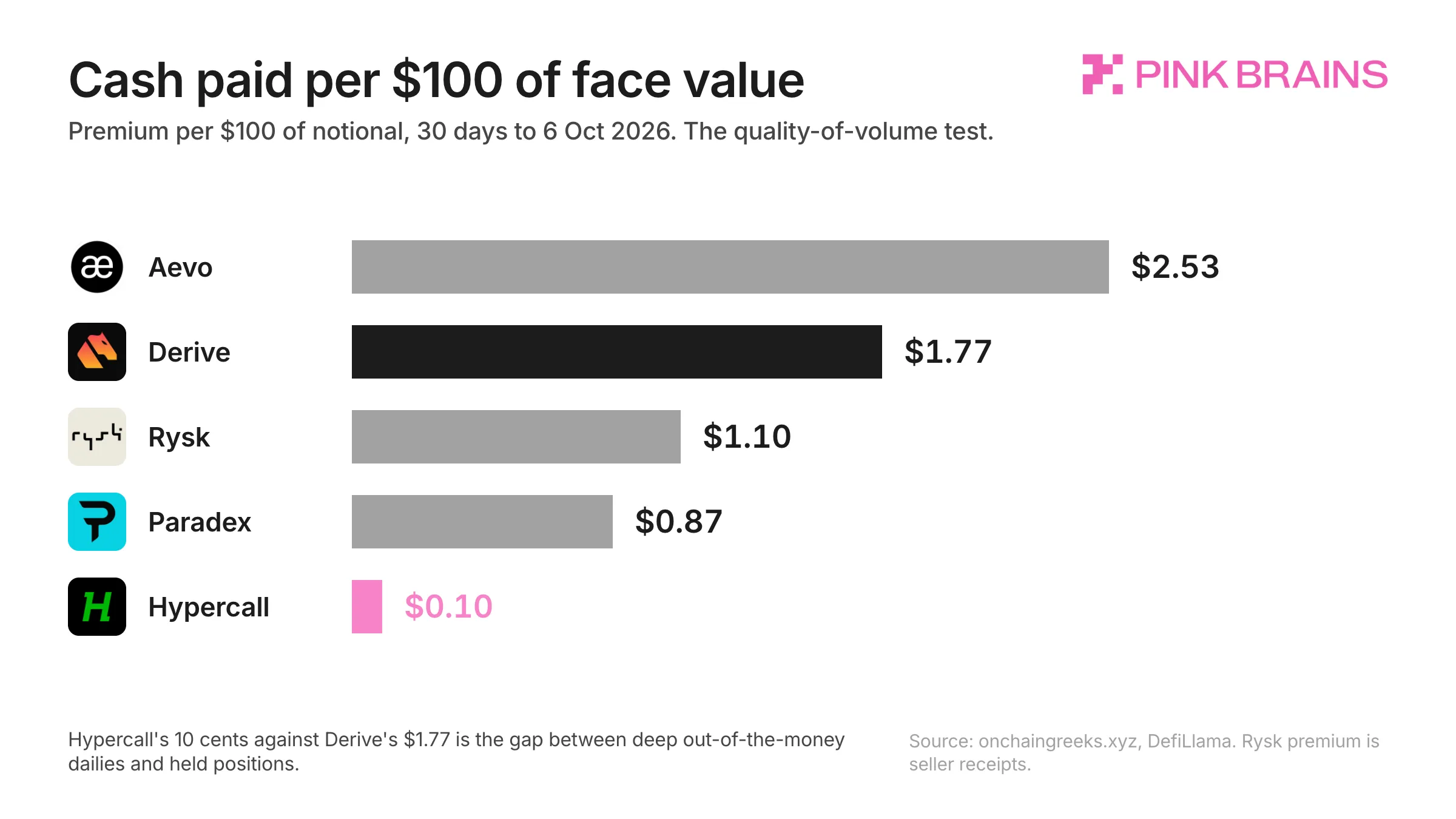
Derive is the venue that looks like Deribit from a market maker's seat. Orders match on an offchain orderbook. Anything large or multi-leg goes through an RFQ, where several makers price the whole package and the taker fills it in one trade. Settlement, margin and liquidations run onchain.
Derive has moved to V3. User funds now sit in Ethereum L1, margin and settlement run through zero-knowledge proofs verified on Ethereum, ETH and BTC can be margined together, borrowing extends to ETH, WBTC and HYPE, and outside teams can launch fee-earning vaults without code.
A 1,000 BTC block, a calendar spread on HYPE, a March 2027 ETH call: all of it gets filled, because paid makers are quoting. Perps sit in the same account as options, which matters more than it sounds: a market maker who sells you a call has to hedge it continuously, and Derive lets them do that without leaving the venue or posting margin twice.
9/10 of all onchain options open interest and premium sit here. Derive is also the one venue where premium share runs above notional share, which means traders are paying for real optionality rather than churning cheap dailies.
Aleá Research found buyers paying around 40% more than on Deribit for the same exposure through 2026, so Derive wins on size, not on price. The first weeks on V3 are the thing to watch.
2. Paradex (@tradeparadex)
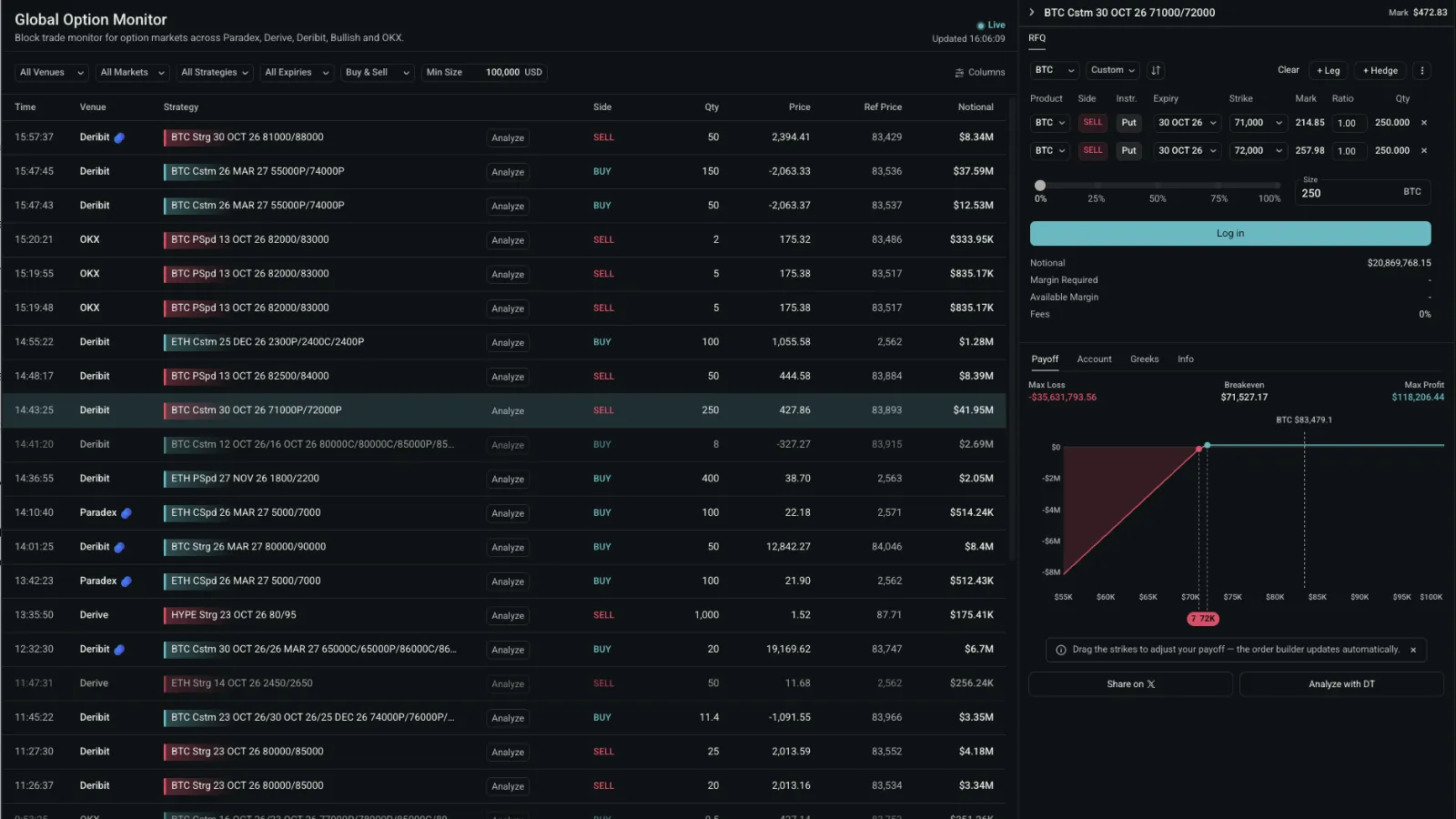
Paradex is a Starknet appchain incubated by Paradigm, the institutional RFQ network that handles roughly a quarter of Deribit's block flow. In mid-September 2026 it switched on dated options with Deribit's exact conventions, daily, weekly and monthly expiries, USDC cash settlement, strikes listed by delta, and routed Paradigm's counterparties onto them.
Options open interest went from near zero to over $250 million in 3 weeks, then fell back sharply before recovering into early October. Attracting flow and keeping it are different tests, and Paradex has so far passed only the first.
The RFQ builder shows Deribit pricing as a benchmark, so you are effectively trading against Deribit's block desk. Multi-leg blocks fill at institutional size, retail pays zero fees, and one cross-margin account covers perps, options and spot, including gold, oil and the S&P 500. The record ETH block in September reportedly printed cheaper than Deribit itself.
3. Hypercall (@hypercall_xyz)
Hypercall is Synapse Labs' pivot from bridging to options, built on top of Hyperliquid. It went live in June 2026 with SpaceX options and has since added the S&P 500, Nvidia, Micron, Alibaba and SanDisk; LTC and DOGE are proposed for later in the year. Contracts are fractional, USDC-settled, and an option writer hedges delta in Hyperliquid's own perps inside the same margin account, which is the part no other venue can copy without Hyperliquid's permission.
It is the only place to buy a no-KYC option on a private company, in $1 increments, with fees capped at a slice of the premium. For a Hyperliquid-native trader it is also the cheapest way to take a view on an equity perp without paying funding.
Notional jumped more than 50x the week a "$1,000 of HYPE a day" rewards program began, while premium and open interest barely moved. A dollar of premium there controls roughly $1000 of face value, against about $50 on Derive.
4. Rysk (@ryskfinance)
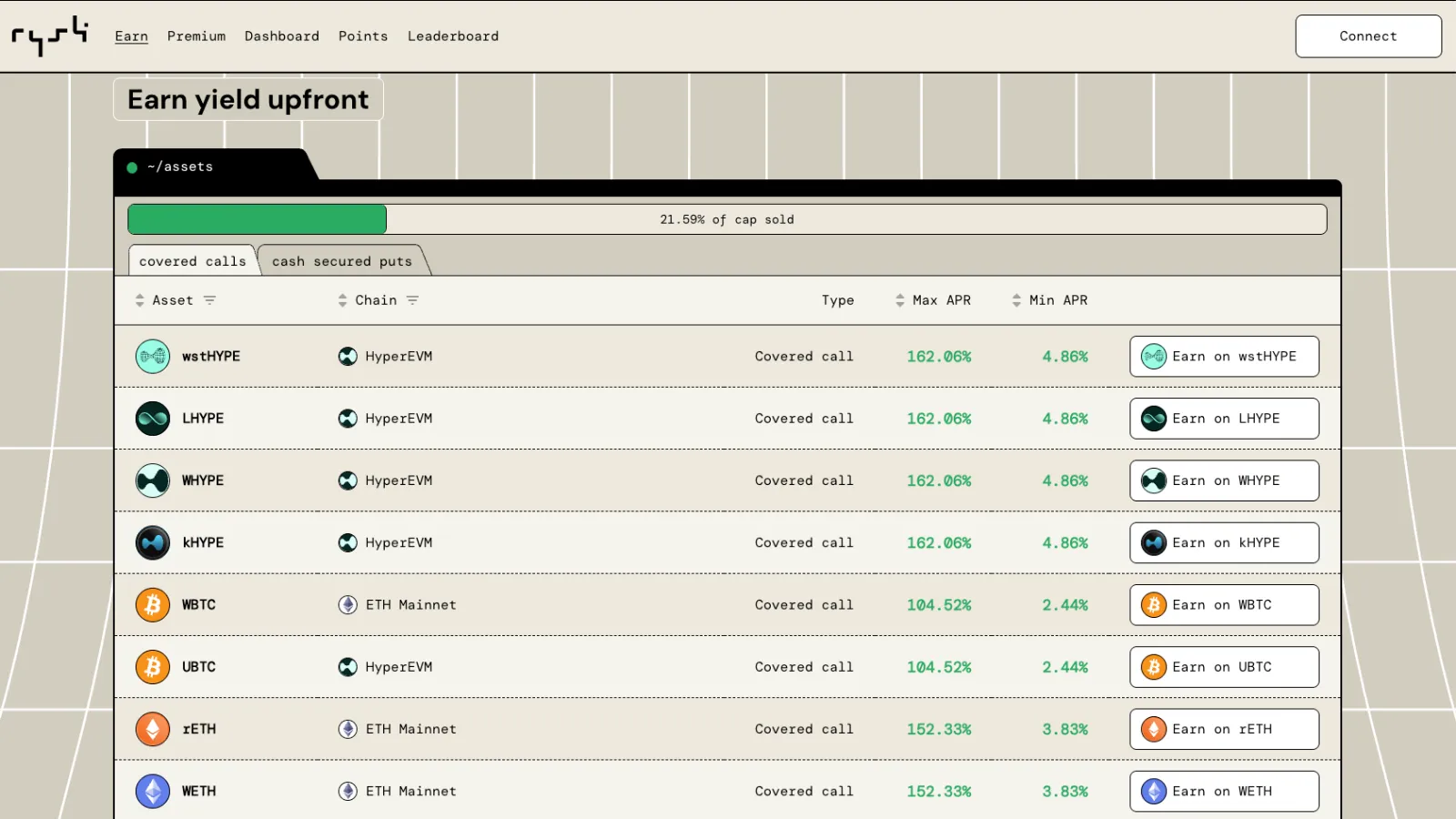
Rysk is a product rather than a market. You deposit HYPE, BTC or ETH, pick a strike above spot, and sell a covered call to whichever whitelisted market maker bids highest over the RFQ. The premium lands in dollars immediately; at expiry you keep the coins or deliver them at the strike. Cash-secured puts work the same way in reverse. Since its 2025 move to HyperEVM it has become the default yield layer for HYPE holders, and a Nasdaq-listed HYPE treasury company runs a vault through it.
There is no orderbook, no Greeks, no liquidation, and one decision per month. You are always the seller, you cannot buy the call back before expiry, and volume has been flat since May 2026 because the makers only want so much HYPE exposure. Fully collateralized also does not mean risk-free: if HYPE drops 40% during the month, you still own the HYPE, and the premium covers a small part of that.
5. Aevo (@aevoxyz)
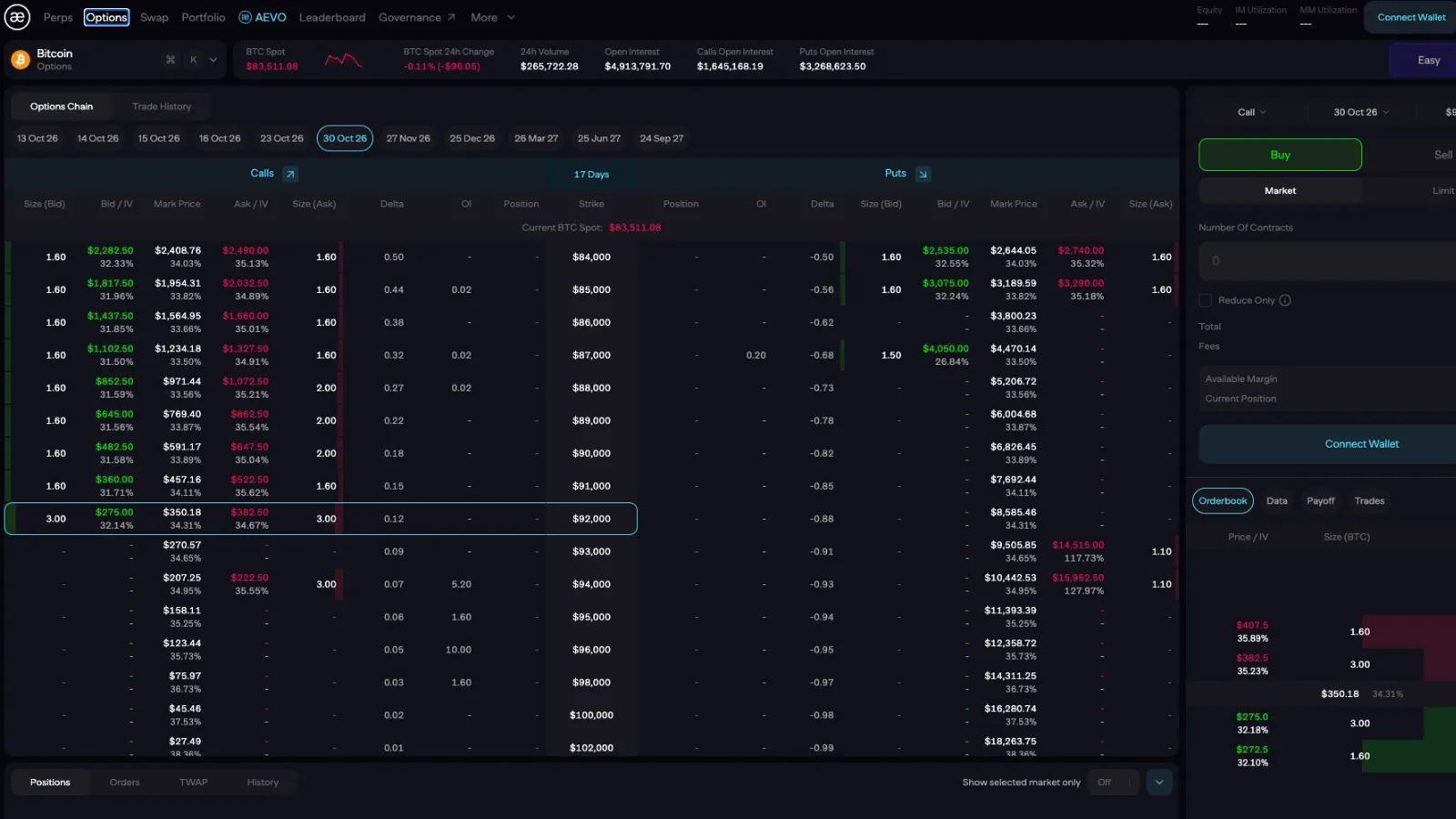
Aevo shares Derive's architecture, its own L2 with an offchain orderbook and portfolio margin, and was the biggest onchain options venue of 2024.
Through 2025 and 2026 it moved its energy to pre-launch token futures, tokenized stocks, 1,000x "Degen" leverage and PERPS+, a perp with an option-shaped stop built in. Listed options stayed limited to BTC, ETH, HYPE and SOL and the options business shrank by over 90% while the category grew four times.
You can try PERPS+ - one-click trade enhancers that attach options strategies to your perps positions. Instead of manually navigating options markets, selecting strikes, and managing separate legs, PERPS+ lets you protect, monetize, or bound your perp trade with a single action.
6. Dream (@dreaming)
Dream is a phone app, not a protocol. You fund it with Apple Pay, pick BTC, ETH, SOL, HYPE, PUMP, LIT, and more tokens coming, choose up or down and a size, and the app buys you a call or a put.
- Buy a call: you’re positioning for the price to rise.
- Buy a put: you’re positioning for the price to fall.
- Pay a premium upfront: that’s the cost of the option. Each contract has a strike price and an expiry date. For a fully paid option purchase, your maximum trading loss is the premium, plus fees.
For example, you could pay $100 for a BTC call. If BTC rises enough before expiry, the option may become more valuable. If the move doesn’t happen, it can expire worthless and you lose your $100.
Dream is running the Genesis Points program. It distributed 600K Genesis Points, with weekly points and referral earnings credited automatically every Friday from Oct 16.
What still has to be fixed
The category has an institutional block-settlement layer and a retail yield-vault annex, and a hole in the middle where retail trading should be.
- Price: The largest venue charges more than Deribit for the same exposure. Until onchain books print tighter on screen, not only on blocks, retail flow has no reason to migrate.
- Maker concentration: No source names any market maker on Derive beyond FalconX, on Paradex beyond "Paradigm's network," or on Rysk and Hypercall at all. One maker leaving a venue is the largest unobservable risk in the category.
- Exits for vault users: Rysk users cannot close before expiry. A covered call you cannot buy back is a worse product than the one Deribit sells.
- Oracle and operator risk: Paradex rolled back its chain in January; Aevo's legacy vaults were drained through an oracle upgrade; Hypersurface can exercise early at its own discretion; Derive's V3 launch multisig can bypass its timelock. None of these venues is trust-minimized yet.
Simple trades for a first-time options trader
1. Buy a call instead of a leveraged long
HYPE is around $87. You think it will rise, but worry about a dip first. You buy a $90 call for $4 per HYPE.
Your breakeven is $94. If HYPE finishes at $100, you make $6 per HYPE after the premium. At $90 or below, you lose your $4.
The tradeoff is time. A temporary dip won’t liquidate a fully paid call, but the move needs to happen before expiry. You can lose the entire premium.
2. Buy a put as insurance on a bag you will not sell
ETH is around $2,560. You hold 10 ETH and want protection against a sharp drop. You buy $2,300 puts covering all 10 ETH, paying $50 per ETH, or $500 total.
If ETH finishes at $2,000, the puts pay $3,000. Your loss is $3,100 including the premium, compared with $5,600 without protection.
The tradeoff is that protection costs money and expires. If ETH finishes above $2,300, the puts expire worthless.
3. Sell a covered call at a price you would happily sell
You hold HYPE at around $87 and would sell at $100. On Rysk, you deposit your HYPE and sell a $100 call, collecting an illustrative $2 per HYPE upfront.
If HYPE finishes below $100, you keep your coins and premium. If it finishes at $120, your HYPE is sold at $100, and you keep the premium.
The cost is you give up gains above $100 while still carrying the downside if HYPE falls. Your collateral stays locked until settlement.
4. Sell a cash-secured put to buy a dip you already wanted
BTC is around $84,000, but you would happily buy at $80,000. You sell a put covering 1 BTC, lock $80,000 in stablecoins, and collect an illustrative $2,000 premium.
If BTC finishes above $80,000, you keep your cash and premium. If it finishes below, you buy at $80,000, with the premium bringing your effective cost to $78,000
The risk is that BTC could fall to $60,000 and you would still buy at $80,000. Your cash stays locked until settlement.
2 notes:
- Keep option sales fully covered. Own enough of the asset for a covered call, or reserve the full purchase amount for a cash-secured put. You can still take a substantial loss if the asset falls.
- Only pay premiums you can afford to lose in full. Getting the direction right isn’t enough: the size and timing of the move, and the price you paid, determine whether you profit.
This is a good beginner guide of option trading on Derive.
Closing thoughts
Onchain options are the largest remaining pillar in crypto derivatives.
Most crypto options activity still takes place on centralized venues. Onchain notional just had its biggest month in 2 years, yet the $5.49B traded over the past 30 days was still only 6.9% of Deribit’s $79.8B. Deribit alone is 14.5 times larger than every onchain venue combined.
The size of the gap is also the size of the opportunity. Attracting sustained retail flow is the sector’s next hurdle.

.png)

%201%201.png)