Crypto AI Inference: How to Earn While Using AI
12 mins


In our company, AI bill now looks like a second payroll line. Market research agents, editing and draft passes add up, and every dollar goes to an API provider that gives nothing back. So we started looking at crypto AI inference with one question. Can using AI earn you something in return?
It can, in four main ways with decentralized AI providers. You can stake a token and let the yield pay for your prompts, get rewarded for the API calls you already make, sell the credits you don't use, or plug a spare Mac into a network that pays per token served.
The catch is who pays for the reward. Some of these setups are funded by real inference demand. Others are funded by token emissions or by trading fees, and that difference decides whether the earnings last. Let's dive into how you can earn or get back from your spending on AI in daily usage.
Crypto AI inference is 1% of the market but the only part that pays users back
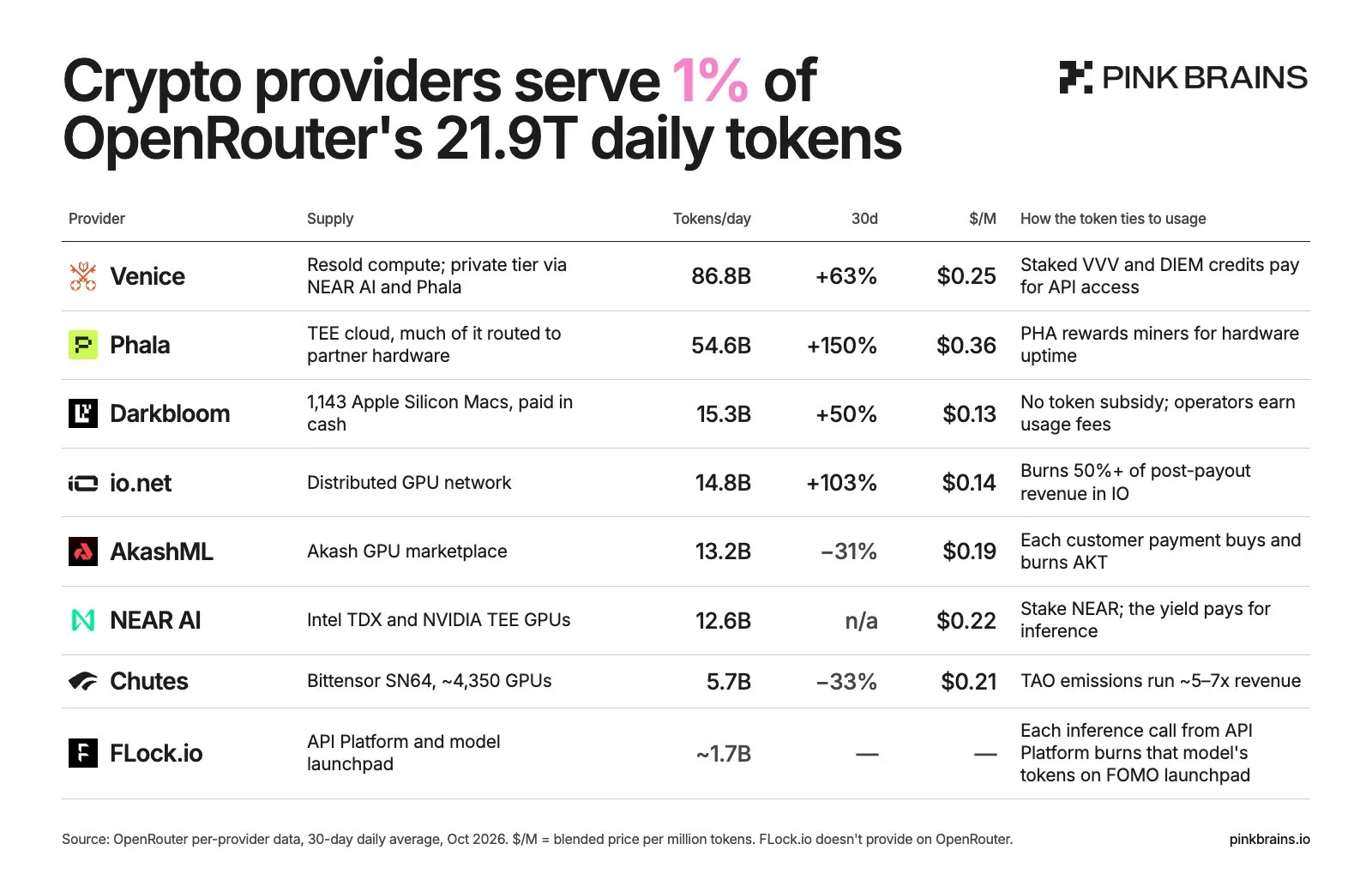
Crypto AI inference means running AI models through providers that use tokens for payment, incentives or access. The seven crypto-native providers on OpenRouter serve about 211B tokens a day, roughly 1% of its 21.9T daily volume. What they offer that centralized APIs don't is a way for the user, or the hardware owner, to share in the economics.
That share is possible because the margin in inference is wide. Deedy's math from this week puts it plainly. Rent a B300 at around $8 an hour, serve open models like GLM 5.3 or DeepSeek 4.1 Flash at about 100 tokens a second, and that same GPU-hour can bill $10-20 in tokens. Open-weight models are now good enough for most everyday work, so plenty of tasks can route to whoever serves them cheapest.
Crypto networks use that spread in different ways. Some pass it to suppliers, like Darkbloom paying Mac owners in USD. Some cover it with emissions, like Chutes on Bittensor. Others hand part of it back to users through staking, burns or rebates. Blockworks' October report has the full provider breakdown, and Venice and Phala alone carry about 70% of the crypto volume on OpenRouter.
Staking yield can pay your AI bill while you keep the principal
The simplest way to earn while using AI is stake-to-compute. You lock a token, the staking rewards turn into inference credits, and the tokens themselves stay yours. NEAR AI and Venice both run versions of this. NEAR AI suits light, private usage, while Venice's DIEM suits heavy API users who want a fixed daily allowance.
NEAR AI turns staking rewards into private inference
On NEAR AI you stake NEAR and the rewards, not the stake, pay for inference on NEAR AI Cloud. The staking rewards are routed to NEAR AI as payment, and you get credits back, each worth $1 of usage. Credits accrue every second based on the size of your stake, and unused credits carry forward instead of expiring.
The model menu is the selling point. Open-source models like Qwen, DeepSeek and GLM run inside a TEE, meaning the prompt is sealed off from the host machine, the GPU operator and NEAR AI itself. Frontier models from Anthropic, OpenAI and Google route through a TEE-based gateway. Venice, Brave and Phala already send private workloads through it, and over 1M NEAR has been staked since the July 30 launch.
How to set it up:
- Log in at near.ai with a NEAR wallet. There is no separate account or card.
- Size your stake with the staking calculator, which pulls the live NEAR price and staking APY.
- Stake for confidential inference. Each stake, top-up or unstake is one signed wallet transaction.
- Spend the credits on NEAR AI Cloud models. When you unstake, your NEAR comes back and credit accrual stops.
There is a second, separate product for agents. Staking for IronClaw, NEAR AI's agent harness, works on fixed tiers instead of yield, so 50 NEAR gets the same $5 monthly hosting allowance as 499 NEAR.
The budget is small. About 500 NEAR covers roughly $5 a month of inference at current rates. Back-of-napkin, covering a $100 monthly coding bill would take around 10,000 NEAR, and that number moves with the NEAR price and the network APY. Validator commission of 1-10% also comes out before the yield reaches you. The real cost is the NEAR yield you no longer receive, so this works best if you already hold and stake NEAR anyway.
Staking for NEAR AI is a new way to put your NEAR to work, powering the inference you run and the agents you deploy. Deploy your first agent, or stake for confidential inference, by logging in with a NEAR wallet.

Venice DIEM is $1 a day of API credit you can sell
Venice stacks three earn layers on one token. Staking VVV pays new VVV, about 6% a year at today's stake. Locking that staked VVV lets you mint DIEM, which pays $1 of Venice API credit every day you keep it staked. And because DIEM is an ERC-20 on Base, any allowance you don't use can be sold.
How to set it up:
- Stake VVV on venice.ai/token. You receive sVVV, and 100 staked VVV also unlocks Venice Pro.
- Lock sVVV to mint DIEM. The Mint Rate sets how much sVVV each DIEM needs, and it rises as DIEM supply approaches its 40,000 target, so check the DIEM calculator first. Locked sVVV still earns 80% of its normal yield.
- Stake the DIEM on the same dashboard. You need at least 0.1 staked DIEM before any of it can be spent.
- Create an API key at venice.ai/settings/api. Requests draw from DIEM first, then earned credits, then bundled credits, then USD.
The allowance resets at 00:00 UTC and unused credit does not roll over. That reset is the detail that shapes the whole strategy. A team with 10 staked DIEM gets $10 of inference a day, and anything left at midnight is gone unless you sell it first (more on that in the resale section). You can check what's left with the billing balance endpoint, which needs an admin key.
Getting out takes two steps. Unstaking DIEM has a 1-day cooldown. To recover the locked VVV you burn the same amount of DIEM you minted, then wait out a 7-day cooldown on the freed sVVV. If you sold your minted DIEM, you have to buy it back before you can unlock.
You can also skip minting and buy DIEM on Base. At $1,600-1,700 in October, one DIEM returns about 22% a year in credit if you use every dollar, roughly a 4.4-year payback. That math works for an agent or a team burning API credit daily. For occasional chat, a Pro subscription costs less.

Some APIs pay you back for the calls you make
Usage rewards work like cashback on inference. You pay for API calls as normal, and the protocol sends tokens back based on how much you used. FLock does this with daily rewards tied to real API spend. Orbio does something that looks similar, but its credits are funded by trading fees on its token rather than by inference demand.
FLock pays daily rewards on every model you call
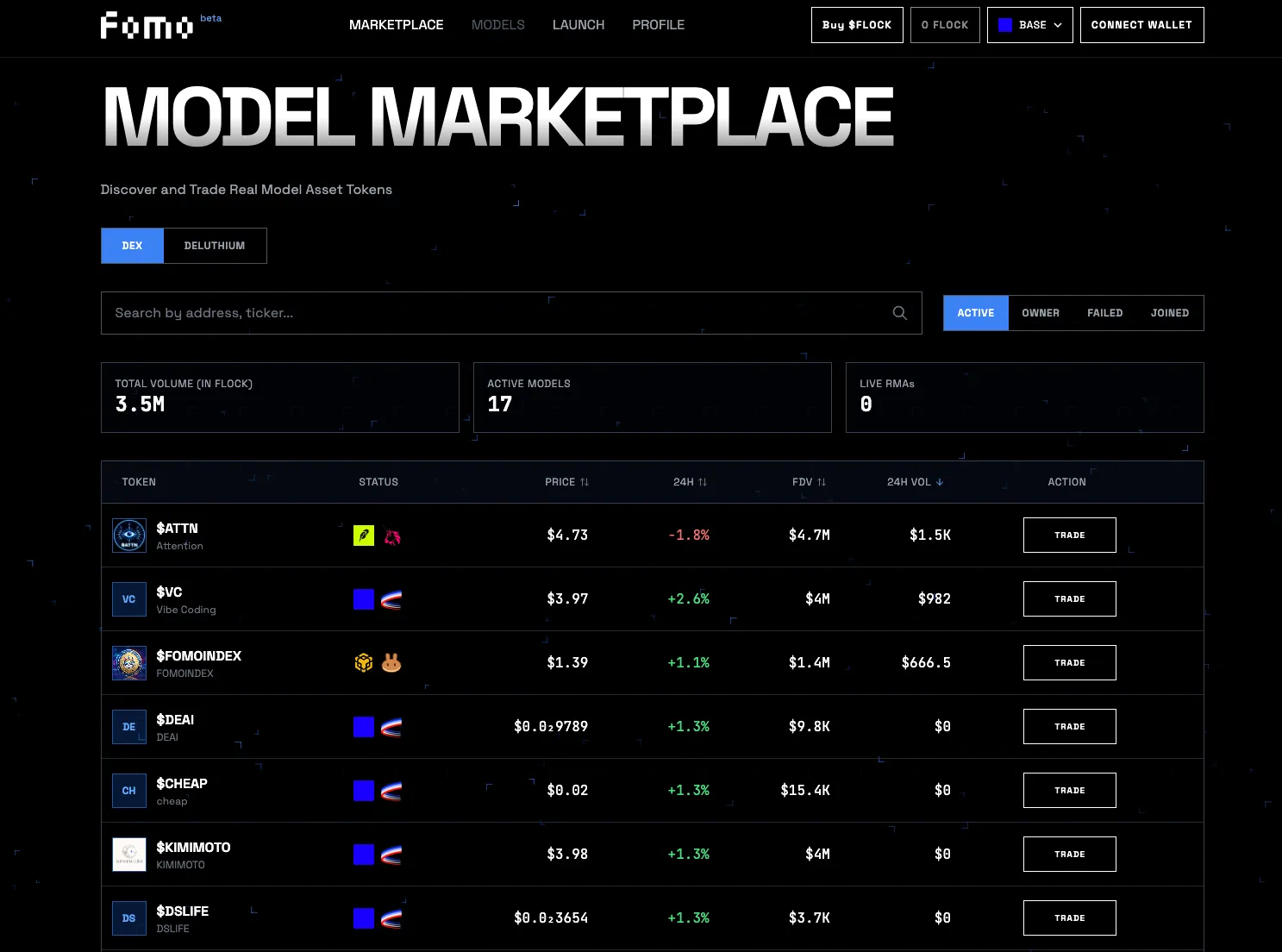
FLock's FOMO launchpad gives each hosted model its own Model Token (MT). Every paid API call on that model buys back and burns some of its MT. On top of that, each MT has its own daily reward pool, split among the people using that model in proportion to their usage. You don't need to stake to qualify. Using the API is enough.
How to set it up:
- Create an account on the FLock API Platform and fund it in fiat or USDC.
- Point your agent or app at a model that has an MT. From Season 2, usage only counts if you call it with that model's exact model ID, so check the ID before you route traffic.
- Optionally stake the MT of the model you use. At equal usage a staker earns more than a non-staker, and staking also lowers your API price.
- Claim. FLOCK rewards from every MT land in one claimable FLOCK balance, while MT rewards stay in each model's own token.
Three rules decide how much you actually earn.
- Each MT is a separate pool, so heavy use of one model doesn't dilute what you earn on another, but other users on the same model do.
- Rewards follow usage, not stake, so a model with stakers and no API traffic that day pays nothing.
- each MT's incentive pool drips out over roughly 180 days from its launch, which means early users of a new model capture more of it. Holding gmFLOCK adds a multiplier on top. FLock suggests migrating an existing OpenClaw or Hermes agent onto the platform to build natural spend.
Our disclaimer is that onchain liquidity of these MTs are low, adoption of FLock API Platform and FOMO is in the early stage. So only test with a small size of your capital.
Orbio turns trading fees into $1 credits
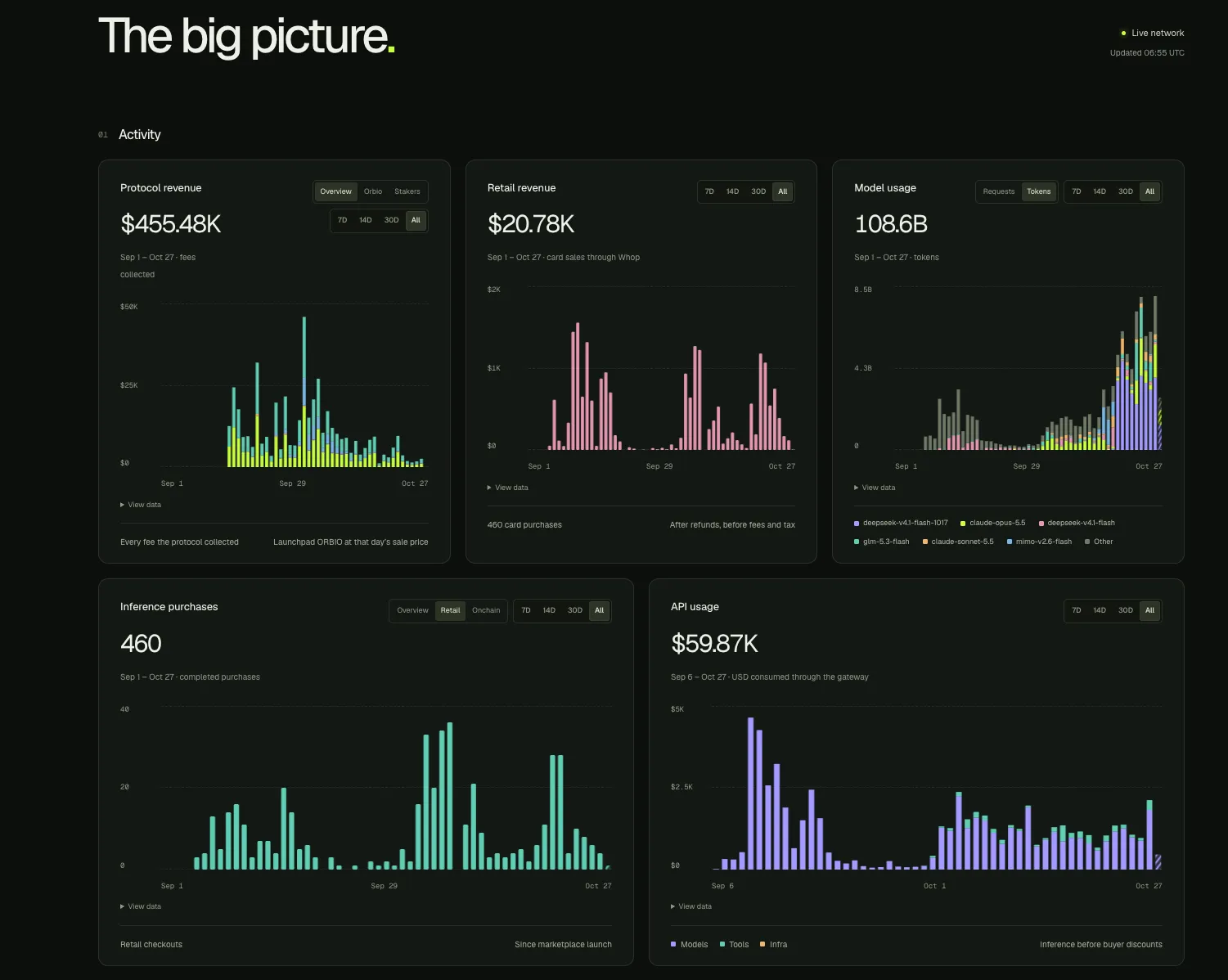
Orbio runs on Robinhood Chain. Every hour, a protocol wallet collects the creator fees from ORBIO trading, swaps them to USDG and splits them 50/50. Half goes to the treasury and half becomes that hour's credit budget for stakers. Each CREDIT is worth $1 of usage across 466 models through Orbio's OpenAI-compatible gateway.
How to set it up:
- Buy ORBIO on a Robinhood Chain DEX with USDG. Paste the contract address from Orbio's own site, since name searches turn up lookalike tokens.
- Stake at least 1,000 ORBIO. Your share of each hour's budget depends on how much you stake and how long you've held it.
- Claim CREDIT to your wallet, or opt into auto-selling so the contract lists it on the order book for you.
- Use it one of three ways. Sell it for USDG on the order book, send it to another wallet or agent, or activate it, which burns the CREDIT into $1 of API balance.
The resale side is where you see the real value. Buyers on the order book were taking credits at discounts of up to 40%, so a CREDIT you don't plan to use is worth closer to $0.60 than $1. Buyers who purchase on the website pay a 5% platform fee and a $5 minimum.
Here's the thing though. The credits keep flowing as long as people trade ORBIO, not because people use the models. We treat it as a trading-volume rebate with an AI wrapper. Three risks to note before staking. One admin wallet can upgrade the staking contract, there is no unstaking cooldown (so a large share of staked ORBIO can leave at once), and requests run on a managed OpenRouter account, so model access sits outside Orbio's control.
Unused AI credits can be resold for USDC
If you pay for more AI capacity than you use, you can list the surplus and get paid per request. Surplus Intelligence on Base is the main venue. Sellers list an OpenAI-compatible endpoint at their own price, buyers get routed to the cheapest available seller, and every request served settles in USDC on Base.
On the buyer side it looks like any other API. One key, one base URL (api.surplusintelligence.ai/v1), funded with USDC credits, fiat, or x402 so an agent can pay per request with no human checkout. Tanaka counted about 4.7T tokens and 91M paid requests through it over 30 days, with reported discounts near 90%. The marketplace takes 0% today to build liquidity, so a fee switch is likely later.

Sell your leftover DIEM before the midnight reset
The cleanest earn play here pairs Surplus with Venice. Because a DIEM allowance resets at 00:00 UTC with no rollover, any credit you haven't used by the end of the day is worth nothing. An open-source seller plugin lists that unused allowance on Surplus as discounted Venice inference and sends the USDC to your Base wallet.
How it works:
- Create a dedicated Venice API key for selling and stake your DIEM. Don't set a Venice spend limit below your staked DIEM, or the offers can't fill.
- Add a Base wallet address for payouts and mint a Surplus seller key.
- List the Venice models buyers can use. The plugin caps offers at your daily allocation.
- Let it reprice through the day. Offers start around a 20% discount and deepen to 75% in the final hour before reset, so the allowance clears instead of expiring.
That turns DIEM from a pure usage asset into one with a cash floor. Use what you need during the day, and sell the rest at whatever the market pays before midnight.
tokensto.cash is the consumer version
tokensto.cash puts a simple front end on the same market. You paste a provider key from OpenRouter, Venice or any OpenAI-compatible URL, your capacity sells on Surplus per request, and you cash out the USDC to Revolut, Venmo, PayPal, Wise or Cash App through peer.xyz.
Two cautions before you list anything. Reselling a subscription quota from Anthropic, OpenAI or Google can break that provider's terms, so check before you list a personal plan key. And your key is now serving strangers. Surplus encrypts it, but use a dedicated key with its own spend cap, and treat the seller key like a credential since it can reach payout settings. The SURPLUS token has no documented role in fees or routing, so buying it is a bet on the narrative, not on marketplace revenue.

An idle Mac is the easiest way to earn from the supply side
You can also earn by serving inference instead of buying it. For most people that means Darkbloom, which pays Apple Silicon Mac owners in USD for the tokens their machine serves. GPU networks like Chutes, Phala and io.net pay more per machine but need data-center hardware, and most of their rewards come in tokens. For retail, the realistic route into those is staking.
Darkbloom pays cash for idle Apple Silicon
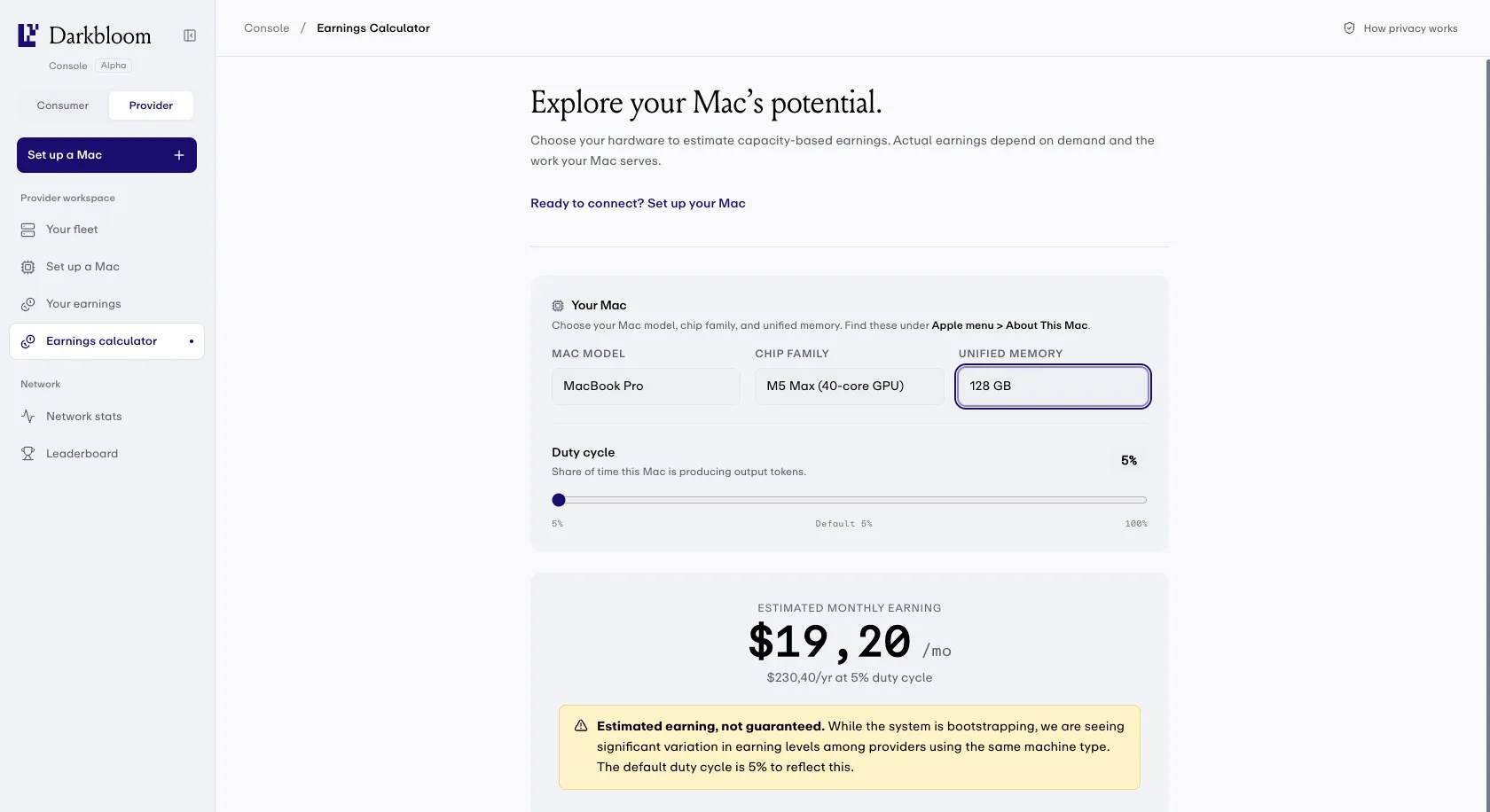
Darkbloom is Eigen Labs' inference network on Macs. Your Mac downloads one model and runs the whole request locally. Prompts are encrypted and only decrypted on a hardware-attested machine, so you as the operator can't read them. The live grid showed 1,231 Macs and 287B tokens served when we checked on October 27.
You earn two ways. A base reward from a fixed monthly pool pays any attested, healthy Mac that stays online at least 90% of each settlement period. Usage earnings come on top for every real request your Mac serves.
How to set it up:
- Check your hardware. Any M1 or later works, macOS 26 is preferred, 16 GB of unified memory is the floor and 36 GB is recommended for most models.
- Sign up at darkbloom.dev and install the CLI with
curl -fsSL https://api.darkbloom.dev/install.sh | bash. - Run
darkbloom login, approve the device, thendarkbloom models listto see which models fit your RAM. - Start serving with
darkbloom start(background) and checkdarkbloom earningsfor totals per session.
Model choice matters more than chip speed. Gemma 4 26B needs 36 GB, the Qwen3.5 122B MoE needs 128 GB, and MiniMax M2.5 needs 256 GB. Darkbloom's own projection for an M4 Max with 128 GB is about $205 a month running Qwen3.6 35B, $182 on Gemma 4 26B and $144 on GPT-OSS 20B, all assuming the Mac serves 60% of the time. They call it a projection, not a promise, and live demand can run lower. Eigen Labs' earlier estimate was $120-200 a month per Mac.
You don't have to give up your machine. The optional menu bar app pauses serving whenever you're actively using the Mac, and a schedule in ~/.config/eigeninference/provider.toml limits serving to set hours, for example 22:00 to 08:00 on weekdays. Outside those windows the node disconnects and frees the GPU memory.
The trade-off is speed. Darkbloom is the cheapest provider on OpenRouter for Gemma 4 26B, at $0.067 per million tokens against Cloudflare's $0.128, but it answers 3-17x slower than the leader on most models. OpenRouter routes by latency as well as price, so a cheap Mac doesn't always get traffic. The code is also unaudited public alpha, and electricity comes out of your side of the math
Chutes pays retail through SN64 staking on Bittensor
Chutes, Bittensor's inference subnet (SN64), runs about 4,350 GPUs, half of them H200s, so mining it is a data-center business. Retail exposure comes through staking. You stake TAO to a validator on subnet 64, the network swaps it into SN64 alpha at the pool price, and you earn a share of the subnet's emissions minus the validator's take (18% by default). You can do it from a wallet like SubWallet or with btcli.
Three mechanics to know. Staking is a swap, so large amounts take slippage, and you should quote first or use a limit order. There is no unbonding period, so plain unstaking settles at once. And your position tracks the SN64 pool price, which traded 78-85% below its mid-2025 high in September. The yield is real but it comes from Bittensor emissions running 5-7x Chutes' onchain revenue, so the next halving is the date to watch.
Phala pays PHA stakers and confidential-GPU miners
Phala splits its 700M PHA mining pool three ways. 40% goes to PHA stakers, 40% to GPU miners and 20% to the treasury. Staking means converting PHA to vPHA through the Ethereum staking contract, with a 21-day unlock. Mining needs Intel TDX hosts with confidential-computing GPUs, plus vPHA collateral per card of 1,250 for an H100, 1,875 for an H200 and 2,250 for a B200. Rewards are paid hourly in vPHA by hardware weight times validated uptime, not by how much inference the GPU served.
io.net lets you supply GPUs or co-stake IO on someone else's
On io.net you install IO Worker and list your machines. Each GPU needs 200 IO staked, scaled up for stronger chips, so an eight-H100 server needs 16,000 IO. Suppliers earn from customer rentals plus block rewards, and to qualify for block rewards a machine passes an hourly proof test that loads it for about 15 minutes. If you hold IO but no hardware, you can co-stake on another supplier's machine at the rate they offer, up to two offers per account. Unstaking takes 14 days, and stake can be slashed if a machine fakes its hardware or serves customers badly. At least half of post-payout revenue in IO gets burned.
Akash is the quiet one here. Its GPU incentives ended, so providers earn only lease fees, and AKT stakers collect the 4% inflation while customer payments buy and burn AKT.
Health check on providers' revenue vs. incentives
Before committing money or hardware, check who funds the reward. If paying customers fund it, it can last as long as demand does. If token emissions or trading fees fund it, the reward shrinks when emissions get cut or trading slows. Below is a table for compar
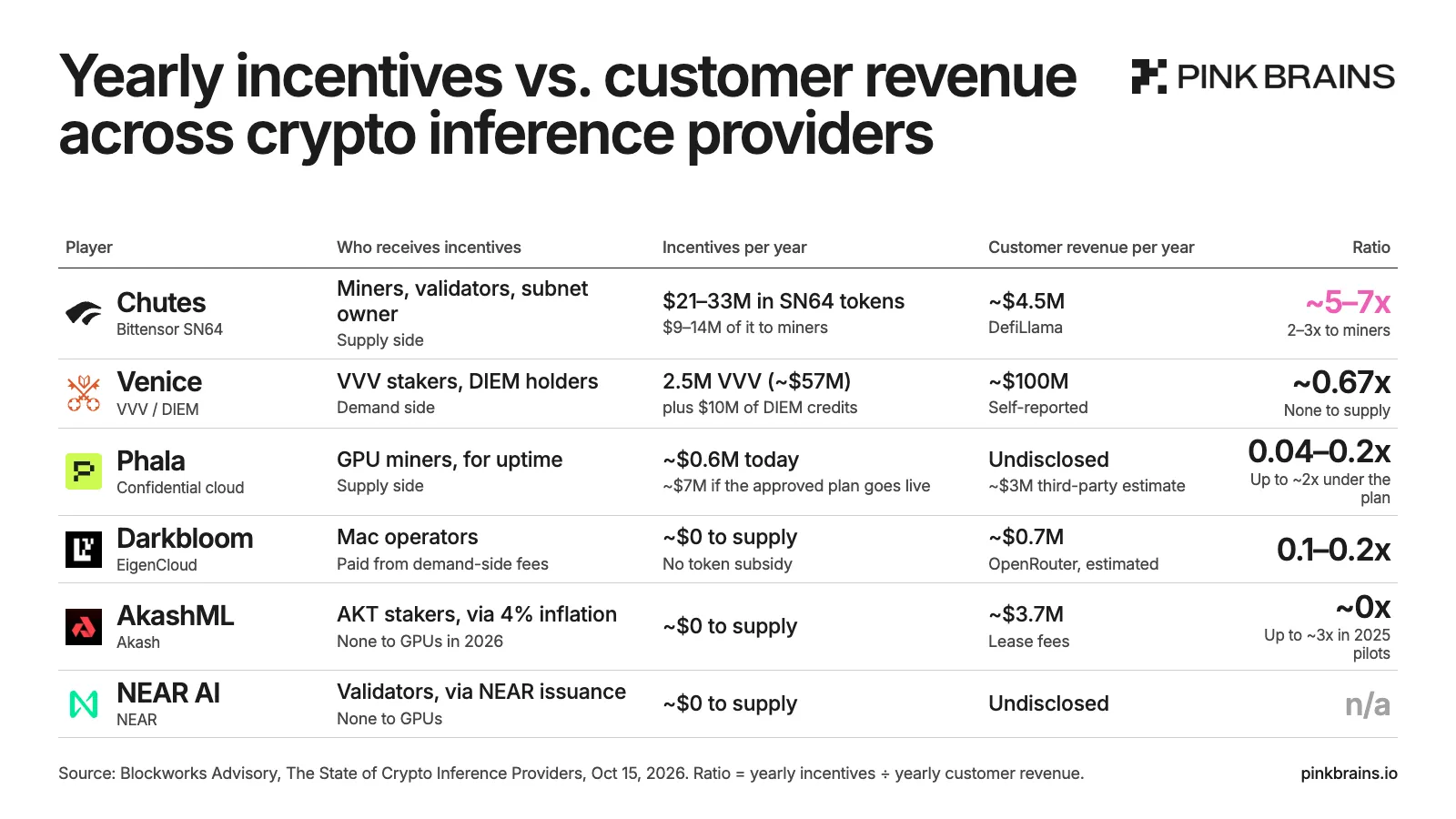
Venice is worth a second look here. Its revenue belongs to Venice.ai, the company, not to VVV. Tokenomist counted on-chain burns and found the token received about a tenth of October revenue, while total supply kept growing. That doesn't make DIEM a bad tool for heavy API users. It does mean VVV's upside depends on company choices a 4-of-6 multisig controls.
Three things will tell us whether this corner keeps paying users. First, Venice's next mint-rate change, which has landed on the first of each month since May, and whether the monthly burn grows past the roughly $400K it was in September and October. Second, Bittensor's next halving, which cuts the emissions that keep Chutes' prices low. If prices rise after it, the subsidy was doing most of the work.
Third, Darkbloom's latency. Yukon, EigenCloud's open research platform, has already pushed Gemma 4 decode speed up 130% on Apple Silicon. If Macs close the gap with centralized hosts, OpenRouter sends them more traffic and operator payouts rise without new hardware.
FAQ
Can I really get free AI by staking crypto? Yes, through NEAR AI or Venice DIEM, but it isn't free. You give up staking yield you'd otherwise receive, and you carry the token's price risk. About 500 NEAR covers roughly $5 a month of inference.
Is Venice DIEM worth buying for API credits? Only if you use most of the $1 a day. At $1,600-1,700, DIEM takes about 4.4 years of full daily use to pay back, roughly 22% a year in credit value.
How much can a Mac earn on Darkbloom? Eigen Labs estimated $120-200 a month per Mac, paid in USD. Real earnings depend on your chip, RAM, the model you serve and how much traffic OpenRouter routes to you.
Is it allowed to resell unused AI credits? The marketplaces allow it, but your AI provider may not. Many subscription plans forbid sharing or reselling access, so check the terms before listing a personal key on Surplus or tokensto.cash.
Which crypto AI earning setup is the lowest risk? NEAR AI staking, because your principal stays withdrawable and you only redirect yield. Darkbloom is the lowest token risk, since it pays in USD, but the software is still unaudited alpha.
This article is for information only and is not financial advice. Several figures are self-reported by the projects.