How to Earn on Tokenized Stocks in DeFi (2026)
10 mins


A tokenized stock sitting in your wallet earns exactly what the share does. Put it into the right DeFi market and it can earn a second return.
Tokenized stock market is growing fast but still young. Distributed tokenized stocks are worth $3.87B across 4.80M holders, up 11.1% in 30 days (as of Nov 10, 2026). The DeFi layer around them is new: Aave's stock market went live on Sep 25, 2026, and Pendle's first stock markets went live on Oct 16.
Here's a breakdown of where the yield comes from, the 5 DeFi projects worth knowing, and how to start safely.
Definition: tokenized stock A tokenized stock is a blockchain token that tracks the price of a listed share or ETF, usually backed 1:1 by real shares held by a regulated custodian. Most give economic exposure (price and, often, dividends), not shareholder voting rights. Examples: xStocks (SPYx, NVDAx), Coinbase Tokenized Stocks (AAPLc, NVDAc), Robinhood Stock Tokens.
What are tokenized stocks, and who issues them?
Tokenized stocks are wrappers. An issuer buys and holds the real shares, then mints tokens that track them and can move between wallets 24/7.
The biggest issuers by distributed value (rwa.xyz, Nov 10, 2026):
The structure differs by issuer, and it matters for risk:
- xStocks are tracker certificates issued by Backed Assets (JE) Limited, fully collateralized 1:1 with shares in segregated custody
- Coinbase Tokenized Stocks are certificates issued by Coinbase Onchain SPV Ltd under Abu Dhabi's ADGM rules, with shares held at Alpaca Securities
- Robinhood Stock Tokens are tokenized debt securities from Robinhood Assets (Jersey) Limited. They give price exposure without legal rights in the underlying shares
New to the asset class? Start with our guide on how tokenized stocks work and where to buy them.
Where does tokenized stock yield come from?
This is the part most guides skip. Stock tokens earn little on their own, because very few people want to borrow Apple shares. On Kamino, deposited xStocks like SPYx and QQQx earn about 0–0.1% supply APY (DefiLlama, Nov 10, 2026).
So yield comes from four places:
- Incentives. Protocols, issuers or DAOs pay rewards (often USDC or USDG via Merkl) to people who deposit stock tokens. These are budgets, and budgets run out.
- Borrow interest, on the stablecoin side. People borrow USDC against their stocks. Whoever supplies that USDC earns real interest.
- Trading fees. Liquidity providers earn a cut of every swap through their pool.
- Dividends. Most issuers pass dividends through by reinvesting them into the token rather than paying cash. xStocks do it by rebasing (Kraken), and Coinbase's tokens do it with a multiplier (Aave).
Why incentives fade: a $1,000-a-week reward budget is $52,000 a year. On a $100,000 pool that's 52% APR. On a $5M pool it's about 1%. The rate falls as deposits arrive.
The yield comes from the gap between what borrowers and traders pay and what holders demand, not from the stock itself.
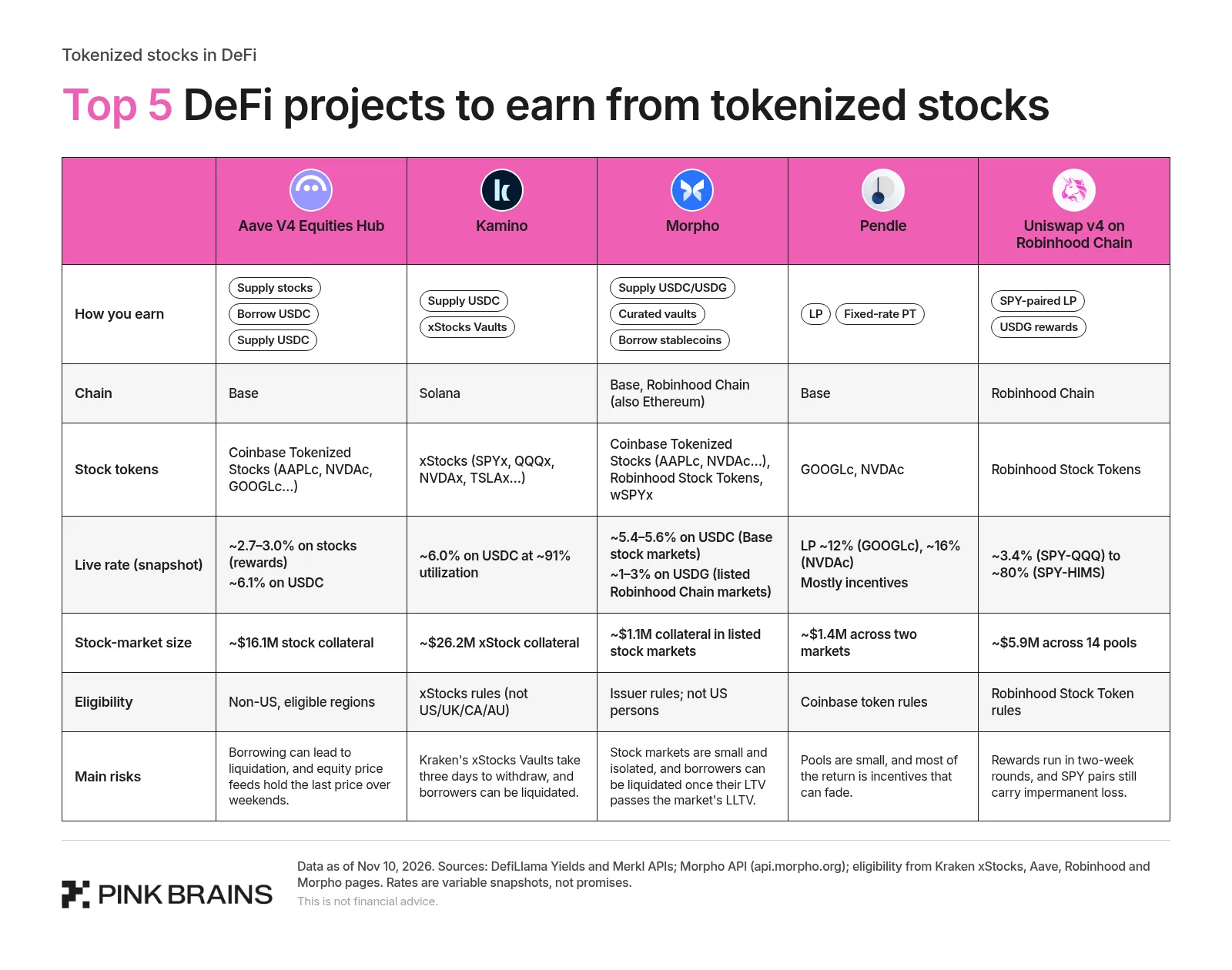
Top 5 DeFi projects to earn with tokenized stocks (2026)
We picked these five because each one has live, verifiable tokenized stock markets, meaningful deposits, and public docs. Between them they cover all 4 yield sources across 3 chains.
1. Aave V4 Equities Hub (Base): lend against Coinbase stocks
Aave is DeFi's largest lending protocol, with $16.3B TVL. Its Equities Hub went live on Base on September 25, 2026 with 7 Coinbase Tokenized Stocks as collateral, and a tokenized SpaceX reserve (SPCXc) has been added since.
If you hold Coinbase stock token on Base, you can put it into work by supplying to the hub. The hub has a single borrowable asset, USDC, and the stocks are collateral-only. Nobody can borrow your AAPLc, so it earns no organic interest. Aave says GHO borrowing is expected later, subject to governance. Stock suppliers get a USDC reward of 2.7% to 3.0% a year through Merkl. USDC lenders earned 6.1%, split almost evenly between borrow interest and rewards. Borrowers get about 1.9% of their loan back in USDC rewards, which lowers the net cost of leverage.
The hub holds about $16.1M of stock collateral. GOOGLc leads at $5.9M, then METAc at $3.5M and NVDAc at $3.0M, with MSFTc smallest at $0.35M. About $6.9M of USDC is borrowed against all of it, so the average borrower sits near 43% of collateral value, far below the 65% to 79% limits. Aave's risk stewards raised the GOOGLc supply cap from 15,000 to 25,000 tokens on October 29
How to earn:
- Buy a Coinbase Tokenized Stock on Base (for example on Aerodrome).
- Supply it to the Equities Hub. Stock suppliers currently earn about 2.7–3.0% a year in Merkl rewards
- Optionally, borrow USDC against it. Collateral factors range from 65% (METAc, TSLAc) to 79% (MSFTc)
- Or skip the stocks entirely: supplying USDC to the hub earned about 6.1% (about 3.1% base interest plus 3.0% rewards)
Good to know: The stocks are collateral-only, so nobody borrows them and they earn no organic interest. What suppliers get is a USDC reward of 2.7% to 3.0% a year through Merkl. The steadier trade sits on the other side. USDC lent on Aave V4 on Base earned 6.1%, split almost evenly between borrow interest and rewards. Prices freeze from Friday 20:00 ET to Sunday 20:00 ET, and a reserve pauses whenever a split or dividend is being applied. Liquidators repay enough debt to return you to a 1.24 health factor and take a bonus of up to 5.5%. Positions that would be left under $1,000 are closed in full. Access is limited to eligible non-US persons under Regulation S.
2. Kamino (Solana): the xStocks lending market
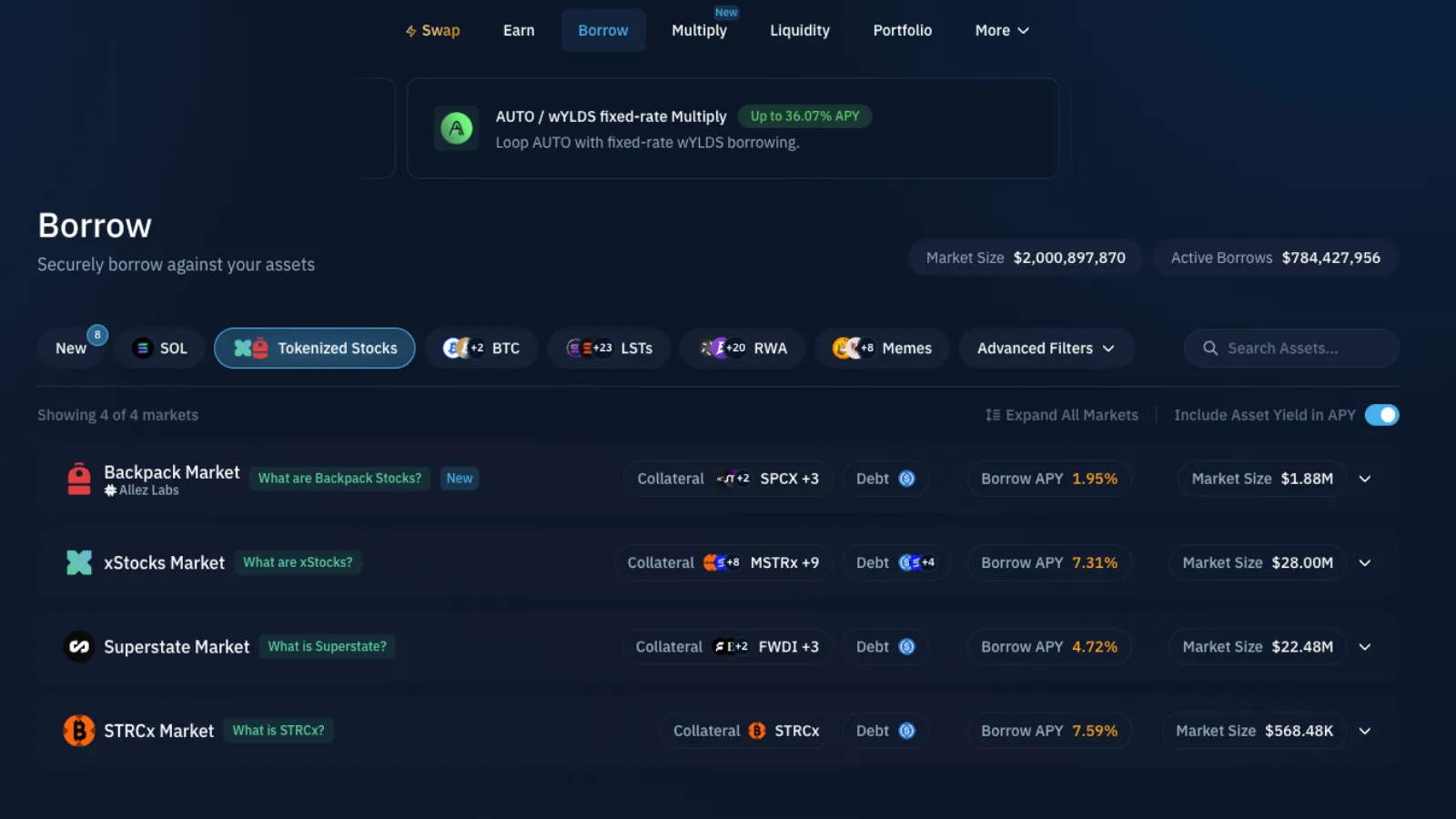
Kamino is a Solana lending protocol with $1.24B in TVL. Its xStocks market takes SPYx, QQQx, NVDAx, TSLAx and 6 other xStocks as collateral for USDC loans, as well as Backpack Market, Superstate Market and STRCx Market.
As the time of writing, the market had $5.67M of USDC supplied and $5.18M borrowed. That 91% utilization is what pushes the supply rate to 6.0%, with no incentives involved. xStocks' own write-up says the borrowers are mostly running leveraged long positions for weeks or months, because a predictable borrow rate costs less than perp funding over that horizon.
If you'd rather keep the stock, Kraken's xStocks Vaults do the borrowing for you. They launched on September 14, 2026 for SPYx, QQQx and NVDAx. Your xStock goes into a Veda vault managed by Sentora, gets posted as collateral, and stablecoins are borrowed against it and deployed. The proceeds are converted back into the same xStock and compounded. Kraken shows a launch estimate of 2.0% net on SPYx and QQQx and 1.8% on NVDAx after a 25% performance fee.
A separate Sentora-curated market on Kamino holds $4.5M of those same three xStocks against $2.7M of PYUSD borrowed at under 1%, which looks like the vaults' borrowing leg.
How to earn:
- The lender side (real interest). Supply USDC to the xStocks market. On Nov 10 it had about $5.67M supplied and $5.18M borrowed (~91% utilization), paying about 6.0% supply APY. Borrowers are mostly people taking longer-term leveraged stock exposure
- The holder side (automated). Kraken's xStocks Vaults launched Sep 14, 2026 for SPYx, QQQx and NVDAx. Your xStock is posted as collateral on Kamino, stablecoins are borrowed against it and deployed, and the rewards are converted back into the same xStock
Good to know: The vaults had a three-day allocation window at launch, so funds aren't instantly liquid. Kamino's own docs say xStocks Multiply (up to 3.7x) is "a purely directional strategy", not yield
3. Morpho (Base and Robinhood Chain): isolated stock-backed lending markets
Morpho is the second-largest lending protocol in this guide at about $11.0B in TVL. It doesn't pool collateral the way Aave does. Every stock gets its own market with one loan asset and one liquidation line, so a bad day in one ticker can't touch lenders in another.
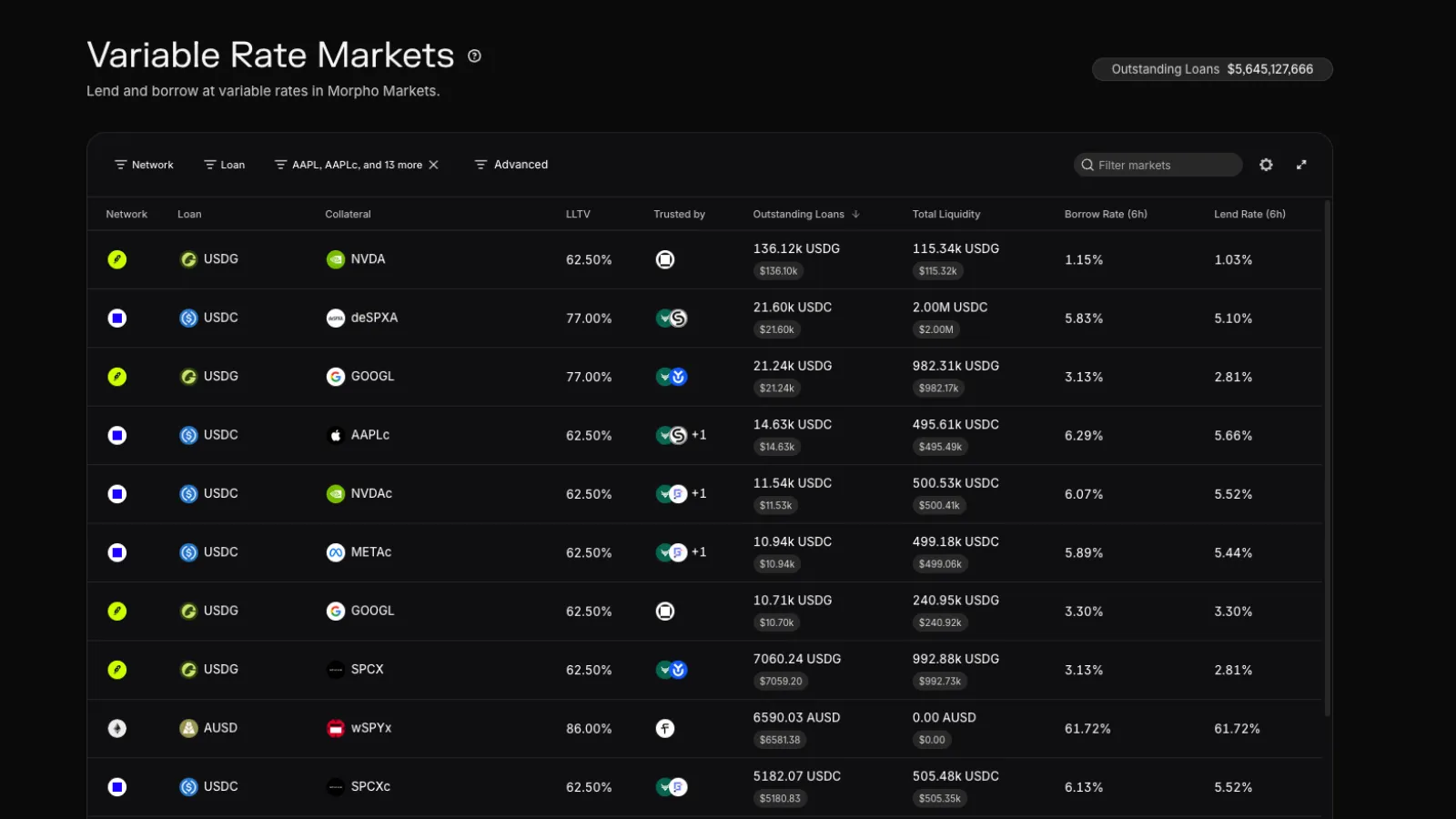
Stock tokens arrived on Morpho twice in 2026. Coinbase Tokenized Stocks became USDC collateral on Base, in markets curated by Steakhouse Financial. Robinhood Stock Tokens followed on Robinhood Chain on, borrowing USDG. Most lenders don't pick a market themselves. They deposit into a curated vault, and the curator spreads that money across markets.
Nearly every market uses a 62.5% liquidation LTV. That is below what Aave gives the same Coinbase stocks, by 2.5 points on METAc and 15.5 on AAPLc, so you borrow less and get liquidated sooner. The one exception is a second GOOGL market at 77%.
Where you lend matters more than which stock backs the loan. USDC lenders in the Base markets earned 5.1% to 5.7%, because borrowers there pay around 6%. USDG lenders in the Robinhood Chain markets earned 0.4% to 3.3%. Two Ethereum markets take wrapped SPYx and Ondo's SPYon, with about $7K borrowed between them.
How to earn:
- The lender side. Deposit USDC (Base) or USDG (Robinhood Chain) into a curated vault that allocates to stock-backed markets, such as Gauntlet USDC Frontier, Clearstar Tokenized Stocks USDC or Steakhouse High Yield USDC on Base, or Yearn Stonk USDG, Steakhouse USDG or Galaxy USDG RH Stock Tokens on Robinhood Chain
- The holder side. Post a stock token as collateral and borrow the stablecoin, staying well below the market's LLTV
- Monitor your health factor, because a position can be liquidated once its LTV passes the LLTV
Good to know: Markets are small, and many listed stock markets were about 88–93% utilized (some higher), so withdrawals can wait on repayments.
The lenders are there and the borrowers aren't. Most Base markets had about $0.5M of USDC waiting to be borrowed, and several Robinhood Chain markets had close to $1M of USDG. On Base, listed AAPLc, NVDAc, METAc and SPCXc markets use a 62.5% LLTV and GOOGLc uses 77%, with USDC supply APY of about 5.4–5.6%. On Robinhood Chain, listed SPY and GOOGL markets use 77%, most others use 62.5%, and USDG supply APY was about 1–3%. Listed stock markets held about $1.1M of collateral, including about $475K of wSPYx on Ethereum.
4. Pendle (Base): fixed yield and LP on stock tokens
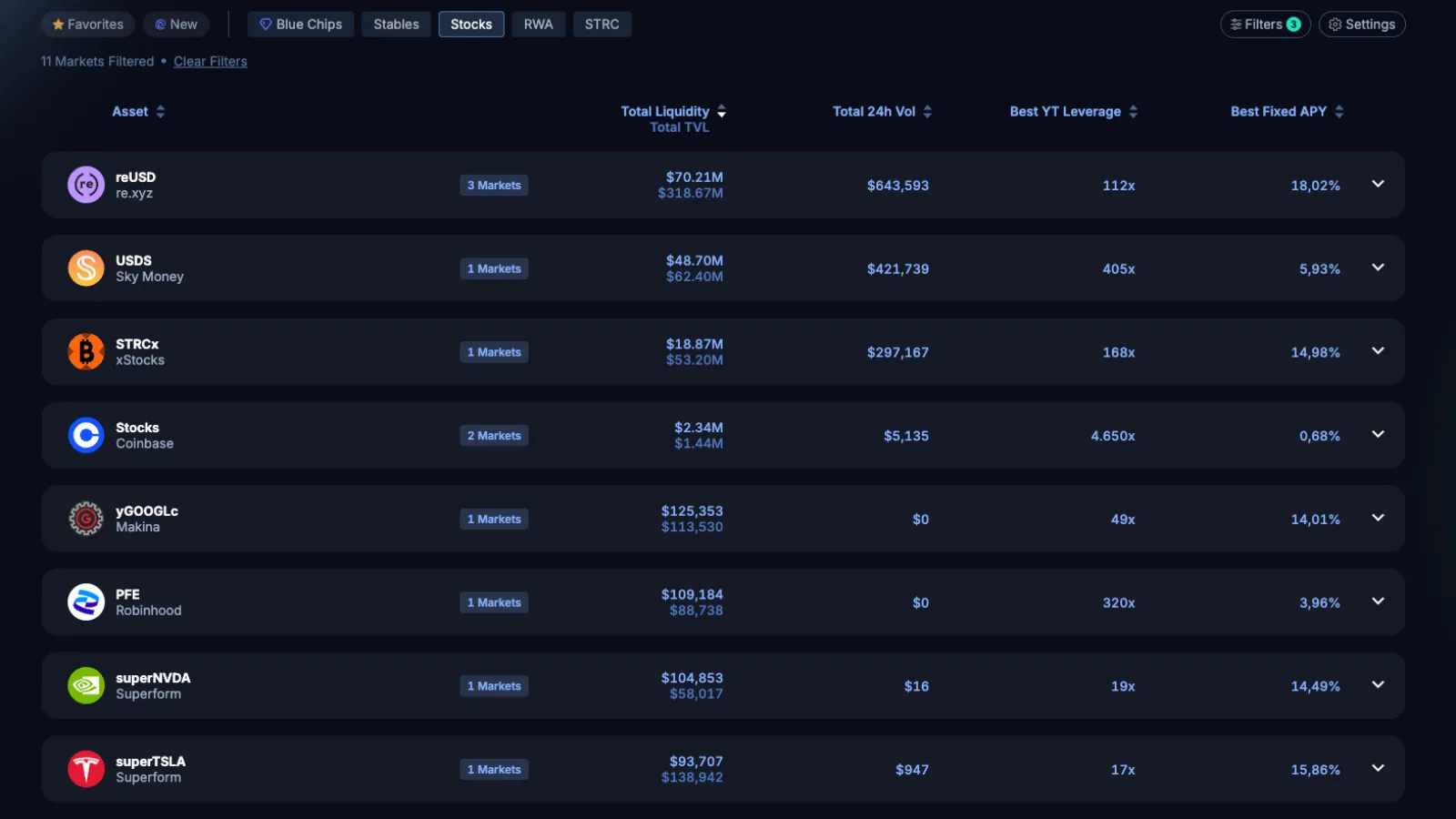
Pendle splits yield-bearing tokens into a principal token (PT) and a yield token (YT). It has $1.00B TVL . On Oct 16, 2026 it listed GOOGLc (maturity Dec 24, 2026) and NVDAc (maturity Jan 7, 2027), with $20K of USDC LP incentives per pool.
LPs earned 12.1% on GOOGLc and 16.1% on NVDAc. Buying the PT and holding to maturity locked in 0.18% and 0.68%. A stock token has no native yield for Pendle to split, so the distance between those two numbers is the USDC incentive.
How to earn:
- Deposit GOOGLc or NVDAc into the Pendle LP.
- Your LP position holds the stock token plus its PT, which redeems for the stock at maturity, so you keep most of the stock exposure.
- Earn swap fees plus incentives.
Good to know: Pools are currently small (~$877K and ~$549K). New markets usually pay most in their first weeks.
5. Uniswap v4 on Robinhood Chain: SPY-paired stock pools
Robinhood Chain is an Arbitrum-based L2 whose public mainnet was announced on July 1, 2026, with Uniswap as a primary AMM. Stock Tokens are available in the Robinhood Wallet in more than 120 countries. We mapped the rest of the chain in Robinhood Chain's RWA DeFi ecosystem.
How Uniswap v4 works in simple terms:
In Uniswap v4, a pool can carry a hook. A hook is a smart contract the pool calls at set moments, such as before a swap, after a swap, or when liquidity is added. It lets the pool run its own rules, for example fees that move with volatility, a tax on certain trades, or limits on who can add liquidity. The hook is chosen when the pool is created, and one hook can serve many pools. Robinhood Chain has become the busiest place for them. It holds 1,206 of the 5,019 hooks in Uniswap's public registry, ahead of Base and Ethereum.
Stock Tokens trade around the clock while their price feeds follow market hours. A plain pool charges the same fee on a Saturday night as on a Tuesday afternoon, so LPs get picked off whenever the pool price is stale. Most stock hooks are attempts to charge more for those trades. That's why Uniswap v4 with hooks is optimal for Stock Tokens.
SPY is Robinhood's Stock Token for the SPDR S&P 500 ETF, the largest fund tracking the S&P 500. The incentivized pools pair one stock with SPY instead of a stablecoin, at fee tiers from 0.02% to 0.05%. You hold both tokens, set a price range, and earn swap fees while the price stays inside it. Two stocks tend to move together, which usually means less impermanent loss than a stock-USDC pair. It also means you hold no dollars, so the whole position falls with the market.
On top of fees, Merkl pays USDG in two-week rounds, and only in-range liquidity earns it. The current round spreads about $48K across 14 pools. SPY-NVDA gets the largest share at $8,000 and paid 57% on $369K of liquidity. SPY-QQQ, the deepest pool at $1.6M, paid 3.3%. SPY-HIMS paid 86% on just $75K, which is the incentive math from earlier working in reverse
14 pools held $5.9M on November 10. After SPY-QQQ, the largest are SPY-GOOGL at $670K and SPY-META at $582K. Stock Tokens also trade on Rialto, Lighter, Arcus and 1inch, so Uniswap is not the only source of volume or of price.
How to earn:
- Hold SPY plus a single-stock token (NVDA, AAPL, TSLA…) in the Robinhood Wallet or another wallet.
- Provide concentrated liquidity to a SPY-paired Uniswap v4 pool.
- Earn trading fees plus USDG rewards from Merkl. Campaigns run in two-week rounds, and only in-range liquidity earns (Merkl).
Good to know: Pairing a stock with SPY rather than a stablecoin usually means smaller impermanent loss, because the two tend to move together. The current round ends November 12, so expect every rate here to reset. A fixed budget on a small pool is the most dilutable yield in this guide. A $100K deposit into SPY-HIMS would more than halve its rate. Robinhood Stock Tokens are debt securities and aren't available to US persons.
Also worth watching
- Jupiter Lend (Solana) accepts SPYx, QQQx, TSLAx and NVDAx as collateral on Solana, though suppliers earn 0% unless an incentive is running
- Managed vaults on Base (Makina/Dialectic "Yielding" tokens, IPOR Fusion, Superform): automated strategies on Coinbase stocks, showing about 4–15% including rewards. Read each vault's strategy before you deposit.
- Raydium is where xStocks LPs earn from trading fees alone, with no incentive budget behind the number. Over the past seven days its main SPYx-USDC pool paid an 8.1% fee APR on $2.0M of liquidity, QQQx-USDC paid 9.1% on $2.3M, and NVDAx-USDC paid 35% on $2.7M . NVDAx pays more because it moves more, and that movement is your impermanent loss.
- StonkBrokers, built by Clutch Markets, calls itself a DeFi suite for stock tokens. Its Smart LP hook applies an oracle-anchored fee to stock pools and charges more for trades away from the reference price (Hookr). Those hooks are assembled on Hookr, a toolkit of reusable hook blocks such as anti-snipe, dynamic fees and LP rewards.
How do you use tokenized stocks as collateral in DeFi?
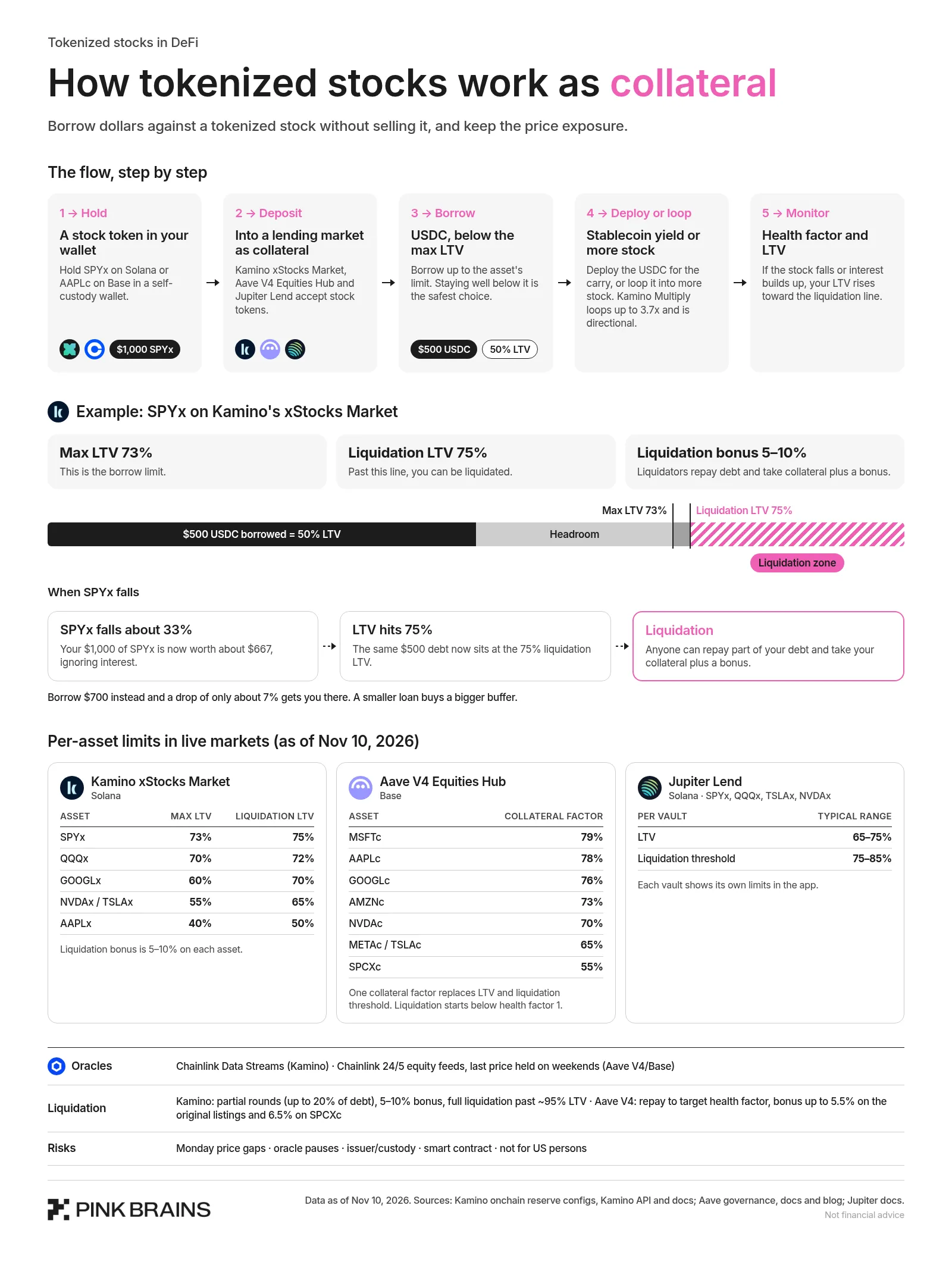
You deposit the stock token into a lending market that accepts it, borrow USDC against it, and keep your price exposure. Kamino lets you borrow up to 73% of the value of SPYx, and Aave V4 gives AAPLc a 78% collateral factor. If the stock falls far enough, a liquidator repays part of your debt and takes your collateral at a discount.
The borrowed USDC goes one of two ways. You can park it in a stablecoin yield and keep the spread over your borrow rate, which is the carry trade Kraken's vaults automate. Or you can buy more of the stock and deposit again. Kamino Multiply loops that up to 3.7x.
The step-by-step flow
- Hold the stock token in a self-custody wallet: SPYx on Solana, AAPLc on Base, and so on.
- Deposit it into a lending market that accepts it, such as Kamino's xStocks market or Aave's Equities Hub, and enable it as collateral.
- Borrow stablecoins (USDC) up to the asset's borrow limit. Staying well below the limit is the safest choice.
- Deploy or loop the USDC. You can deploy it into a stablecoin yield (that's the "carry": you earn more than you pay in borrow interest). Or you can loop it: buy more of the stock and deposit it again for leveraged exposure. Kamino Multiply automates looping up to 3.7x, which Kamino itself calls "a purely directional strategy"
- Monitor your health. When using tokenized stocks as collateral in DeFi money market, you should pay attention to max LTV - how much you can borrow, and liquidation LTV - where a liquidator can step in. If the stock falls or interest builds up, your LTV rises toward the liquidation line.
What happens over the weekend
Stock oracles keep market hours even though the tokens trade around the clock.
On Aave, Chainlink's equity feeds publish from Sunday 20:00 ET to Friday 20:00 ET and hold the last price in between, so your health factor can only fall through interest until markets reopen. That sounds safe until Monday. Any weekend news lands in one price update, and your position takes the whole gap at once.
Kamino also uses Chainlink Data Streams, a custom tokenized-equity feed with sub-second updates that handles corporate actions
Jupiter adds a second catch. Its xStock vaults pause for about five minutes at each session change and for 24 hours before a dividend or split, and while a vault is suspended you can't repay or add collateral.
How liquidation works
On Kamino, each liquidation closes at most 20% of your debt, and the liquidator's bonus grows the further you are past the line. If your LTV passes the insolvency threshold, typically 95%, the whole position can go in one transaction.
On Aave V4, liquidators repay only enough debt to bring you back to a target health factor, set at 1.24 for the equities market, with a bonus of up to 5.5%.
For example: deposit $1,000 of SPYx on Kamino's xStocks Market and borrow $500 USDC. Your LTV is 50%. You reach the 75% liquidation LTV if SPYx falls to about $667, a drop of roughly 33% (ignoring interest). Borrow $700 instead and a drop of only about 7% gets you there. A smaller loan buys a bigger buffer. Stocks gap when markets reopen on Monday, so leave more room than you would with a 24/7 crypto asset.
Checklist to start earning with tokenized stocks: step by step
- Check eligibility. Read your issuer's restricted-country list. xStocks exclude the US, UK, Canada and Australia. Coinbase's tokens are Reg S, for non-US persons only. Robinhood's exclude the US, Canada, the UK, Switzerland and the UAE, among others.
- Set up a self-custody wallet for the right chain: Phantom or Solflare for Solana, a Base-compatible wallet for Coinbase stocks, or the Robinhood Wallet for Robinhood Chain. Here's how to pick a self-custody crypto wallet.
- Fund it with USDC (or USDG) plus a little native gas token.
- Acquire the stock token on a supported venue: Kraken or a Solana DEX for xStocks, Aerodrome for Coinbase stocks, the Robinhood Wallet for Stock Tokens. Prefer index tokens (SPY, QQQ) to start.
- Pick one earning route from the table and match it to your risk level. Supply-only (no borrowing) is the simplest.
- Deposit, then verify. Confirm the position shows in the app, and note the reward token and the campaign end date.
- Monitor weekly. Check rates, LP ranges and health factor. Claim rewards (Merkl rewards are claimed on Merkl).
Choosing by risk level:
- Simplest: supply stocks on Aave, or supply USDC to a stock-backed market.
- Medium: index-pair LP on Raydium or Uniswap, or Pendle LP.
- Advanced: borrowing, looping or hedging with perps. Only if you already manage liquidation and funding risk (see our perp DEX comparison).
What are the risks of earning with tokenized stocks?
- Issuer and custody risk. You rely on the issuer and the custodian holding the real shares. Some tokens are debt instruments, so in a failure you're a creditor, not a shareholder.
- Price gap vs. the underlying. Tokens trade 24/7, but primary minting and redemption follow market days. xStocks direct redemption needs KYC and a $5,000 minimum. Outside market hours, the onchain price can drift from the last close.
- Liquidity risk. Many pools hold under $1M. Large exits can move the price, and vaults may have withdrawal windows.
- Oracle risk. Equity feeds pause on weekends and holidays. Aave's hub holds the last price until markets reopen, and corporate actions can pause a reserve.
- Smart contract risk. Every protocol layer you add (lender, vault, AMM, rewards distributor) is another contract that can fail.
- Liquidation risk. If you borrow against stocks, a sharp drop can trigger liquidation.
- Incentive risk. Most stock-side APYs are reward budgets. When the campaign ends, the rate can drop to near zero.
- Regulatory and regional risk. Eligibility differs by issuer and country, and apps may geo-block. Tax treatment varies.
Tokenized stocks are moving from "hold it onchain" to "put it to work onchain". Lending, LPs and fixed-yield markets now exist for them on three chains, and they're still early enough that most rates are incentives. Treat today's APYs as a snapshot, pick the simplest route that fits you, and let the market mature around you.
FAQs
- Can you earn yield on tokenized stocks? Yes. You can supply them as collateral for rewards (Aave), provide liquidity for trading fees (Raydium, Uniswap), use Pendle markets, or deposit into automated vaults. Most stock-side yield today is incentive-based, so rates change often.
- Where does the yield on tokenized stocks come from? Mostly from incentives, trading fees and stablecoin borrow interest. Few people borrow stock tokens themselves, so on Kamino deposited xStocks earn about 0–0.1%, while USDC lent to stock-backed borrowers earns about 6% (Nov 2026).
- Do tokenized stocks pay dividends? Many do, but usually by reinvesting rather than paying cash. xStocks pass dividends through by rebasing the token balance, and Coinbase Tokenized Stocks reinvest them through a multiplier. Check each issuer's terms.
- Are tokenized stocks safe? They carry issuer, custody, smart contract, oracle and liquidity risks on top of normal stock market risk. Major issuers back tokens 1:1 with shares in segregated custody, but most give economic exposure rather than direct ownership.
- Can US residents earn with tokenized stocks? Generally not with the products in this guide. xStocks, Coinbase Tokenized Stocks and Robinhood Stock Tokens are all offered only to eligible non-US persons. Always check the issuer's restricted-country list first.
- Can you use tokenized stocks as collateral in DeFi? Yes. Kamino, Jupiter Lend and Aave V4 on Base and Morpho let you deposit tokenized stocks and borrow USDC against them. Limits are per asset, for example a 73% max LTV and 75% liquidation LTV for SPYx on Kamino's xStocks Market (Nov 2026).
- How do tokenized stocks stay pegged to the share price? Authorized participants mint and redeem tokens against real shares, which pulls the token price back toward the stock price. Outside US market hours, when minting and redemption pause, the onchain price can drift temporarily.
- What is the difference between tokenized stocks and stock perps? A tokenized stock is a backed token you hold and can use in DeFi. A stock perp is a derivative contract with leverage and funding payments that never holds the share. Some advanced users hold the token and short the perp to earn funding, which adds liquidation risk.
NFA. This is educational content, not financial advice. Rates are variable snapshots as of Nov 10, 2026 and will change. Tokenized stocks aren't available in every country. Do your own research.