Robinhood Chain DeFi RWA Ecosystem Overview
10 mins


The first wave of Robinhood Chain was impossible to miss: memecoin x stocks, fast trading, big wins, and dopamine. But the music may stop soon.
The more interesting story is what people start to do with those tokenized RWAs.
A tokenized stock can now sit in a liquidity pool, back a loan, feed an onchain treasury, or become the underlying asset for a derivative. That is where Robinhood Chain starts to look less like another memecoin venue and more like an onchain capital market.
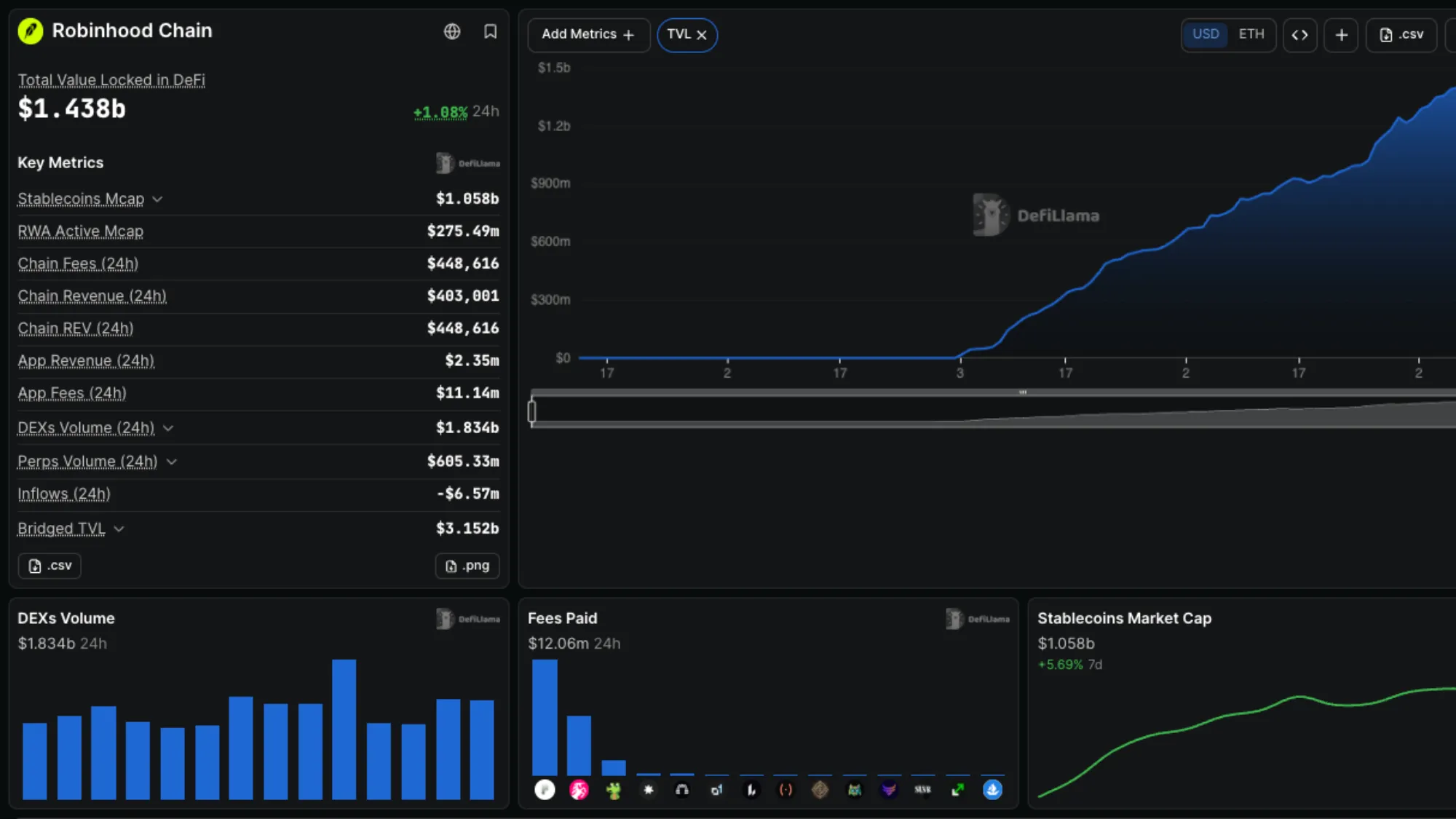
As of Sep 2026, Robinhood Chain held about $903M in DeFi TVL, $1B in stablecoins, and $260M in active RWA market capitalization. The numbers will change quickly, but builders are no longer experimenting on an empty chain.
A Robinhood Stock Token is not the same as owning the underlying share. Just like other tokenized stocks like xStocks and bStocks by Binance, Robinhood Assets Jersey issues an ERC-20 debt security that tracks the economics of a referenced stock or ETF.
It means that:
- Holders do not receive legal ownership or voting rights.
- Dividends and stock splits are reflected through an onchain multiplier, and access is restricted in the United States and several other jurisdictions.
- Every DEX, lending market, and derivative built on Stock Tokens inherits that issuer-and-oracle structure.
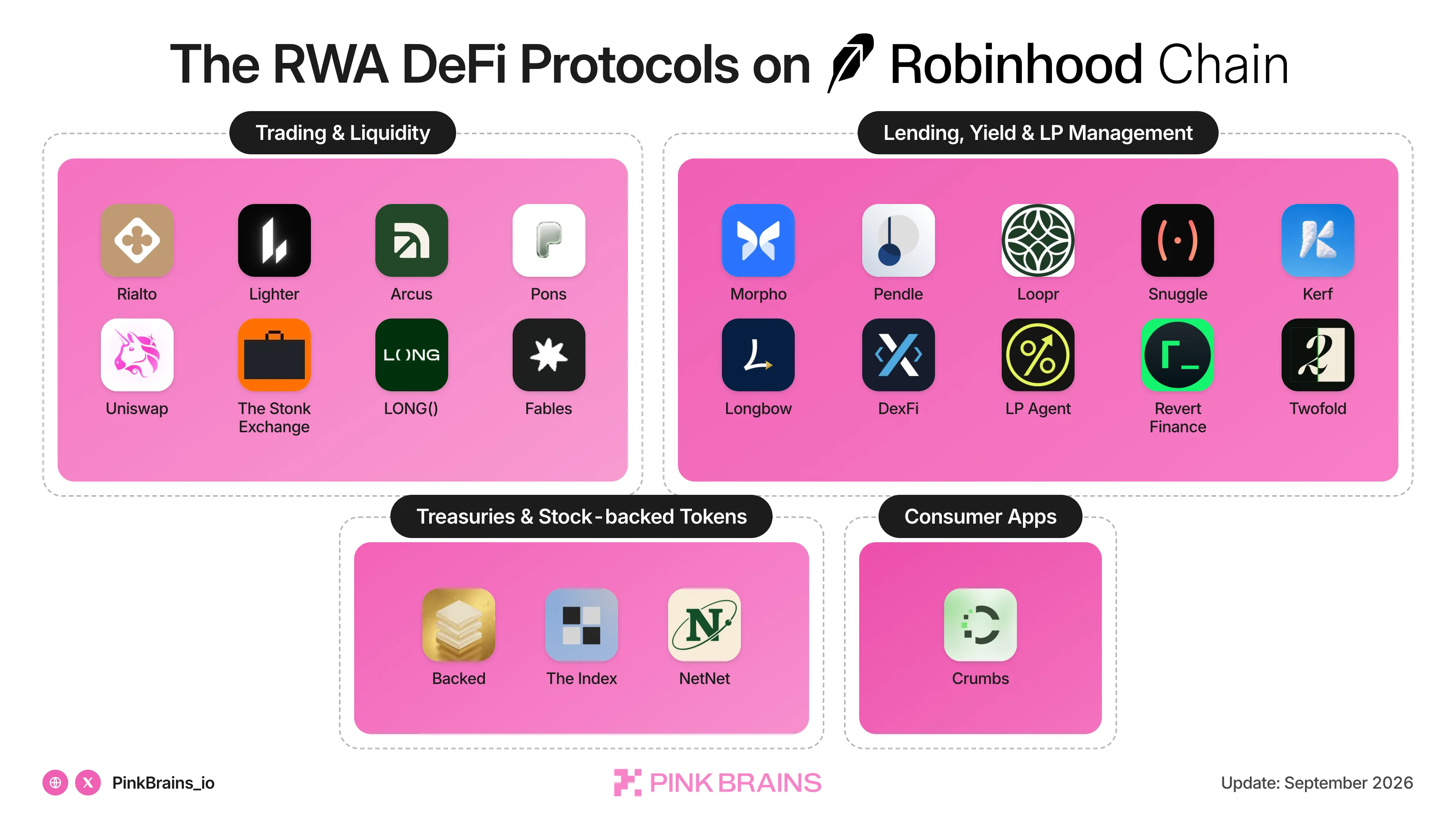
RWA DeFi Ecosystem on Robinhood Chain
- Exchanges Uniswap, Fables, Rialto, Lighter, Arcus, and up. help users swap, trade Stock Tokens, spots, and perps.
- Launchpads like Pons, LONG, and StonkBrokers allow anyone to launch tokens paired with Stock Tokens.
- Morpho turns USDG into borrower-funded lending yield.
- Longbow and Loopr let holders borrow against tokenized assets.
- Snuggle, Revert and Twofold try to make the liquidity around those assets work harder.
- Pendle separates the principal and future yield and offers fixed yield on any yield-bearing assets.
Then come the more experimental products.
- NetNet, The Index, and Backed use treasury capital or trading fees to build tokenized-stock exposure.
- StonkBrokers Leverage Machine is the options-like product to watch.
- Kerf packages LP, hedging, and structured-product tools in one interface.
- Revert and LP Agent help users find and copy liquidity positions
- DexFi automates multi-farm vaults.
- Crumbs pushes Stock Tokens into consumer rewards.
Now let's dive into details. DYOR. NFA.
Spot trading and RWA liquidity
Uniswap sits at the centre of trading on Robinhood Chain. At the snapshot, it held $253.1M in liquidity and processed $27.6B in 30D volume, making it the chain’s largest public DEX.
Many projects below build on its pools or extend them with new incentives, automated strategies and RWA-specific market designs. Below, we look at the other DEXs and trading products building new markets around Stock Tokens.
1. Fables
Fables is a hook-native ve(3,3) DEX built on Uniswap v4. Its first Robinhood Chain markets, NVDA/USDG and SPY/USDG, use dynamic fees that respond to volatility and stock-market hours. Fees can rise when the reference market is closed, or order flow becomes more toxic, helping LPs price periods of higher risk. Liquidity stays inside Uniswap v4.
Its points program runs from 24 Aug to 5 Oct, ending with the Fables TGE. 1B fixed-supply points are distributed based on fees earned, with emissions increasing weekly.
LPs can also earn weekly USDG rewards funded by $PROLOGUE creator fees, on top of swap fees and points. Referrers receive an additional 10% of the points earned by referring friends.
At the snapshot, Fables held about $16M in TVL, $201M over 7 days, generating $282K in fees, $170K paid to LPs.
2. Rialto
Rialto is where you can buy or sell tokenized equities, ETFs, commodities, and crypto available on RH Chain, without relying on one public pool. Its router searches available liquidity, while its prop AMM can provide another source of quotes.
Rialto is an execution venue rather than a passive-yield product. Its value comes from connecting fragmented liquidity and giving other applications a cleaner route into tokenized markets.
This is useful for a treasury such as NetNet or Backed, or trading apps like fomo, which may need to acquire a basket of stocks in code and care more about the final execution price than where the order was filled.
3. Arcus
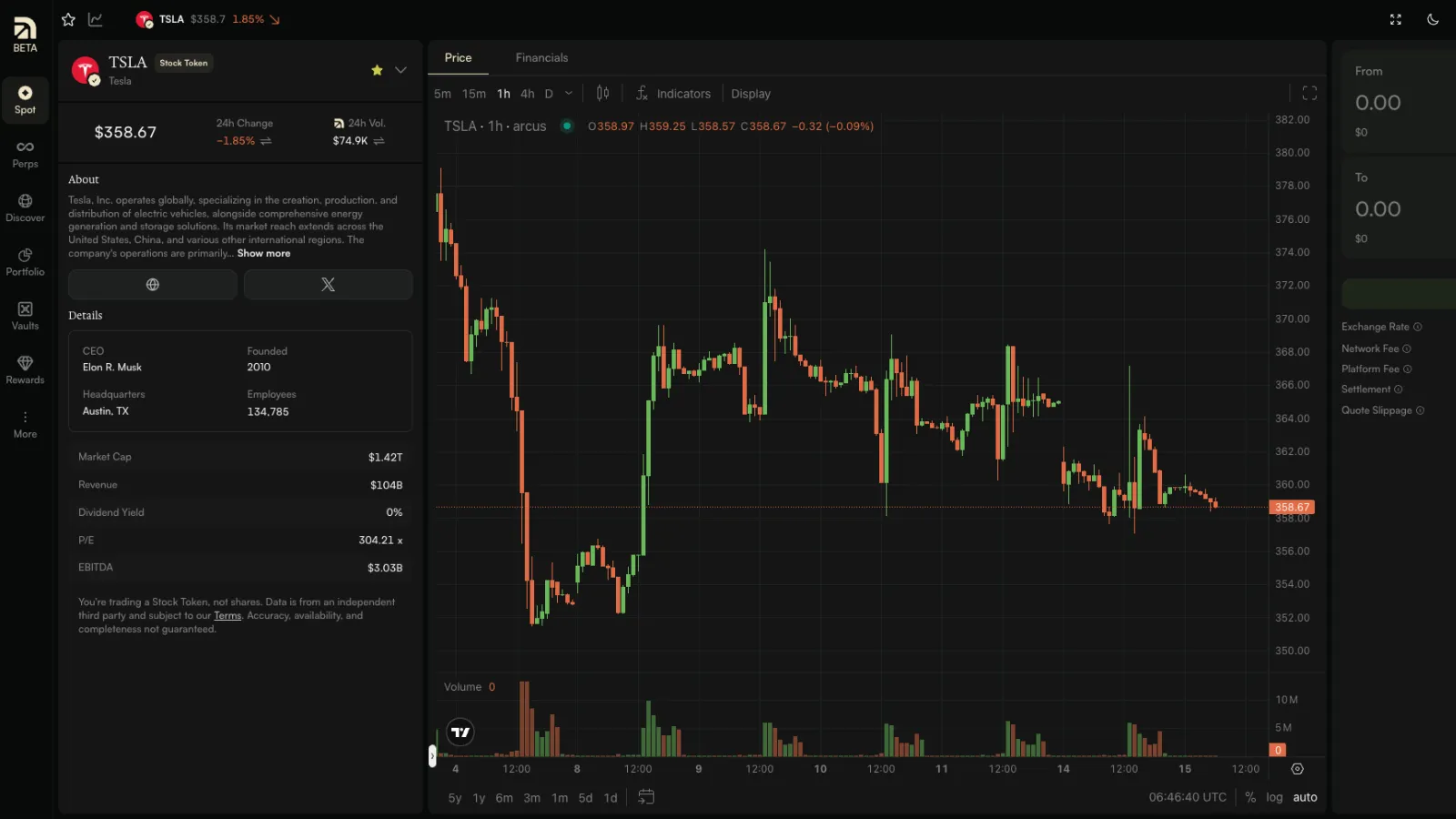
Arcus brings spot Stock Tokens and perpetuals into one self-custodial account. It offers 24/7, zero-fee spot trading across more than 80 equities, alongside indices such as SPY and QQQ, commodities and crypto. Its perps markets are still in the whitelist phase, offering up to 50x leverage with cross or isolated margin.
Its most distinctive product is pTokens, which package managed perp positions into transferable ERC-20 tokens. Products such as pHOOD3x and pBTC3x maintain fixed leveraged exposure through automatic rebalancing, though returns still reflect funding, trading costs, and changes in NAV.
Arcus had roughly $22.5M in TVL at the snapshot. Over 30 days, it handled about $165M in spot volume (passing Lighter) and $2.05 billion in perp volume, with $17.0M of open interest.
4. Lighter
Lighter is Robinhood Chain’s leading derivatives venue, and one of the biggest perp DEXs in all-time trading volume just behind Hyperliquid. Spot trading is currently limited to SPY and QQQ, while perpetual markets cover a wider range of stocks, ETFs, private-market assets and crypto.
You can stake $LIT for trading benefits and access to its liquidity pool, while protocol revenue funds buybacks and burns.
At the snapshot, Lighter held about $80.93M and processed $8.76B in monthly perpetual volume, compared with $135.92M in spot volume.
5. LONG()
Long() may look similar to Pons, but the focus is different. Pons is a large token-launch platform where creators can choose ETH, Stock Tokens or other supported assets as the trading pair.
Pons V2 begins on a bonding curve before graduating into a permanently locked Uniswap v4 pool. Trading fees are divided between creators, the protocol and token buybacks.
LONG is designed specifically around stock-paired markets. A token launches against NVDA, AAPL, SPY or another Stock Token, so the pair itself becomes a secondary market for that stock. Fees can be used to deepen the stock liquidity, support buybacks or flow into the community’s treasury, depending on the market.
@ahboyash explained how Community Pools on LONG turn trading fees into a community-owned stock reserve. For example, $MOO, fees help the vault accumulate memory stocks like $MU while locking and burning $MOO. Over time, the community could decide how to use that growing reserve.
LongX creates another difference. It turns positions on Lighter into transferable ERC-20 tokens. NVDA3x wraps leveraged NVDA exposure, while OPENAIx1L and ANTHROPICx1L wrap 1x pre-IPO perp positions. These assets can then become the base of new LONG pools. It's still experimental.
LONG combines the launchpad, the synthetic asset and the market around it. This gives it more flexibility, but also adds funding, liquidation and liquidity risks from the underlying Lighter position.
6. up.
up is a native (3,3) DEX, supporting both v2 and concentrated liquidity pools. LPs earn swap fees and $UP emissions. veUP voters direct incentives and receive fees from the gauges they support. The Stonk Exchange uses up. as its liquidity engine.
Its markets include Stock Token pairs such as TSLA/USDG alongside crypto and ecosystem assets. Returns depend on trading activity, pool positioning and UP incentives, so headline APYs can fall quickly as emissions or votes move elsewhere.
$8.3M in TVL and $1B in 30D volume. The protocol generated $2.26M in fees, with $1.44M routed to veUP voters. $1.86M distributed in incentives over the same period.
7. The Stonk Exchange
StonkBrokers is one of the all-in-one DEXs on RH Chain.
The Stonk Exchange is the trading floor inside StonkBrokers, built by @ClutchMarkets. You can swap, create pools, launch tokens and stake liquidity for UP emissions. Because it runs through up.’s contracts, its TVL and volume should not be counted as a separate DEX.
The wider ecosystem begins with 4,444 StonkBrokers NFTs. Each has an ERC-6551 wallet seeded with a Stock Token and can receive additional Stock Token rewards after activation.
Its Anvil AMM v2 lets other NFT collections create bonded markets between their NFTs and collection tokens. These markets support instant two-way swaps, soft staking and NFT-backed loans without an order book. Broker Box takes a different approach, packaging listed Stock Tokens into 1x digital bearer certificates.
StonkBrokers also offers Smart LP vaults for automated Uniswap v3 liquidity management. You can deposit a Stock Token single-sided or as a pair, with fees compounded and ranges rebalanced automatically. Next is the STORMM-powered Leverage Machine, where LPs will earn trading fees and option premiums while calls and puts trade as NFTs.
Yield lending and capital efficiency
Yield can come from very different sources. It may be interest paid by USDG borrowers, fees generated by swaps, or the spread between the yield on borrowed USDG and the cost of the loan. Before chasing a headline APY, understand exactly what is funding it.
1. Morpho x USDG
Morpho is becoming Robinhood Chain’s credit base layer. It powers Robinhood Earn, while its isolated-market design lets other builders create USDG lending markets against Stock Tokens, crypto and other collateral.
The main entry point is the Steakhouse USDG vault. Users deposit USDG, Steakhouse allocates it across approved Morpho markets, and the yield comes from borrower interest.
Morpho currently holds about $527M on Robinhood Chain. The Steakhouse vault accounts for roughly $459M, with $48M available liquidity and a 3.64% base APY. Paige Horinek, Leading Incentives Strategy at Base broke down the mechanics behind Robinhood Earn’s headline 7% APY, in which Morpho powers the borrower interest, and of that return comes from temporary Merkl incentives.
Still, Morpho remains the credit engine powering DeFi on Robinhood Chain.
2. Longbow
Longbow is the RWA lending layer built on Morpho Blue. Longbow handles market curation, supply caps, oracle adapters and liquidation monitoring, while the loans settle through Morpho’s immutable contracts.
You can lend USDG or WETH, then earn interest from borrowers. On the other side, they can borrow USDG or ETH against tokenized stocks, crypto, RWAs, memecoins and supported NFTs. Live markets include assets such as AAPL, MSFT, NVDA, CRWV, CLSK, USO and AMC.
Its most interesting product is one-click leverage on Stock Tokens. Longbow borrows USDG, swaps it for more stock collateral and completes the loop in one transaction, with the liquidation price shown before signing. It also offers zero-fee flash loans, NFT-backed lending and $BOW staking that earns USDG from protocol revenue.
3. Loopr
Loopr creates a leveraged yield position from a Stock Token. You deposit a supported stock as collateral, borrow USDG through its isolated Morpho market, and send the borrowed USDG into the Steakhouse yield vault in one transaction.
You keep the stock exposure while the USDG earns lending yield. Your net return is the vault APY minus the borrowing rate. For example, a 4% vault yield and 1% borrowing cost leaves a 3% positive spread before fees.
Loopr supports AAPL, MSFT, NVDA, GOOGL, AMZN, META and TSLA with a 62.5% liquidation LTV, while SPCX uses 38.5%. If the stock falls, the health factor declines. Because stock-price feeds pause outside market hours while debt continues accruing, a large weekend gap could trigger liquidation when the feed resumes.
Loopr currently has only $10,000 supplied across its 8 markets. Liquidity remains very early, limiting borrowing capacity and making rates more sensitive to small changes in activity.
4. Snuggle
Snuggle is for LPs who want the fees without manually babysitting a concentrated liquidity range. Users deposit into a managed vault, and the strategy rebalances the position, compounds fees and tries to keep the liquidity close to the active market price.
On RH Chain, It powers MaxFi vaults for Stock Token pairs such as SPY, NVDA, TSLA, COST and others. That matters more for Stock Tokens than for many crypto pairs. Earnings, news or a closed trading session can produce a sharp gap, leaving a static range far away from the new price.
When a position moves out of range, Snuggle places a new single-sided range near the market price without swapping the assets first. This avoids rebalance slippage and MEV, while fees are automatically compounded where possible. It can improve capital efficiency, but it cant remove impermanent loss or guarantee a better return than holding.
Users keep 85% of LP fees and staking rewards, while Snuggle charges a 15% performance fee on earnings. There are no separate deposit, withdrawal, compounding or rebalancing fees.
Snuggle's TVL continues to grow to nearly $10M, including $5.8M on RH Chain. The chain generated about $2M in gross LP fees and $278,000 in protocol revenue over 30 days. These figures measure fees generated, not the LPs’ final return after IL.
5. Revert Finance
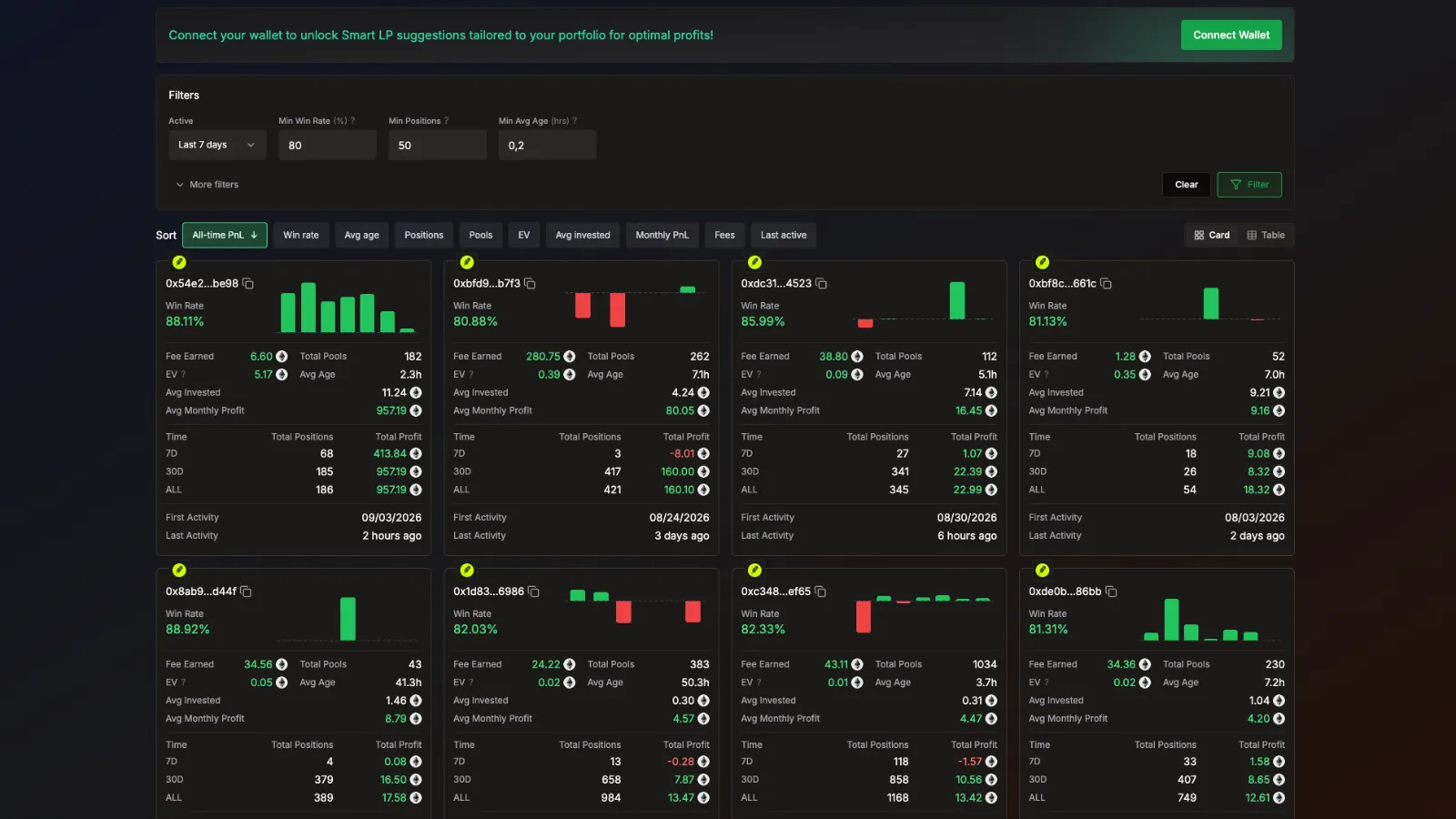
If you find it too difficult navigating and manging top pools, Revert Finance is an LP management platform supporting Uniswap v3 and v4 on Robinhood Chain (and other chains). You can easily find top RWA pools, compare liquidity and fees, create positions and track their performance.
Its Top Positions page ranks public LP positions by PnL, APR and ROI. You can simply copy another LP’s pool and price range with their own capital, although you will enter at a different price and may not earn the same return.
Revert also provides automatic compounding, range adjustments and preset exits. These tools reduce manual work, but the yield still comes from trading fees and remains exposed to IL.
Revert has no separate Robinhood Chain TVL because the capital remains inside Uniswap pools. Top DeFi influencer, DeFi Ignas, also mentioned Revert as one of the tools he's using to farm yield on Robinhood Chain.
6. LP Agent
lpagent helps you find active Uniswap pools, study successful LP wallets and copy their positions. It can also automate compounding, take-profit and stop-loss rules.
On Robinhood Chain, LP Agent helps you manage Uniswap v3 positions. The capital remains inside Uniswap, so LP Agent doesn't have a meaningful standalone TVL. DeFiLlama recorded a growing generated fee of $520K over 30 days and $42K in protocol revenue from its 8% commission.
7. Twofold
Twofold lets the USDG inside an LP position earn lending yield between trades. You provide a Stock Token and USDG, while the DualPool hook deposits the idle USDG into the Steakhouse Morpho vault.
When a swap arrives, the hook withdraws the liquidity needed, completes the trade and returns the USDG to the vault in one transaction. Twofold also adjusts the pool’s concentrated range as the market moves, helping liquidity stay active after large stock-price changes.
LPs earn Steakhouse lending yield and swap fees. Some pools also offer additional USDG rewards that can be boosted by staking TWO.
Twofold has 21 live Stock Token/USDG pairs, including AAPL, NVDA, TSLA, SPY, QQQ and COST. $119,000 in TVL, so liquidity and fee income remain limited. LPs still face IL, Stock Token price gaps and risks from the underlying vault.
7. Pendle
Pendle is one of the 0-1 DeFi protocols that turns future yield into something users can trade. Each asset is split into PT, which represents the principal at maturity, and YT, which receives the yield generated before then.
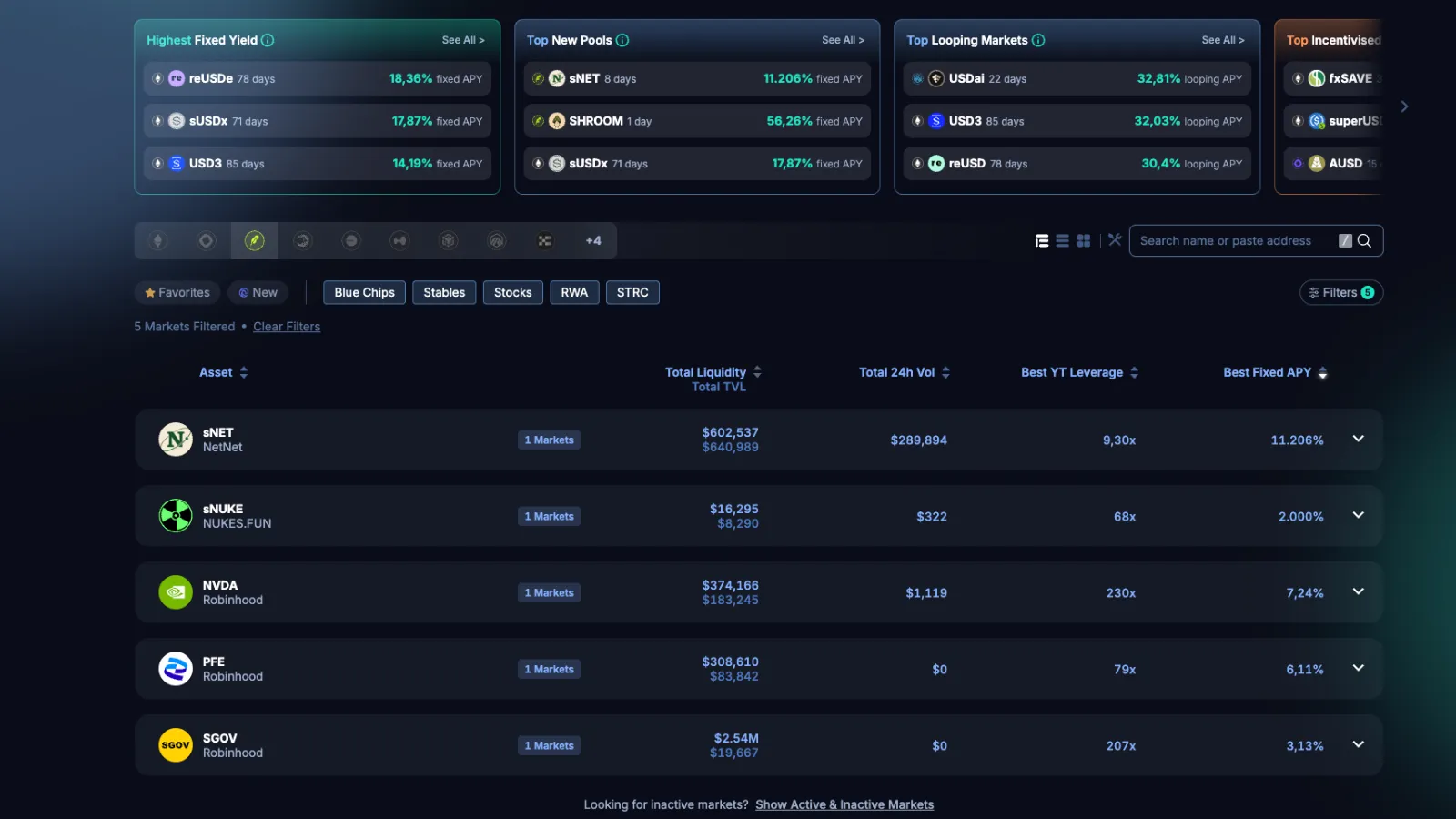
On Robinhood Chain, Pendle now has 7 markets SGOV, NVDA and PFE, alongside sNET, SHROOM, sNUKE and microduck.
The strategy depends on which side you buy. For example, PT-SGOV lets users lock in a fixed return from a tokenized US Treasury asset. You can buy PT-NVDA or PT-PFE below the price of the Stock Token and redeem it for one token at maturity. The return is fixed in stock units, however, so its dollar value still moves with the underlying share price.
YT takes the other side. YT-NVDA and YT-PFE receive dividends paid before maturity, giving traders leveraged exposure to those payments without buying the full Stock Token. The leverage figures can look very high because YT costs only a fraction of the underlying asset, but it expires worthless after maturity.
LPs provide liquidity between PT and the yield-bearing asset. They earn swap fees, underlying yield and PENDLE incentives, while taking liquidity, rate and IL risks. Positions can be redeemed at maturity or rolled into a later market.
Pendle directs 80% of its V2 yield and swap fees toward PENDLE buybacks and distributes them to sPENDLE holders every two weeks.
Indexes treasuries & stock-backed tokens
The word “index” is used loosely across this ecosystem. Some projects hold Stock Tokens in a treasury, while others use trading fees to buy and distribute them. Each model offers stock exposure, but that does not make it an ETF.
1. NetNet Capital
If you remember the OHM era, NetNetCap will feel familiar. NET is backed by an onchain treasury, with its own bonds, staking and protocol-owned liquidity.
You can buy NET at a discount through bonds, then stake it for sNET. Your sNET balance rebases every eight hours, but the rate depends on NET’s price relative to its backing. If NET trades at or below NAV, no new staking rewards are issued.
The treasury earns from Morpho lending and a 5% fee on NET trades. Both can increase the backing behind each token over time.
There is also a separate RWA strategy. USDG raised through Real World Bonds is used to buy Stock Tokens such as NVDA, AAPL and SPCX through Rialto. However, these stocks sit in a separate RWA Sleeve and do not count toward NET’s official NAV. By holding NET, you are not directly buying a share of that stock portfolio.
DeFiLlama currently tracks around $7.62M in treasury assets, while NET trades roughly $1.7M per day. The numbers to watch are treasury growth, backing per token and how much NET trades above or below that backing.
2. The Index
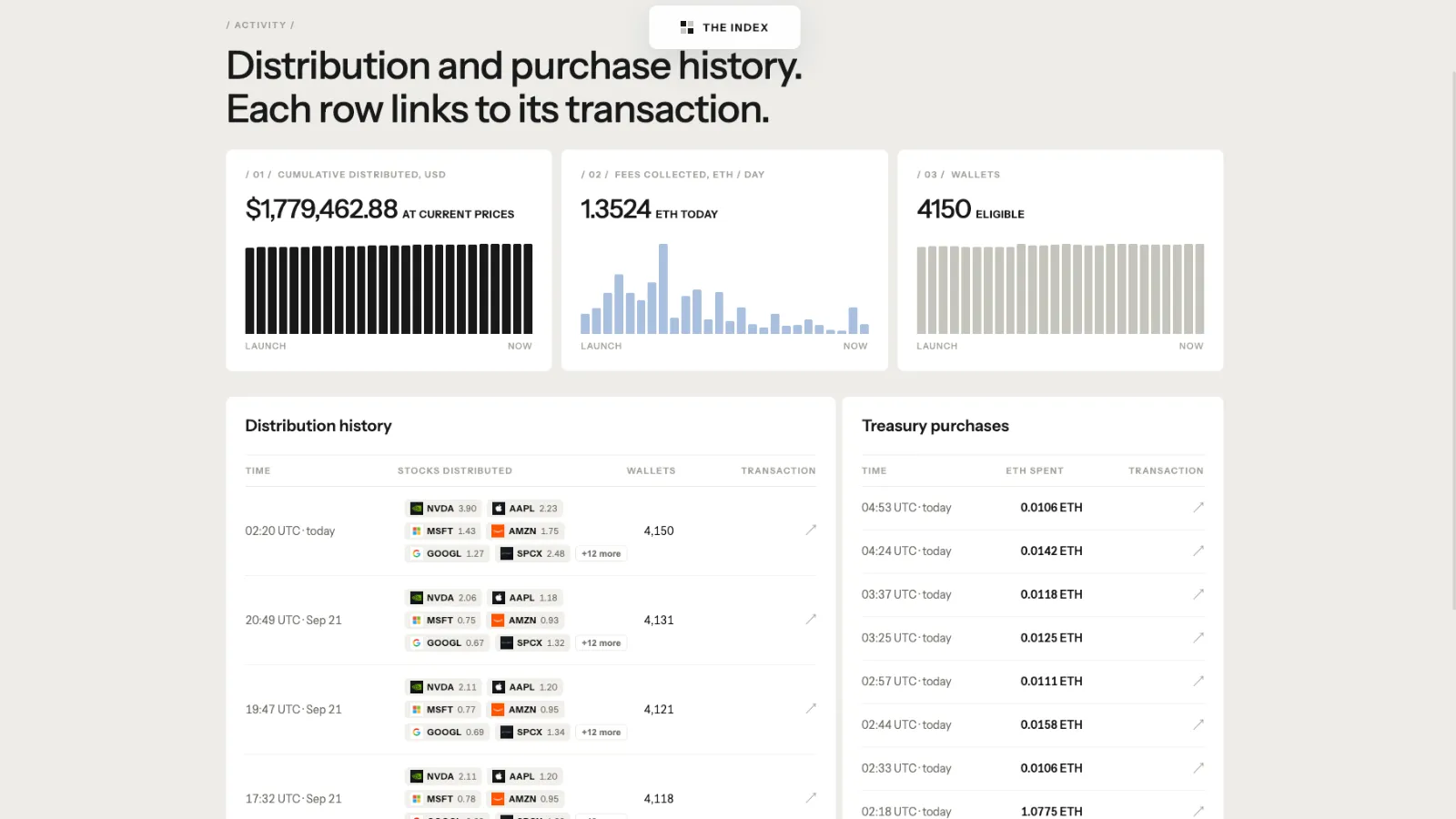
Despite the name, The Index is not a normal index fund. When you trade INDEX, a 3% fee is collected in ETH and used to buy a basket of 18 Robinhood Stock Tokens, including AAPL, NVDA, TSLA, AMD and SPCX.
If you hold at least 10,000 INDEX, your share of those Stock Tokens is sent directly to your wallet every 15 minutes. You don't need to stake or claim anything.
Your rewards depend on how much INDEX is traded. More volume means more fees and more stock purchases; lower volume means smaller distributions. You also pay the 3% fee when entering or exiting the token.
The project reported almost $1.1 million of Stock Token distributions. One of its larger INDEX/WETH pools now holds around $913K in liquidity and processed nearly $1M over 24 hours.
The main risk is that you still hold INDEX while waiting for rewards. INDEX is not redeemable for the stock basket, and its price can fall by more than the value of the Stock Tokens you receive.
3. Backed
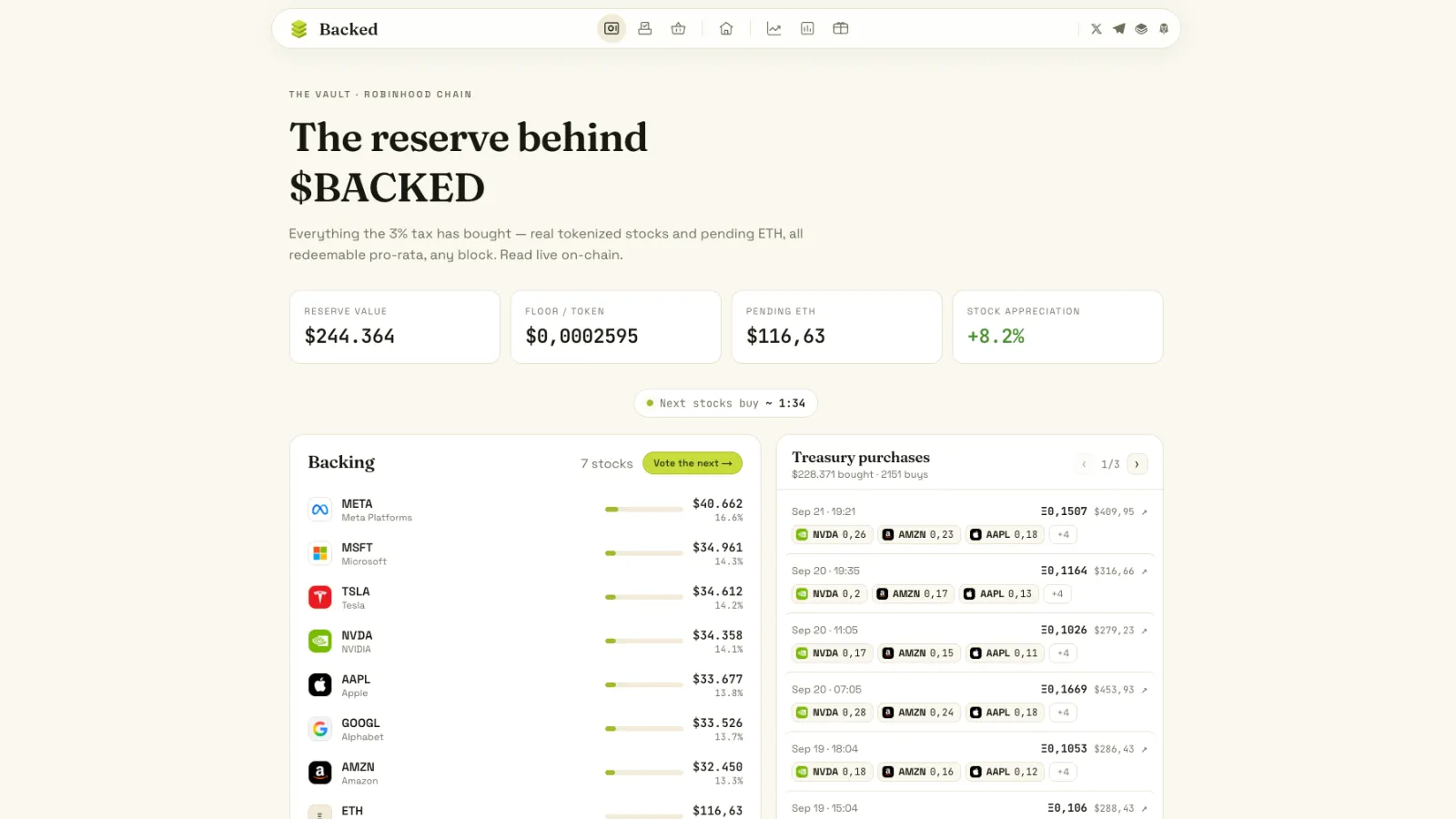
Backed gives you a direct claim on a vault of Robinhood Stock Tokens. Every BACKED trade pays a 3% fee in ETH, which is used to buy stocks through Rialto or Uniswap.
The vault currently holds seven stocks: META, MSFT, TSLA, AAPL, NVDA, AMZN and GOOGL. At the snapshot, it was worth around $227K, with more than $224K of Stock Tokens.
The stocks stay in the vault instead of being paid out. You can burn BACKED and redeem your share of the entire basket, plus any ETH waiting to be invested. A 5% redemption fee stays behind, and the redeemed BACKED is removed from supply.
There are also other products around this system:
- Vote: BACKED holders choose which stocks the vault buys.
- Baskets: creators can direct fees from a Pons or Pools token into a custom basket. The fees buy stocks, ETFs or other tokens and distribute them directly to that coin’s holders.
- Trade: a terminal for Stock Token, pre-IPO, ETF and crypto perpetuals powered by Lighter.
- Predict: binary markets for earnings, indices, commodities and economic data, settled in ETH.
- Spend: use BACKED or supported Stock Tokens to buy gift cards, mobile data and eSIMs.
There is no fixed APY. Your return depends on trading activity and the value of the vault. The contracts are not yet independently audited, so check the live backing before using it.
Potential projects
Not every interesting RWA product needs to look like a vault or exchange. This section is for consumer and product experiments that use Stock Tokens in a new way but are still early.
1. Crumbs
Crumbs turns everyday purchases into Stock Token rewards. You upload a receipt or forward an order email, Crumbs verifies it, and the corresponding stock lands in your wallet. Costco can pay COST, Netflix can pay NFLX, with rates ranging from 2% to 5% across 31 supported brands.
Crumbs is closer to an onchain loyalty program than a yield product. The project also directs 75% of its protocol fees toward CRUMBS buybacks and burns. The metrics to watch are active shoppers and the value of stocks distributed, not TVL.
2. Kerf
Kerf brings LP management, trading and structured products into one interface. You can zap into Uniswap v3 or v4 positions, create fee-earning range orders or deposit into managed vaults.
Its hedged vaults go one step further by shorting the LP asset through Lighter, reducing price exposure while keeping the trading fees. Kerf’s contracts are non-upgradeable, but this is still an early release. Vaults are capped at 5 WETH or 15,000 USDG, and hedged products depend on an offchain service reporting the Lighter position correctly.
3. DexFi
DexFinance packages yield farms into managed vaults that rebalance and compound automatically. You can choose how capital is allocated and direct profits into another asset.
Its Robinhood Chain rollout includes vaults built around GLD and SLV Stock Tokens, combining tokenized metal exposure with an automated farming strategy.
At the snapshot, DexFi held $2.51M across all chains, including $1.28M on Robinhood Chain. The Robinhood deployment generated about $31,300 in fees and revenue over 30 days.
What this tells us about Robinhood Chain
Memecoins may bring the crowd onchain. Stock Tokens could give them a reason to stay on RH Chain.
The same wallet that trades a memecoin and earns fee sharing in Stock Tokens can rotate into SPY or NVDA, provide liquidity, borrow against those assets, hedge them with perps, or put them into a yield strategy. Imagine how this will change the crypto cycle. People don't have to cash out and rotate to stocks/TradFi. Money stays onchain. People who don't have easy access to the U.S. equity markets can now easily hold, trade, and earn from it onchain.
What Robinhood creates is a global onchain market that can hold both the casino and the portfolio you build. As @redphone put it.
You can check out of the casino anytime. You just don’t have to leave crypto.
It sounds very plausible now.

.png)

%201%201.png)

