Prediction Market Ranking in 2026
10 mins


Most prediction market rankings focus on trading volume, but volume is noisy. It spikes around resolutions and gets inflated by traders churning positions, so it says more about recent activity than actual depth. Open interest is the cleaner signal: the value of unresolved positions still open, showing how much real capital is committed to markets right now.
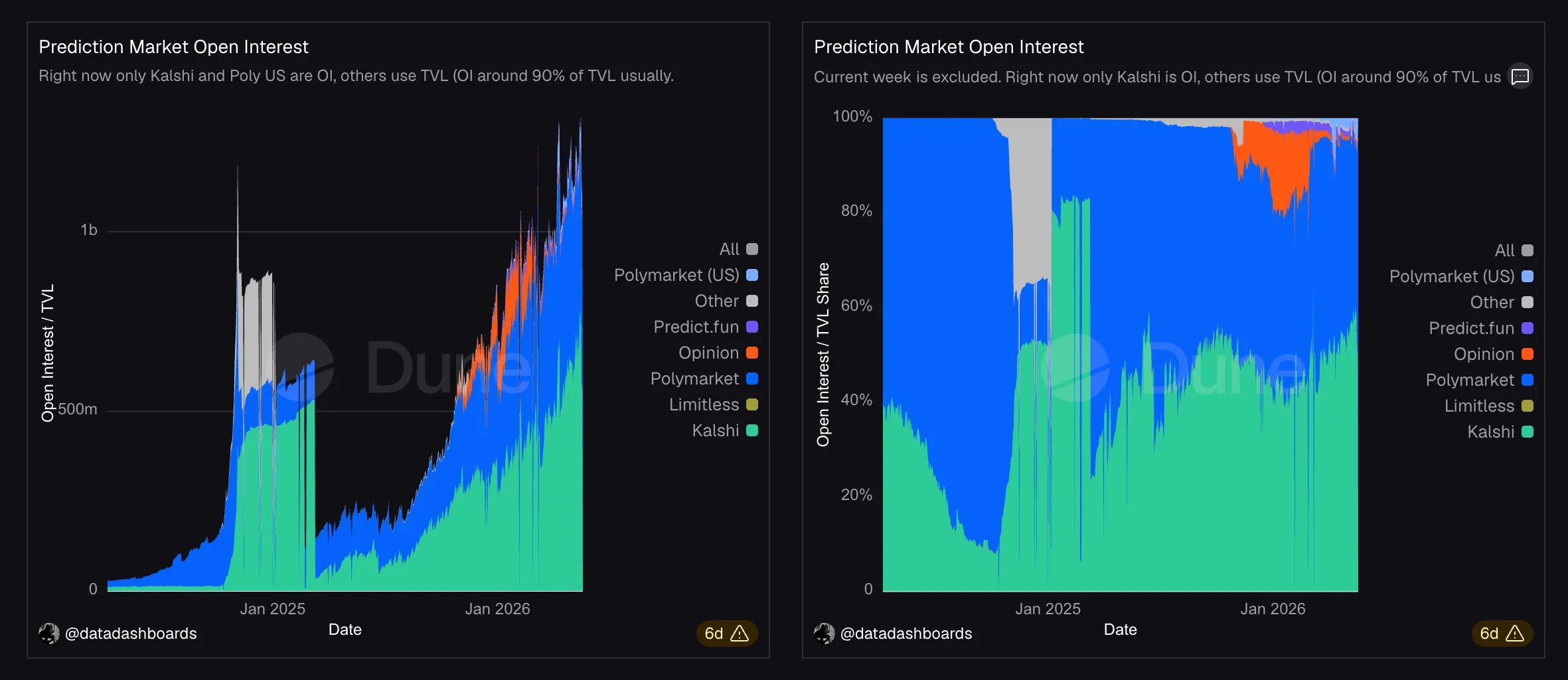
Using @datadashboards’ Dune dashboard, I ranked prediction markets by open interest instead. As of May 1, 2026, tracked platforms held about $1.11B in total open interest, with Kalshi and Polymarket controlling nearly 98% of it. That concentration matters more than most people realize.
Below, I break down the five platforms that matter most by open interest, including how they work in practice: funding, UX, market resolution, liquidity, and where the friction is. Figures are snapshots, not live quotes.
A quick word on open interest, and why I rank by it
Open interest is the total value of positions that are still live and unresolved. If a market shows $40 million in open interest, that's $40 million of "yes" and "no" shares people are still holding into the result - money they haven't taken off the table. It's a more honest gauge of depth than volume, which counts every trade, including wash activity.
For a trader, the practical takeaway is simple: in a deep-OI market you can get in and out near the price on your screen; in a thin one, your own order can move the price against you.
On May 1, that split was stark. Kalshi sat around $630.7 million, Polymarket around $449.9 million, and the next tier - Limitless, Opinion, and others - was under $15 million each. I've kept the two leaders in their order, placed the two most active challengers next, and given the fifth spot to HIP-4 as the newest entrant worth knowing about.
1. Kalshi: the deepest book, regulated, and slower to cash out
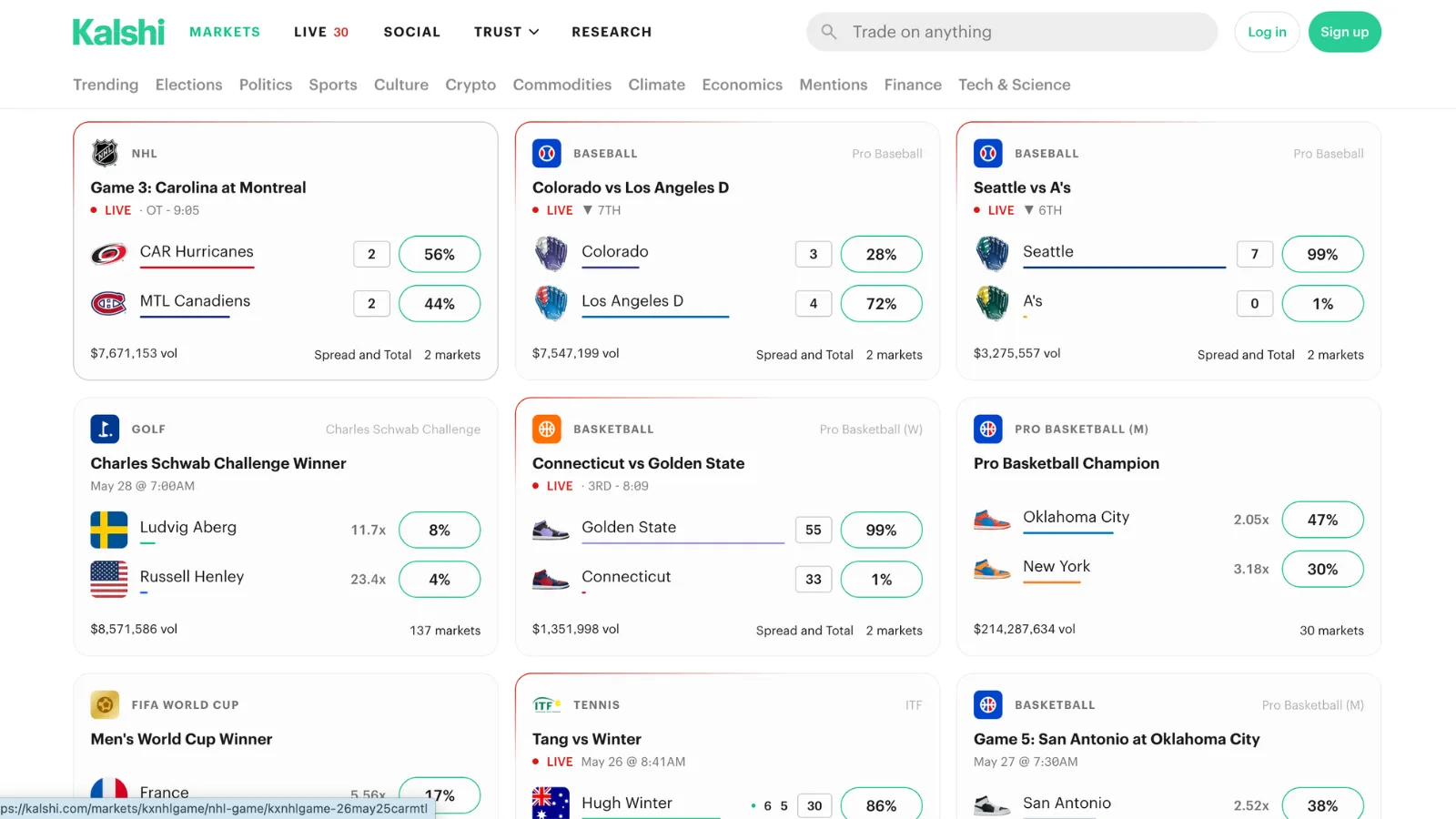
Kalshi carries the most open interest in the sector, roughly $630.7 million on May 1, and on recent monthly volume it has pulled ahead of Polymarket too (around $5.42 billion in April taker volume versus Polymarket's $1.99 billion, per the Dune data). It's the first federally regulated (CFTC) event exchange in the US, and trading it feels like using a brokerage app rather than a crypto product.
Funding is via fiat. You connect a bank account and move dollars in over ACH. That's convenient if you don't want to touch crypto, but the trade-off shows up on the way out: ACH withdrawals take business days, and you'll need a government ID and Social Security number on file before you can withdraw.
Users have also reported occasional withdrawal delays, app glitches, and support bottlenecks, and the company isn't BBB-accredited, so it's worth setting expectations that cashing out isn't instant.
Fees are charged per contract plus settlement, working out to roughly up to 5% of your profit, capped around $0.85 per contract, so they bite more on small wins than on size.
Where Kalshi is genuinely good: depth and coverage on US-centric events like elections, Fed decisions, economic data, sports, awards shows, and a clean, responsive mobile app with tighter push notifications than Polymarket's.
Resolution is handled by Kalshi's own markets team against documented rulebooks under CFTC oversight, which gives you a clearer recourse path than a token-vote system when something is contested. In early 2026 it also added responsible-gambling tooling (an IC360 self-exclusion integration) and tightened identity checks.
There's no crypto-native composability here and nothing onchain to verify yourself. You're trusting a regulated company, the same as you would a broker.
The bigger open question is legal. Several US states argue Kalshi's contracts (especially sports) are gambling under state law. On May 22, 2026, the Ninth Circuit declined to pause enforcement actions in Nevada and Washington, and Kalshi is contesting cases across multiple states. None of that has frozen normal trading, but it's a real overhang you should factor in if you're in an affected state.
2. Polymarket: the largest crypto-native prediction markets
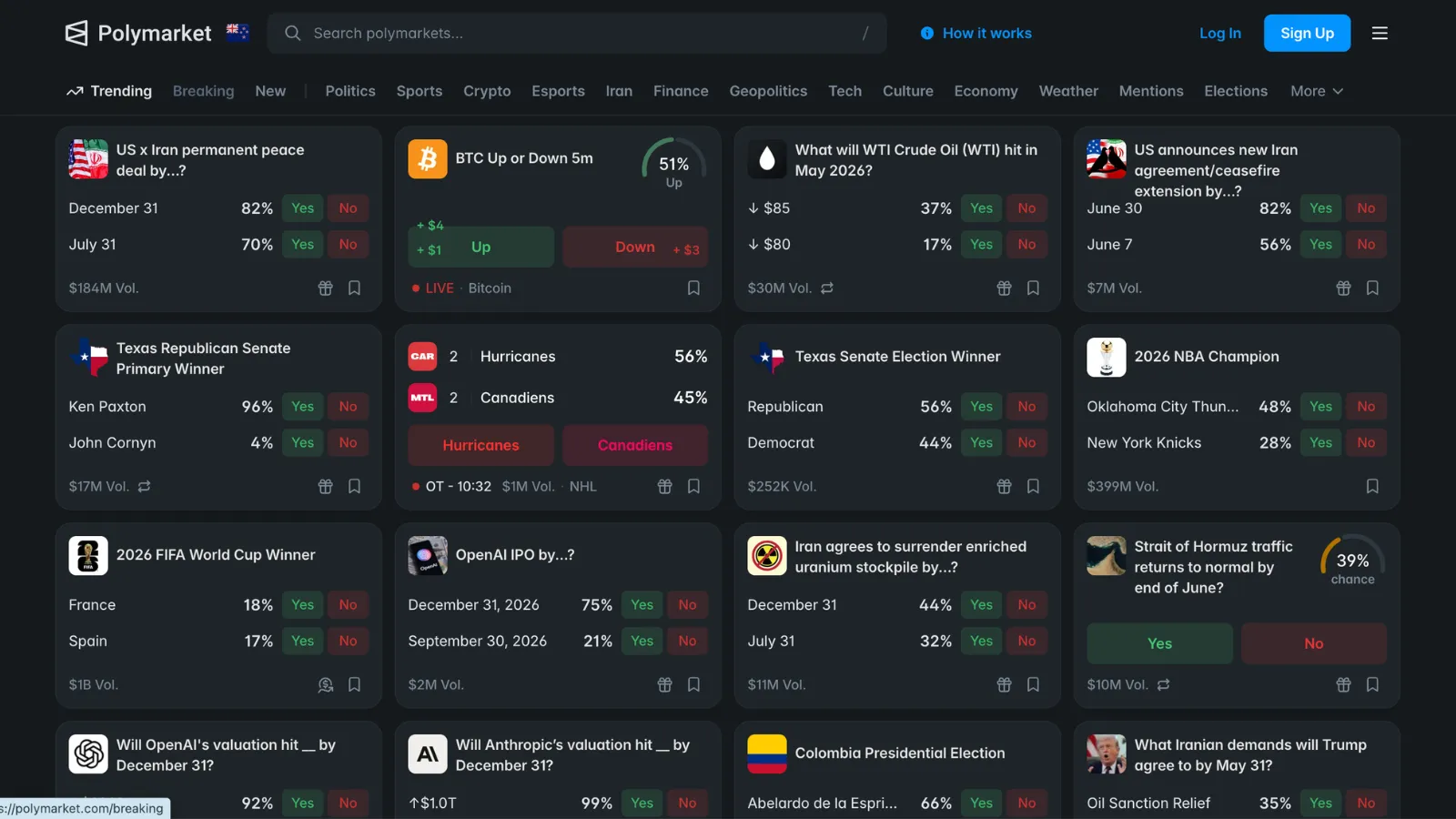
Polymarket holds the second-deepest open interest (around $449.9 million on May 1) and the widest catalog I've used; it's the venue I reach for on international politics, geopolitics, and culture markets that simply don't exist cleanly anywhere else. It settles onchain on Polygon, and US access now runs through QCEX, a CFTC-registered exchange it acquired to re-enter the country.
The trading experience is a genuine mix of better and rougher than Kalshi.
- On the plus side, withdrawals are effectively instant, winnings land in your wallet as USDC in under a minute, which is a real advantage if you want your capital back quickly after a result.
- On the rougher side, there's an onchain learning curve, and the mobile flow makes you bounce to your wallet app to sign and back to Polymarket to confirm, which is more steps than a fiat app. If you trade on mobile a lot, it's worth setting up a wallet with clean deep-linking first.
One change worth flagging is that Polymarket was effectively fee-free for years, but since a March 2026 fee rollout, it charges taker fees on most categories, roughly up to 1.8% on crypto at 50/50 odds, with lower fees toward the extremes, while limit-order makers pay nothing and earn rebates. In practice, that means resting limit orders are now meaningfully cheaper than market orders.
Liquidity scales with interest. Flagship markets, like a major election or a closely watched macro print, comfortably absorb five-figure positions. Smaller or more niche contracts can be four-figure deep, where your own order starts moving the price, so size accordingly.
Recent infrastructure changes are worth knowing about before you trade through an event: in late April, Polymarket migrated to a rebuilt exchange and a new USDC-backed collateral token (pUSD), and the cutover cleared all resting orders, so anyone holding open limit orders that day had to re-place them.
The part I'd flag hardest is resolution. On the international platform, outcomes settle through UMA's optimistic oracle, with disputes decided by token-weighted voting; on the US side, Polymarket's markets team determines outcomes directly.
The token-weighted model has drawn legitimate criticism. DeFiLlama's founder has pointed out that controlling the UMA’s vote is far cheaper than the capital sitting in the markets it governs, and there have been a handful of high-profile, contested resolutions.
given the recent polymarket manipulation reminder that:- 51% of UMA mcap: 63M- polymarket TVL: 120Mand polymarket security relies on UMA holders voting correctly (although theres a multisig that can override it). Source: 0xngmi
In practice, most markets resolve cleanly, but you should read each market's resolution rules before you bet, because ambiguous wording is where disputes start. Like Kalshi, Polymarket is also named in state-level gambling cases.
3. Limitless: the onchain order-book trading on Base, fast but thin on the edges
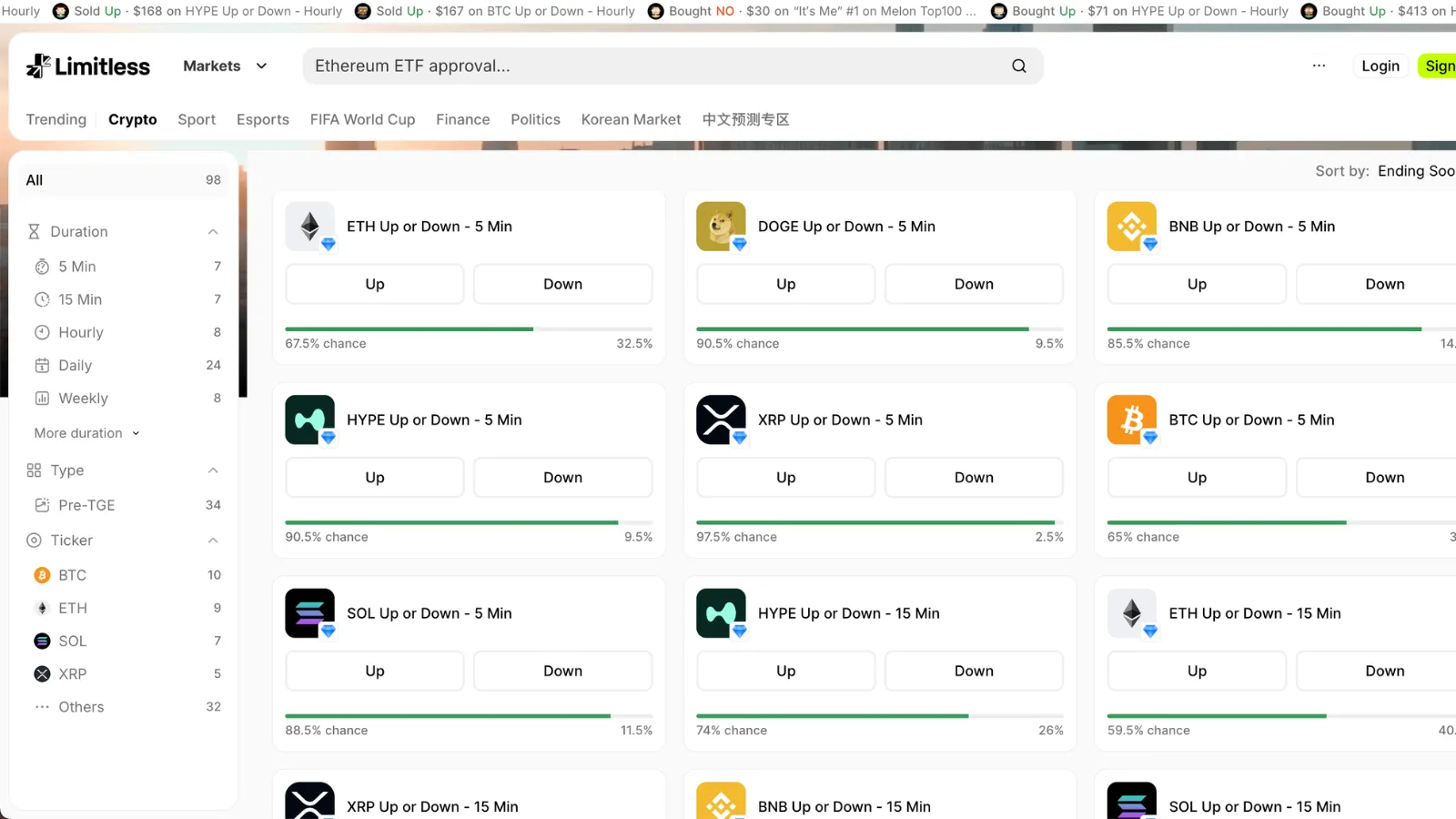
Limitless is the largest prediction market on Base and the one that feels most like an actual exchange rather than a betting site. On the open-interest snapshot, it sits in the sub-$15 million tier with the other challengers. Its April notional volume (around $205 million) trailed Opinion's. Still, it had the most active users of the smaller venues, north of 71,000 in April, which tells you where a lot of the casual-to-active retail flow is going.
What sets it apart is the trading model. Limitless runs a central limit order book (CLOB) rather than an AMM, so each market has separate "Yes" and "No" books with real bids, asks, and a readable spread - closer to Deribit or a normal exchange than to Polymarket's tap-to-bet interface.
You place market orders for instant fills or limit orders to set your own price, and an Advanced mode lets you post limit orders and provide liquidity. Reviewers tend to describe the UI as clean and familiar without being overwhelming, which matches my experience: a Simple mode for quick yes/no, an Advanced mode for people who want depth and order types.
The markets are mostly short-dated crypto and sports markets like hourly and daily BTC and ETH price binaries, plus some equity-linked events, like "Will BTC close above $X." They resolve fast, minutes to days, using Pyth price data, and each settles onchain as a binary with no leverage and no liquidation, so your downside is capped at what you put in. You can also split or merge "Yes" and "No" shares to free up capital, which is genuinely handy when you're juggling a few positions.
On costs, Limitless uses an adaptive fee that starts very low when a market opens (around 0.03%) and climbs toward 3% as it nears resolution, which nudges you to take a view early rather than pile in at the end. A slice of trading fees goes toward buying back the platform's LMTS token, and staking it earns fee discounts — worth knowing if you trade often, though it's not something you need to touch to use the platform. Trading is wallet-based with no KYC, gas on Base is cheap, and settlement is quick.
The honest caveats for Limiteless are that it's a younger venue (the token only launched in late 2025, with roughly 13% of supply circulating as of May 2026), and while the short-term crypto markets are active and reasonably deep, the longer-dated or niche markets thin out fast — fine for quick directional trades, less so for sizing into a slow-moving event. As with any newer onchain platform, there are isolated user complaints online about specific resolutions, so it's sensible to start small and read how a market resolves before committing.
Backers include Coinbase Ventures, 1confirmation, DCG, and Paper Ventures, and the team has shipped developer SDKs and signaled plans to expand beyond Base. But for now, it's best understood as a fast, exchange-style venue for short-term crypto predictions, not a broad events market.
4. Opinion: macro-focused, fee-driven, and past its liquidity peak
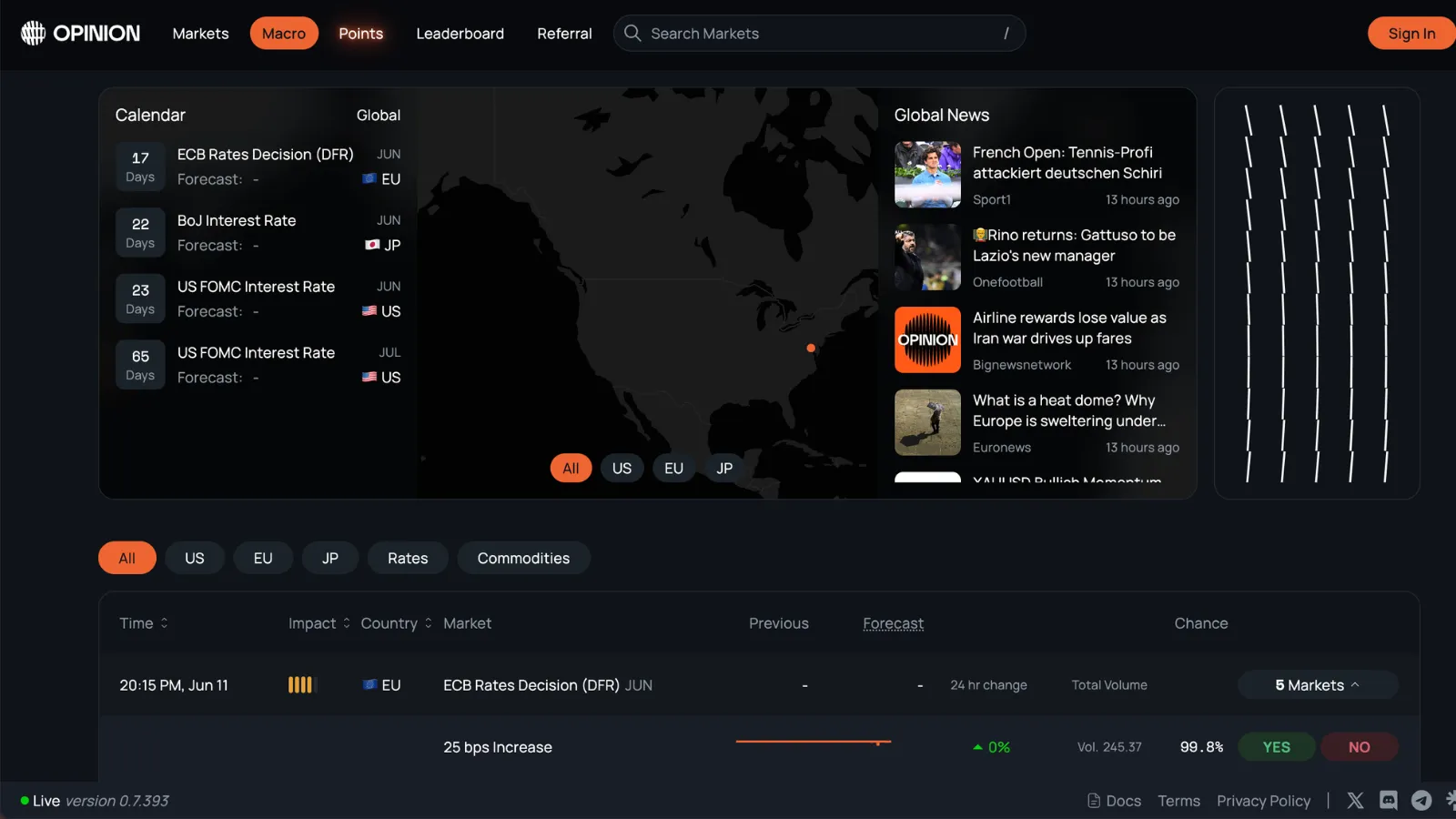
Opinion (the OPN platform on BNB Chain) is the most distinctive of the group in what it tries to be: a prediction venue aimed at macro forecasting like rates, inflation, economic outcomes, rather than culture and sports. A Dune industry report called it a leading example in the macro-forecasting category, and its cumulative notional volume has run past $8 billion since an October 2025 launch, with some single days above $200 million. Its April taker volume of around $376.2 million put it fourth in the field, again with open interest under $15 million.
What it's like to trade: the macro markets are the draw, and they cover ground that's awkward to express elsewhere without professional tools. Resolution is AI-assisted, and unlike the zero-fee venues, Opinion runs a fee model, which is part of why it generates real revenue relative to its size.
The flip side, and the thing to be honest about, is that its liquidity surged hard on early incentives and then thinned considerably once those cooled - at one point in late 2025 it was posting weekly volume near $1.5 billion, briefly above both giants, and it's well off that now.
The community read I trust most describes it as "low-risk to try, high-risk to size up," which matches my experience: it's fine to explore the macro markets with small clips, but with only a few thousand active traders in April, the books don't support much size. Useful for the markets you can't get elsewhere; not a venue for large positions.
5. Hyperliquid HIP-4: the outcome market built for the Hyperliquid ecosystem
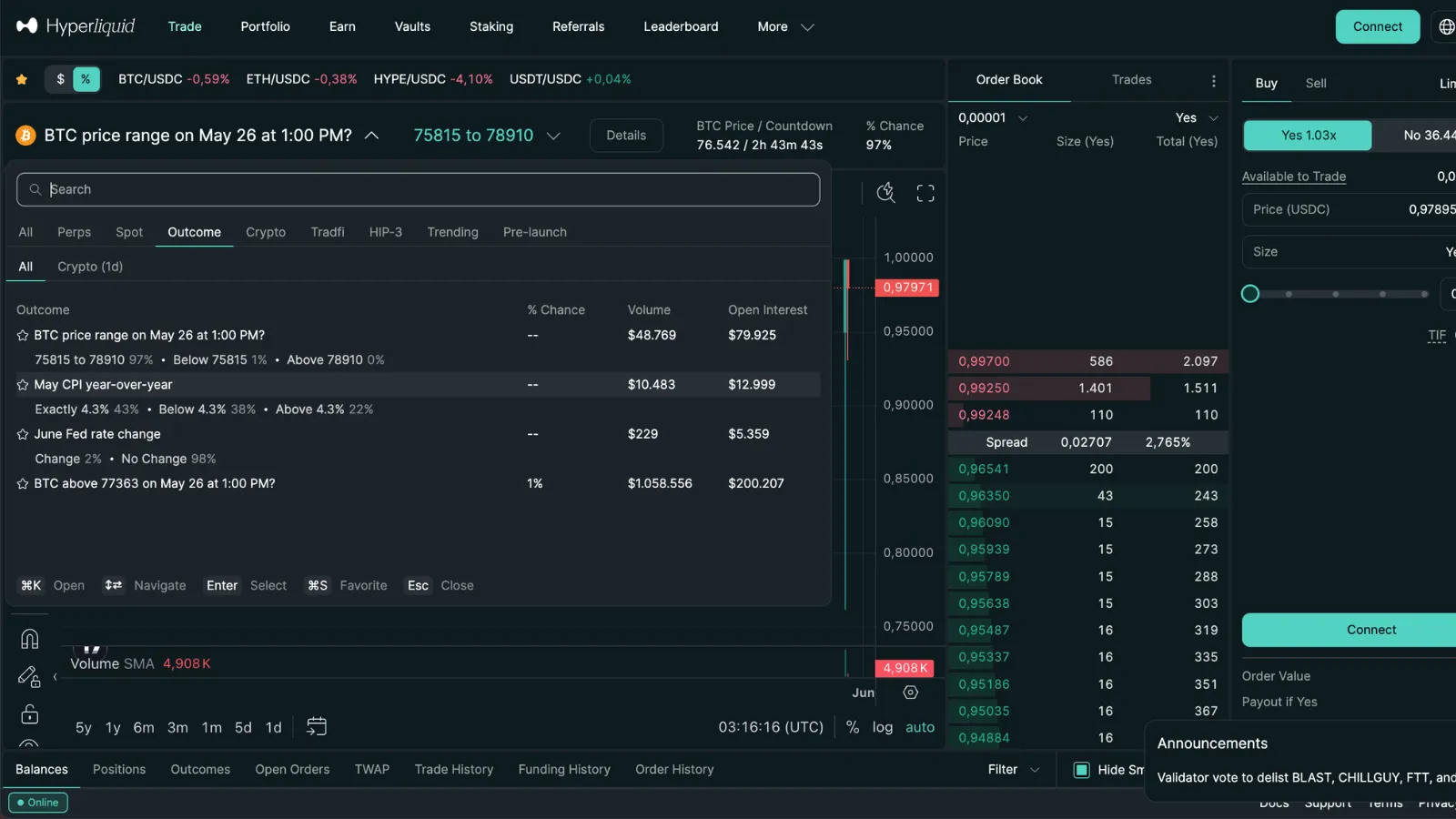
Hyperliquid's HIP-4 is the newest entry and the one with the least open interest, because it only went live on Hyperliquid's mainnet around May 2, 2026. I'm including it because the design is genuinely different, not because it's big yet, its numbers are small.
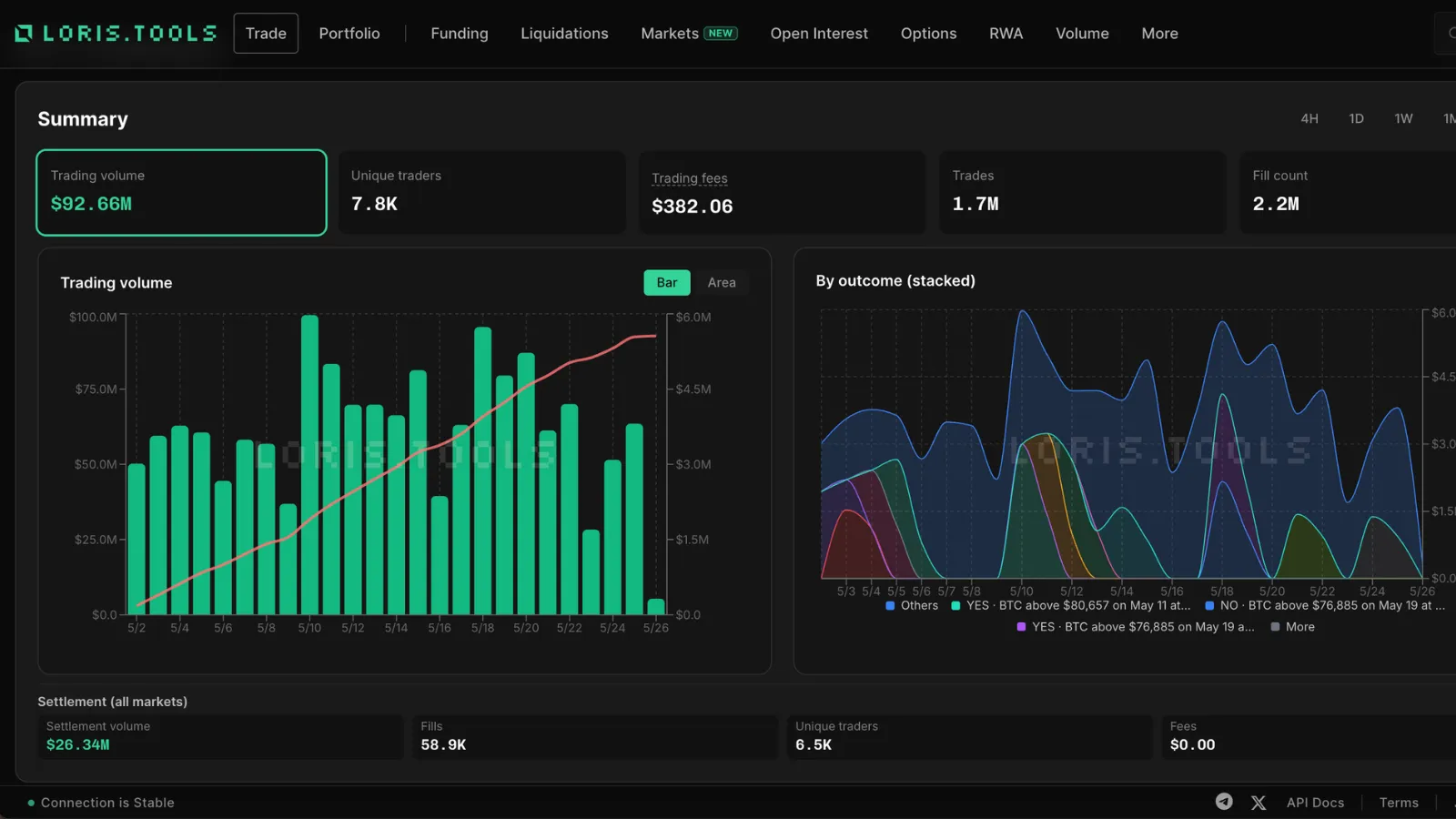
HIP-4 adds "outcome contracts" to Hyperliquid. Each is a fully collateralized, dated market that settles between 0 and 1 based on a real-world event - the same yes/no structure as Polymarket or Kalshi, but running onchain through Hyperliquid's order book and settling in USDH, its native stablecoin. Because positions are fully collateralized, there's no leverage and no liquidation risk; your maximum loss is the amount you put up. The first market is a daily recurring BTC price binary that settles every day at 06:00 UTC, and it has since started extending into macro (there's a US CPI market). The Loris Tools dashboard currently tracks $92 million in trading volume on HIP-4 markets.
The real selling point for the people it suits is that outcome markets live in the same account as Hyperliquid spot and perpetuals trading, sharing one margin balance. If you already trade there, you can hedge a perp position with an outcome contract without moving funds to another app - that composability is something a standalone prediction site can't offer.
Early activity reflected the existing user base rather than a cold start: day one saw about 6.05 million contracts and over $6 million in notional, roughly 0.7% of daily prediction-market activity. For scale, over the same day, Kalshi cleared around 546 million contracts and Polymarket about 190 million, which is the honest picture - meaningful for a launch, tiny next to the leaders.
HIP-4 is not for non-DeFi native users. Hyperliquid is a trader's platform. Most reviews consistently describe it as polished and liquid but closer to a centralized exchange in complexity than a friendly consumer app, and the order-book model favors active market makers over someone who just wants to browse questions and tap "yes."
The long-term question is about product market fit, whether prediction markets even fit Hyperliquid's hardcore-trading audience. Add early-stage limitations - thin liquidity on most outcomes, permissionless market creation still gated behind a large HYPE stake, and the usual oracle and regulatory uncertainty.
Tools that help you explore prediction markets faster
You don't have to trade off the native interface alone, and most useful tools are free.
For watching where money is moving, onchain whale trackers like Polywhaler and Pariflow are solid free starting points, and DropsBot pipes Polymarket order flow into Telegram.
For analysis, Polymarket Analytics has good open-interest charts, and custom Dune dashboards (including the datadashboards one this article is built on, and Loris Tools for HIP-4) let you check the raw numbers yourself rather than trusting a screenshot.
If you trade across venues, a signal aggregator like YN Signals tracks new markets and odds moves on several platforms at once.
And whatever you trade, keep records, prediction market tax reporting is messy, and a tool like Blockstats handling onchain records beats reconstructing a year of trades by hand.
The one habit I'd actually recommend over any single tool: chart open interest against price before you commit. OI tends to move ahead of headlines, and a sharp jump is usually worth investigating before you take a side.
How I use these prediction markets
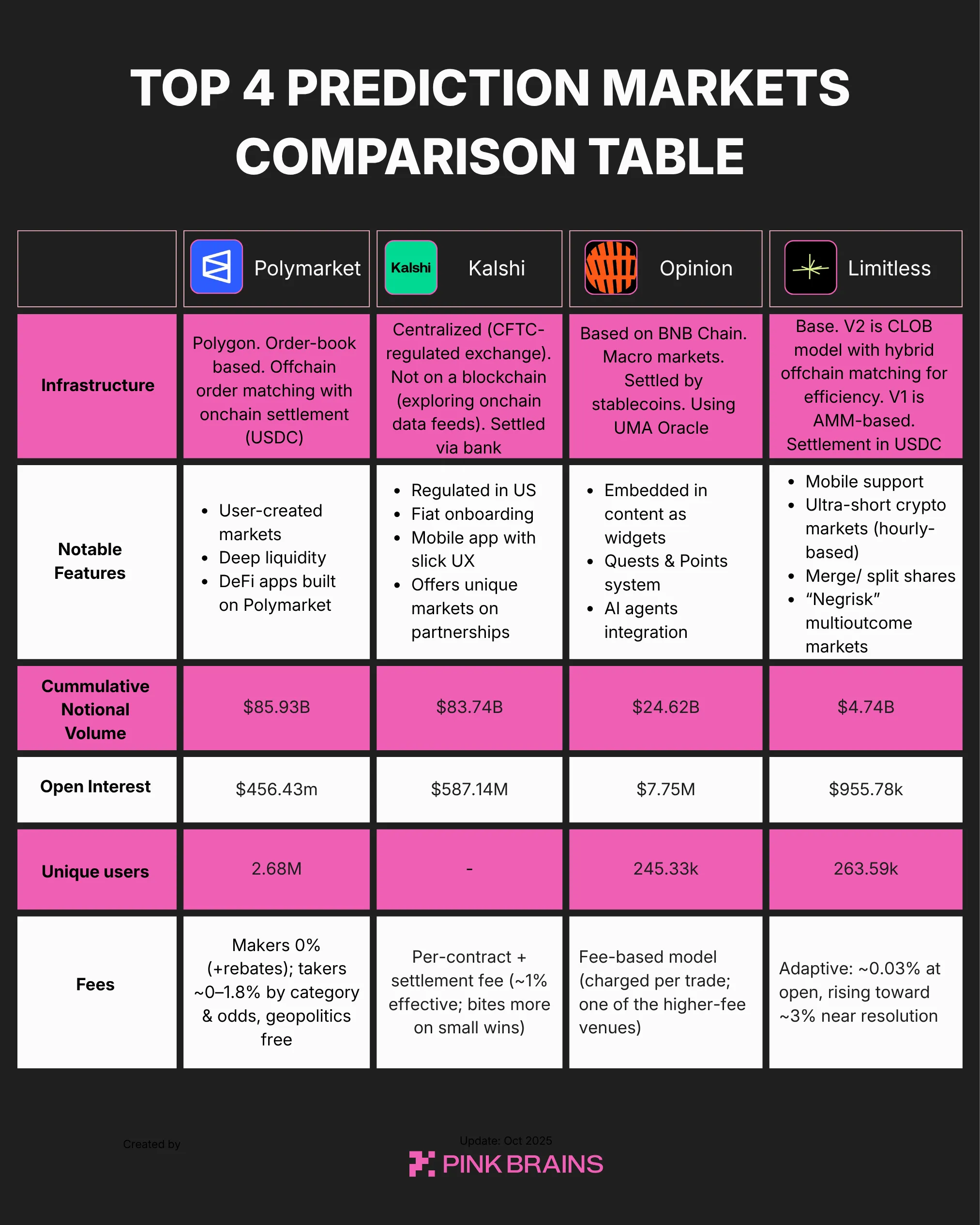
After enough time across all of them, my approach is boring on purpose. Real positions go on Kalshi or Polymarket, because that's where I can get filled without moving the price against myself. Kalshi is my pick for fiat rails and full US coverage. Polymarket still leads for international markets and fast cash-outs, especially for users outside the US. That said, Polymarket is restricted across several regions including Australia, the EU, Singapore, Thailand, and parts of the Middle East. In those markets, platforms like Opnion, Limitless, and HIP-4 markets are emerging as the alternatives.
The smaller venues - Limitless on Base, Opinion on BNB Chain - I keep small and treat them as places to access specific markets (short-term crypto trades on Limitless, macro on Opinion), not to size up, because their books are thin and their liquidity has proven inconsistent.
HIP-4 only makes sense to me as part of a Hyperliquid account I'm already using. But it’s getting more interesting now that Hyperliquid has expanded HIP-4, giving validators a role in publishing, listing, and settling off-chain event markets. With macro events now in scope, it’s definitely worth watching.
None of these is "the best" outright. The right one depends on whether you value regulated rails, onchain transparency, specific market coverage, or trading everything from one account.
This is a personal review for informational purposes, not financial or legal advice. Prediction markets carry real risk of loss, several venues here are young and lightly tested, and the legal status of these contracts is unsettled in parts of the US. Verify current figures and rules through each platform's official channels before trading.

.png)

%201%201.png)