How Perp DEXs Grow Traders in 2026: Incentives & KOL Playbook
10 mins


Perp DEXs Need a Growth Operating System
Perp DEXs don't have a user acquisition problem. They have a retention problem.
Why? It has been the fastest growing crypto sector in the last 2 years, led by the success of Hyperliquid.
- Sector volume grew from $1.5T in 2024 to $7.9T in 2025, a 5.3x expansion in one year.
- Perps trading volume in 2026 has already surpassed all of 2025, scaling exponentially from $0.23B last January to $347.17B this May.
- The DEX-to-CEX perps ratio rose from 2.7% to 13% in a year, which still leaves roughly 88% of perp volume on centralized exchanges.
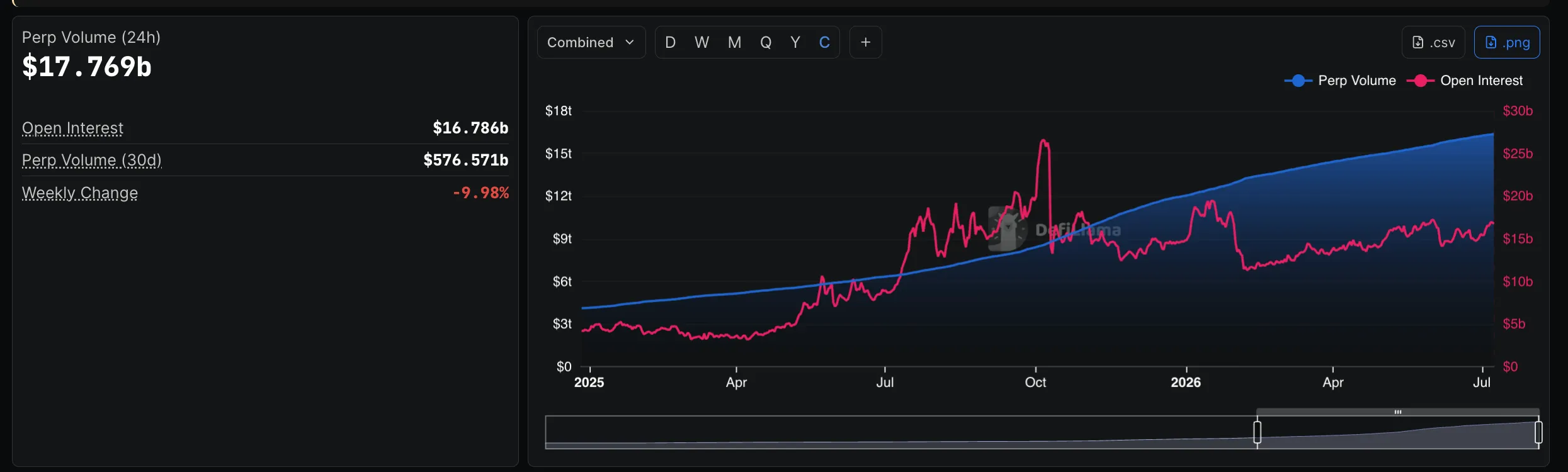
New perp DEXs emerge every month, all competing for the same pool of traders. The real battle is earning their first deposit, becoming part of their daily trading routine, and keeping them engaged as loyal community members.
The venues that solved this don't run marketing campaigns. They run an operating system of incentives and marketing growth strategies.
We studied the campaign history of the 2025-2026 breakouts, including Lighter, Aster, Grvt, Ostium, Variational, edgeX, StandX, and more, mapped their strategies into six growth layers.
- Positioning: why traders care
- Acquisition: how traders arrive
- Activation: how they place their first trade
- Retention: how they become habitual traders
- Expansion: referrals, creators, communities
- Monetization: expand distribution channels via whales, bots, AI, builder integrations
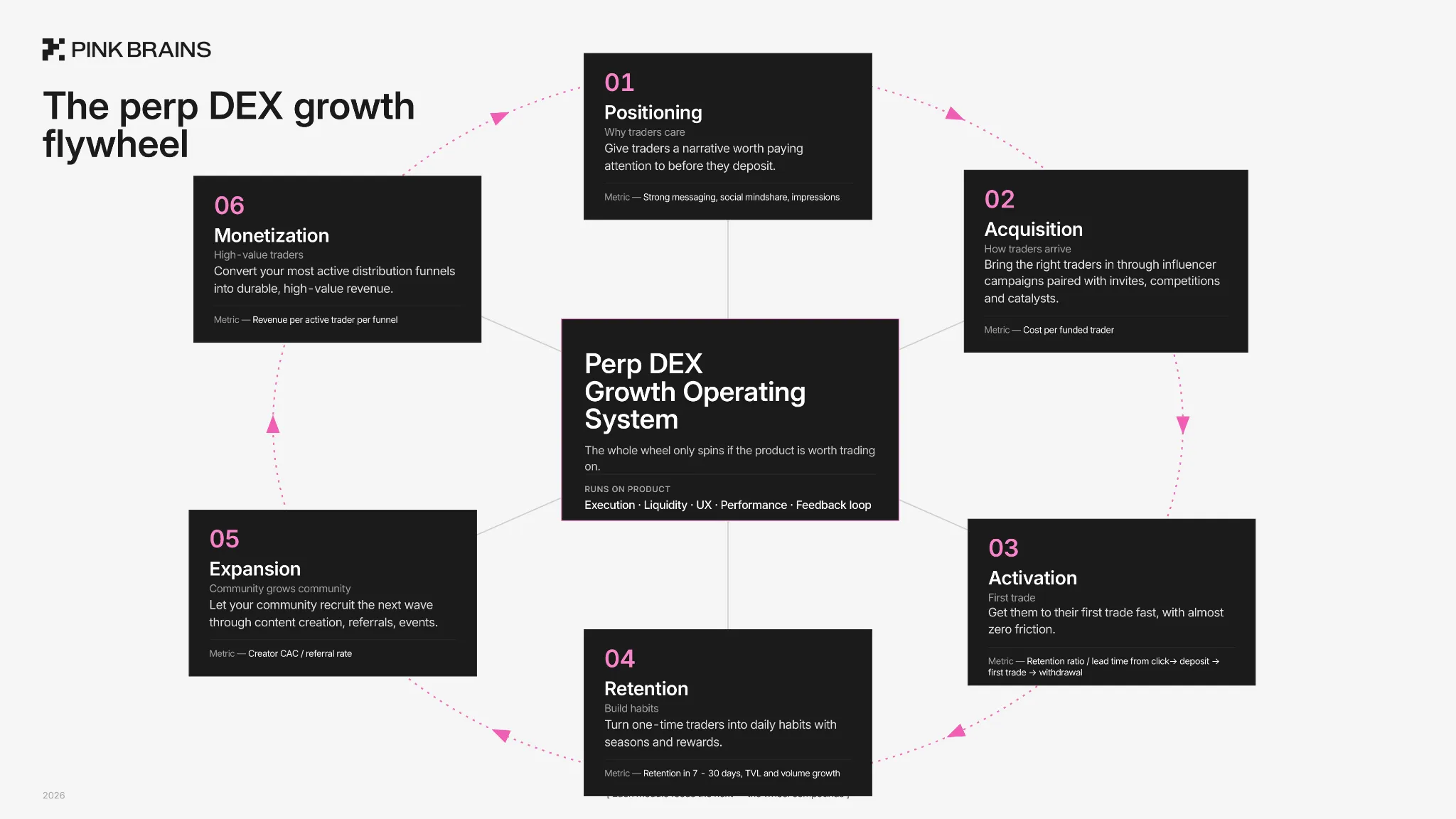
Layer 1: Positioning - Why traders care
Every breakout perp DEX wins the narrative before it wins the user. Traders hear about your product before they try it, usually through another trader. If your story can't be explained in one sentence, isn't relatable, or isn't easy to repeat, it gets lost in the retelling.
1. Hyperliquid: founder as the first marketing manager
From the early stage, Jeff Yan was actually Hyperliquid's CMO, before the narrative spread across Twitter through communities. What he’s been publicly vocal about repeats in every podcast, tweets and interview: 11 people, no VCs, product-first, community above all. Hyperliquid is positioned as the most open, decentralized DEX for onchain trading.
As more traders experienced the product, the community carried that message further than the founder ever could. Every tweet, podcast recap, and ecosystem product launches reinforced the same positioning until the narrative became inseparable from the brand. That's how Hyperliquid grew to more than 70% of perp DEX market share without a marketing department.
2. Aster: build the lore with public figures
On June 1, 2025, CZ posted that it might be time for someone to launch a dark pool perp DEX. That tweet defined a problem in public.
On September 17, 2025, Aster launched as the answer: hidden orders, MEV protection, a privacy L1 on the roadmap. CZ posted praise within hours of the TGE. The token rose roughly 1,650% on launch day, first-day volume hit $3.71B, and over 330,000 new wallets appeared. In November, his post that he'd bought $2M of ASTER moved the price 30% within minutes. The pattern ran sector-wide: single posts from Ben Zhou moved APEX and from Justin Sun moved SunPerp.
Why it works: a trusted voice can give your product instant credibility and reach. But if the product can't live up to the hype, that attention quickly turns into scrutiny. Aster learned this the hard way when DeFiLlama delisted its volume data over suspicious activity, and its market share dropped from roughly 30% to 21%.
Lessons for a perp DEX growth marketer:
- Define your core message before launching any campaign. Campaigns don't create clarity, they amplify what's already there. Without a clear message, you only amplify noise.
- Put a face behind the product. Founder-led marketing, team-led content, or trusted KOLs and public figures give people someone to believe in before they believe in the product.
- Turn your unique features into a simple, repeatable story. Every layer of complexity adds friction throughout the funnel.
- Coordinate ecosystem partners and DeFi KOLs to deliver the same message at the same time. Aligned incentives and synchronized distribution create momentum that isolated campaigns can't.
Layer 2: Acquisition - How traders arrive
Traders arrive through scarcity, spectacle, and timing, not through ads. Perp traders are the most ad-blind audience in crypto and read ad spend as a signal that organic demand is missing. Here are some tactics that growing perp DEXs use to acquire traders.
1. Gated access for a viral launch
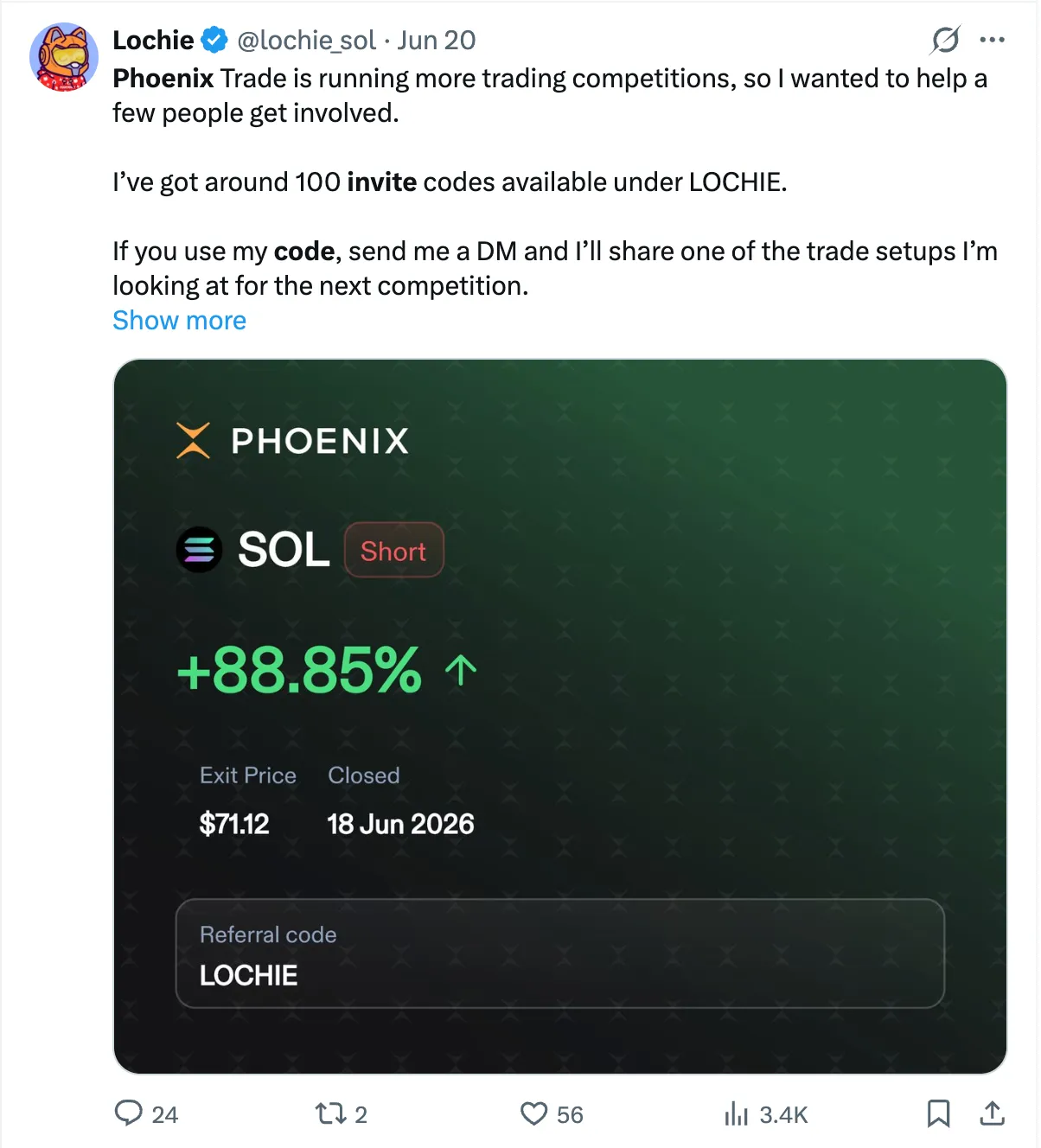
An invite-only launch does two things: it creates scarcity and filters for high-quality early users. Your first 1,000 users shape your reputation, so optimize for traders who genuinely enjoy the product, not people chasing giveaways.
Lighter executed this well. Throughout most of 2025, access required an invite code, but anyone could see its public dashboards. Traders watched volume grow on a platform they couldn't yet join. That's what made the strategy work: scarcity without visibility is just obscurity. Invite codes became status symbols across Crypto Twitter, creating demand before the product even had a token.
By November 2025, Lighter's 7-day volume of $73.77B briefly exceeded both Aster ($72.03B) and Hyperliquid ($70.42B), pre-token. Its 30-day volume peaked at $232B ahead of the December TGE, alongside a $68M raise at a $1.5B valuation.
The 2026 class has made the gate standard: Cascade opened deposits invite-only before trading went live, 01.xyz runs an invitation-only testnet, Phoenix, RiseX and Bulk Trade do the same.
2. Well-designed trading competitions
Trading competitions are common across perp DEXs, but the best ones do more than reward volume. They become acquisition, activation, retention, and content campaigns at the same time.
Synthetix is one of the success cases. Their mainnet competition put 100 traders against each other for a $1M prize pool, and the design choices explain why it worked.
1/ Curation: The 100 traders were selected through top Kwenta users, pre-depositors, and lottery winners, with 30 spots reserved for users depositing into sUSD or sUSDe vaults, so entry itself drove TVL.
2/The prize was a story, not a budget line. First place took $1,000,000 alone, which is a headline any trader can repeat.
3/ The roster was the distribution. Season 1 handed over $1,000,000 to the top 10 traders from a roster of 100 of X's best and most influential voices, plus core historical Synthetix and Kwenta power users, meaning every participant was also a content channel.
4/ They iterated. Season 2 flattened the prize distribution across the top 50 and opened 800 of 1,000 spots to the community via sUSD pre-deposits with a 10,000 sUSD minimum that had to be maintained to stay prize-eligible. Capital locked for the whole competition.
The numbers landed. Across 6 weeks, traders generated $11B in volume and paid over $4.5M in fees, against roughly $2M in distributed prizes. The competition more than paid for itself in fees, and $SNX jumped about 26% the day it kicked off.
3. Launch with strong catalysts
This May, Variational announced its $50M Series A led by Dragonfly, and launched Phase 1 of its RWA perps rollout in the same post: gold, silver, copper, and oil markets, with its Omni Points program running across them and 100+ TradFi markets promised for the summer.
Variational hit $1B in OI shortly after the announcement because it combined trust with action. The funding showed the project had strong backing. The new markets gave traders a reason to try the platform immediately. The roadmap kept the community looking ahead.
The lesson: Never let fundraising stand alone. Pair every credibility milestone with a product launch, rewards program, or other reason for users to act today.
Layer metric: cost per funded account, not per wallet.
Layer 3: Activation - How traders place their first trade
Activation is the moment a deposited user opens their first position. Every extra step before that is another chance to lose them.
1. Remove friction
Most traders compare your onboarding to the simplest alternative. If they need to bridge assets, buy a gas token, or install another wallet before trading, many won't finish the journey.
Aster understood this. Its launch offered multi-chain deposits and a one-click trading mode, helping it reach $1B in TVL and 330,000 wallets within its first 24 hours.
2. Make the first trade feel safe
For newly designed perp DEXs, let people experience the core loop before asking for commitment.
StandX's testnet Alpha ran losses in play-money with a guaranteed 50% points floor even through liquidation, so the first liquidation taught a lesson instead of ending a relationship. Hyperliquid's paper trading format, covered in Layer 2, did the same job in 2023.
3. Reward early believers, not just big traders
Habits are built through repetition. Reward traders for completing their first deposit, first trade, or first week of activity instead of only rewarding high trading volume.
edgeX, for example, boosted XP for mobile trading, encouraging users to build a daily habit on the platform.
Variational rewarded everyone who traded before December 17, 2025 with 3 million retroactive Omni Points and a permanent 10% boost. The move did more than reactivate dormant users. It recognized early supporters before incentives existed, reinforcing one of crypto's strongest social norms: being early should be rewarded. It also gives a signal to crypto users that using products before the crowd arrives can pay off, making future launches easier to bootstrap.
Layer metric: first-trade conversion rate, and time from deposit to first position.
Layer 4: Retention - How traders become habitual users
Retention is where the sector's budgets go to die, because most programs pay for volume, which is the easiest metric to rent. The retention layer pays for frequency, duration, and consistency instead, and structures the whole thing as a marketing calendar rather than a campaign.
1. Build point programs that truly reward real usage
Instead of "trade $10M, win $5,000," think "trade x volume, unlock higher points" or “deposit y, earn boosted points”. A volume target can be hit in one wash-traded afternoon; a frequency target requires showing up for a month, and after a month, checking your venue is a habit.
- Ostium guarantees a minimum 500,000 points weekly, a fixed pool that creates relative competition, and keeps its snapshot date undisclosed, which kills deadline farming and forces consistent activity. Its TVL rose roughly 10x, from $5.5M to $53.6M, in the weeks after the late March 2025 launch. It weights rewards toward positions held through funding cycles.
- edgeX allocates 10% of XP to trading losses, keeping real directional traders in the game at exactly the moment they'd otherwise churn.
- StandX became the first perps DEX to pay Maker Points for limit orders that never execute, provided they rest on the book for more than 3 seconds. That's an incentive for liquidity depth itself, and it spawned its own genre of "farm without trading" guides.
- Hyperliquid constantly evolved the points algorithm and rewarded different activities on a weekly basis (providing liquidity, perps volume, spot volume, holding eco coins, refs). Each mattered on different timeframes, encouraging you to explore all facets of the platform.
2. Build loyalty programs, not campaigns
One-off campaigns create spikes. Seasons and retroactive rewards create habits and loyalty. Instead of ending the experience after one competition, keep traders engaged with leaderboards, weekend events, limited-time boosts, and regular season resets. There should always be a reason to come back next week.
Once the points program officially concluded, reward a fat bonus in points, meme coins airdrop or NFT airdrops for users who have been active on your DEX and continued using the platform despite no clear incentive to do so. That creates organic usage and stickiness to your brand.
Midway through the points program, Hyperliquid playtested the TGE by airdropping $PURR (a meme coin) 1:1 based on your points, resulting in 4-6 figure airdrops for many users and keeping everyone motivated to reach the finish line. More than a meme coin, $PURR became a cultural badge for Hyperliquid's earliest community.
3. Make user capital itself sticky
Idle capital is churn risk. Attach yield, time multipliers, or token-gated access to make leave that the platform means forfeiting something.
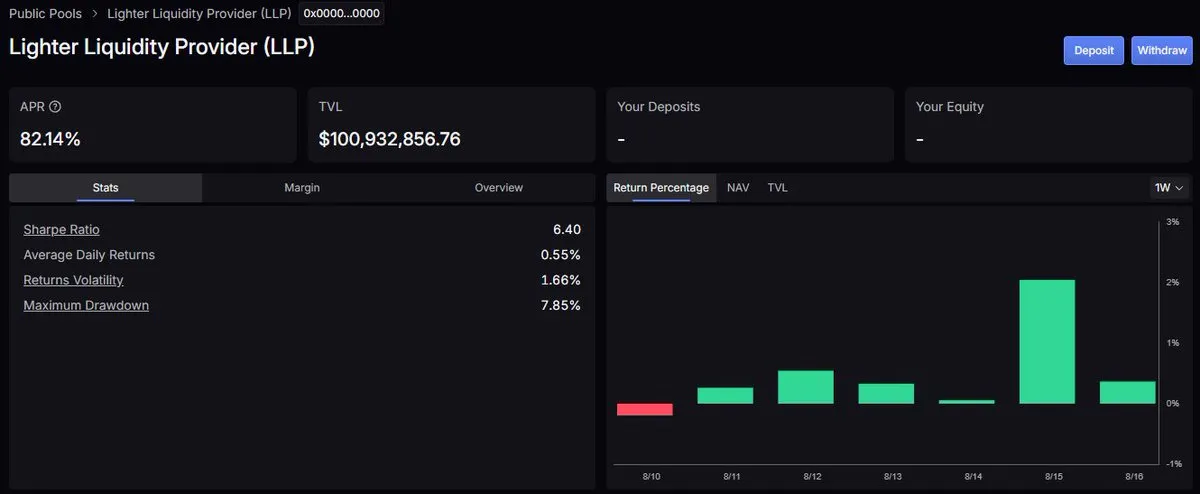
Pre-TGE, Lighter paired its points program with the LLP vault, which delivered high double-digit APY through early 2025. After TGE, $LIT became the retention layer. Staking $LIT unlocked LLP deposit capacity, waived fees for larger holders, and offered discounted trading fees.
In June, Lighter strengthened the flywheel again. All revenue buybacks are now permanently burned - starting with 15.5M $LIT (6.3% of circulating supply) - while staking targets a 6% annual yield. Leaving Lighter now means giving up LLP access, fee discounts, and staking rewards, making retention part of the token design rather than the points program. As a result, $LIT has begun reclaiming its previous all-time high range.
Bulk Trade applied the same mechanic, but to its pre-mainnet phase. Its Season 1 pre-deposit campaign pays 1 million AURA points weekly, with each wallet's share scaling by deposit size multiplied by time held. Deposits are withdrawable anytime, which removes the risk objection, but withdrawing resets your time multiplier, which makes staying the rational default. At mainnet, deposits convert directly into trading margin, and 30% of $BULK supply is committed to users. The capital is technically liquid and behaviorally locked.
Layer 5: Expansion - Referrals, influencers, communities
The best perp DEXs don't rely on a single growth channel. They combine referral campaigns with KOL management, and community initiatives so that each campaign continues generating new users after launch. The goal isn't just to buy attention. It's to build growth that compounds.
1. KOLs should build trust before reach
Not every creator plays the same role.
- Technical anchors are experienced traders who spend weeks using the product and publish honest breakdowns. Their credibility gives the community confidence to try a new venue. Connect 2-4 content creators who are builders, or educators, and publish honest breakdowns. The included criticism is what makes the endorsement credible.
- Strategy educators follow by creating trading guides, onboarding tutorials, and farming strategies. Unlike educational content, these posts help attract traders through FOMO on profits or benefits. 5-10 creators producing tweets on specific strategies can build an evergreen layer that converts for months.
- Campaign amplification comes last. Threads, articles, and clips maximize reach around fundraising, product launches, trading competitions, or token announcements. Amplification works best after trusted creators have already validated the product, giving them real experience to explain what makes it different, why it matters, and how traders can benefit.
When evaluating creators, don't optimize for follower count alone. A 40K-follower trader with a proven track record of driving funded accounts is often more valuable than a 500K-follower crypto entertainer. Trading audiences follow creators for an edge, not entertainment.
That's why, when selecting creators for perp DEX campaigns at Pink Brains, our first filter isn't follower count, it's experience promoting trading products with engagement quality and credibility. Creators who already understand perpetuals, trading psychology, be able to write actionable content deliver higher impressions, and thus converting higher-quality users than general DeFi influencers.
2. Referrals and affiliate programs with network effects
Simple invite-a-friend campaigns plateau after one invite. Hyperliquid's design compounds instead: creating a code required $100+ in personal trading volume, so every affiliate was a proven trader, and the referrer's score combined their own volume with 50% of referees' volume, so inviting dead wallets earned nothing.
Three weeks in: $9.25M in referred volume from 81 active addresses. A small number of people pass a very effective filter.
Graduate your top referrers into business relationships: custom terms, co-branded competitions, dedicated leaderboards.
Synthetix pays 25% of referee trading fees indefinitely, making the affiliate's income dependent on referee longevity. This tier is where affiliate and KOL programs merge for long-term collaboration.
3. Build locally before expanding globally
Every perp DEX eventually wants global liquidity, but communities grow locally first. Identify where your target traders are concentrated - whether that's APAC, Europe, or the US - and focus your early efforts there.
Hyperliquid nails this with localized community building with local KOLs, meetups, side events, and regional competitions creating trust far faster than spreading your budget across every market at once. Once a strong community exists in one region, it becomes much easier to expand into the next.
Layer metric: referral activation rate, referred wallets still trading at Day 30, and creator CAC against creator LTV.
4. Speculation is a new expansion layer
Prediction markets are lowkey becoming one of crypto's most powerful distribution engines. Give the market enough certainty to believe, and enough uncertainty to keep talking. Lighter's TGE generated $26.9M in Polymarket prediction volume, with airdrop odds reaching 88% before launch.
Variational's pre-market points valuation and moonsheets around Omni Points created a similar speculation loop, with traders actively pricing future rewards long before the token existed.
The lesson is simple: public token allocations, clear points-to-token conversion, and a transparent roadmap give traders, creators, and prediction markets something to debate for months. Every odds update, farming guide, and speculation thread becomes another piece of organic distribution.
Layer 6: Monetization - Expand for whales, arbitrageurs, and integrations
The monetization layer is where a small population of major players can generate most of the volume and fees, and each converts on a different offer through a different channel.
That’s why teams need to think about specific programs, not a generic VIP page. A blanket offer overpays the bottom of your base and underpays the accounts that fund the business.
The whale desk
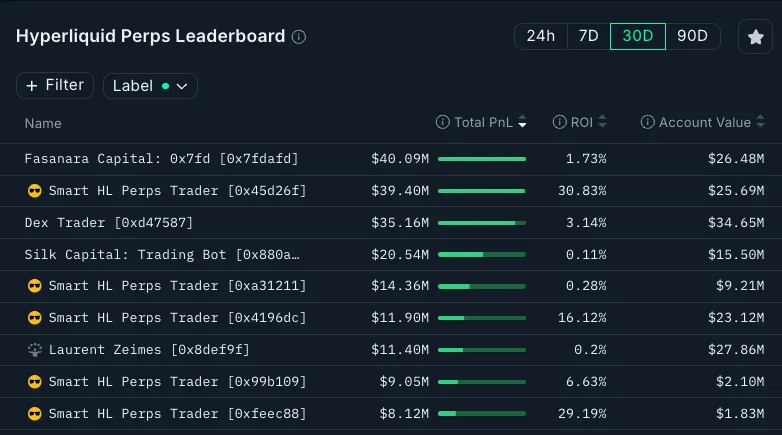
Whales and public figures bring more than volume. They tighten spreads, create onchain and social proof that attract other whales and copy traders.
Hyperliquid's flat margin meant a $100M position needed roughly $1M in collateral, against a reported $5-10M on Binance, with no auto-deleveraging and no withdrawal limits. That's whale acquisition written into the margin engine.
Beyond product design, winning whales is a business development practice:
- dedicated VIP managers
- direct team access and negotiated terms in private
- aggregate results published as content afterward
Incentives work too. Grvt paid 10% APY on balances through a 24-day window, meaningless at $500 and very meaningful at $5M.
The arbitrageur desk
Funding arbitrageurs are one of the biggest users of points programs. Pro traders use tools like Loris Tools, or Arbitrax to scan funding rate arbitrage opportunities. Rather than fighting them, design for them. Delta-neutral traders deepen liquidity while improving execution for everyone else.
Avantis' new RWA markets make it the efficient leg for cross-venue carry trades, while funding dislocations and points programs on other perp DEXs market the strategy whenever yields diverge. Just one caveat: arbitrage volume follows spreads, not brand loyalty. Measure it separately from retained users.
Trading bots / AI agents / Builder integration
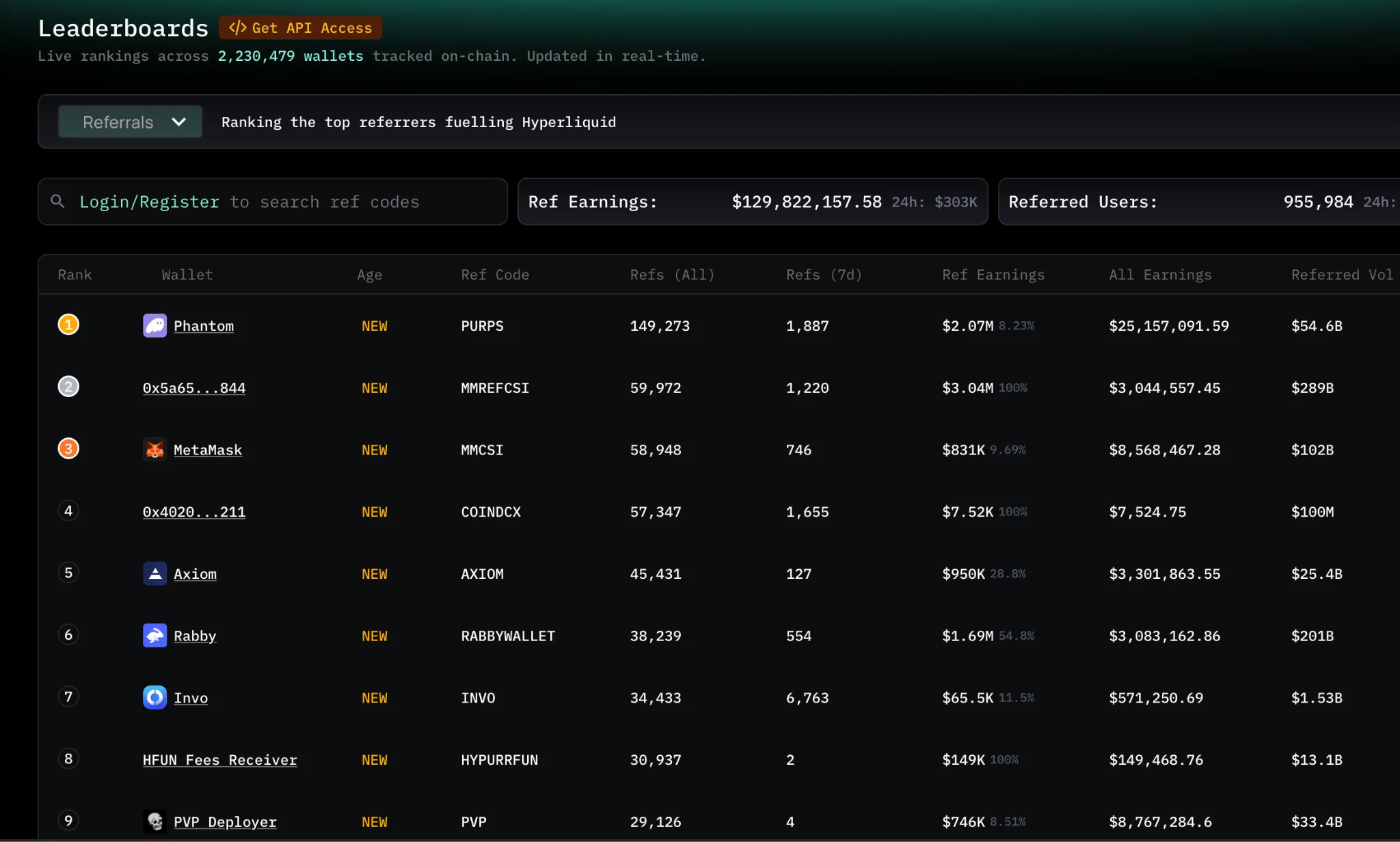
The most valuable users of perp DEXs aren't always individuals. Trading bots, crypto wallets, terminals, and AI agents generate consistent volume regardless of market conditions. More importantly, every integration brings its own users, has its own marketing channel, turning partners into acquisition channels.
Hyperliquid's Builder Codes is the best example. Apps that route trades earn up to 0.1% per fill through a user-approved, onchain revenue share, with just 100 USDC required to become a builder.
The results speak for themselves: $84M+ in builder fees generated from $265B in routed volume. Around 40% of daily active users now trade through third-party frontends in 2025-2026.
Trading bots and trading AI agents are becoming the next integration layer. If an AI agent decides where to trade, being integrated into its toolset becomes another acquisition channel.
- Fast, well-documented APIs make it easier for developers to build on your platform.
- Predictable maker rebates, competitive maker fees attract market makers because rebates are part of their trading model
- MCP servers connect your perp DEX with Claude Desktop and Cursor.
- Tools like perp-cli let AI agents compare funding rates across venues such as Hyperliquid, Lighter, Pacifica, and Aster.
Running the OS for the growing perp DEXs
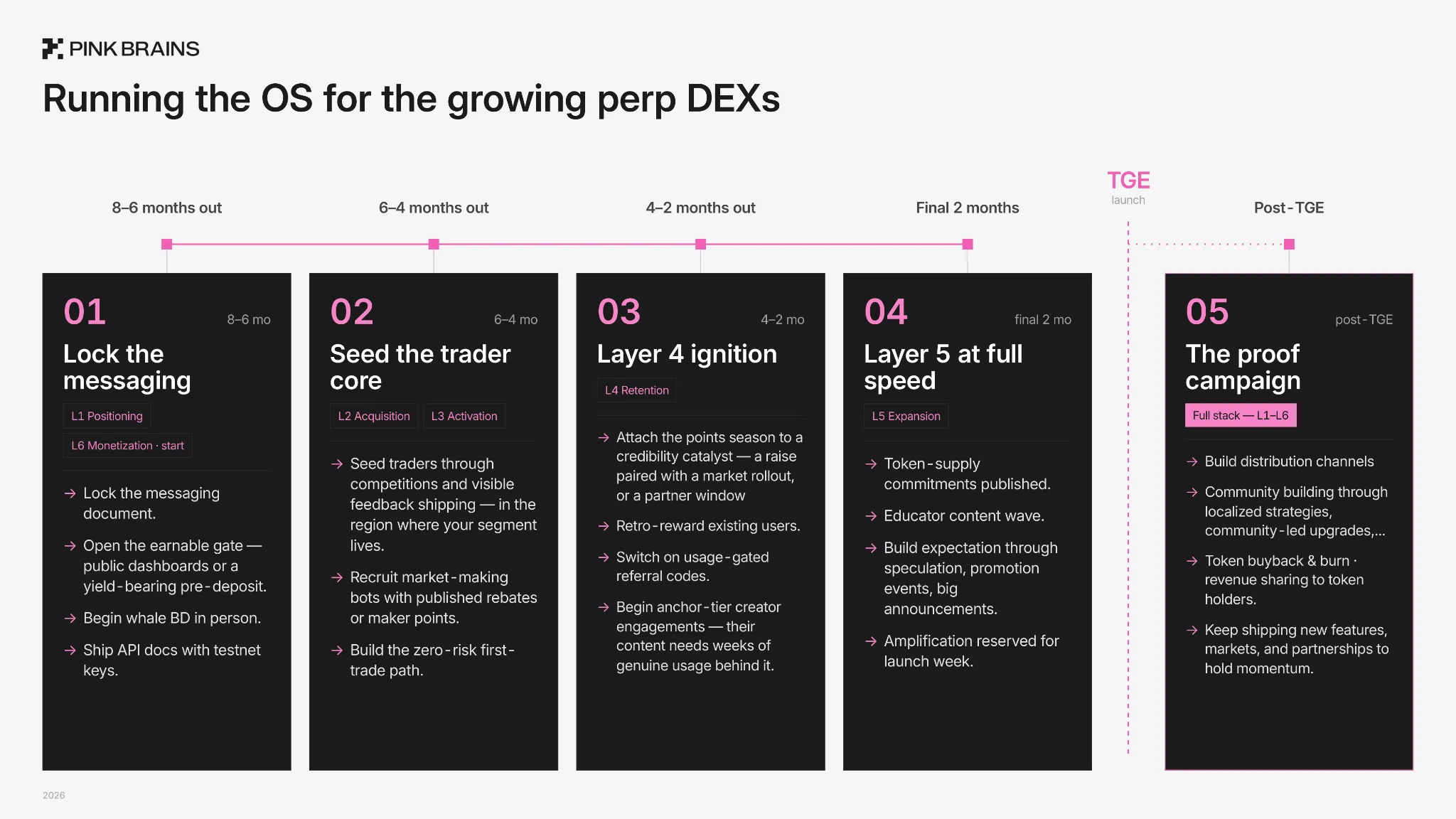
- 8–6 months pre-TGE: Lock your positioning and messaging. Open the earnable gate with points, pre-deposits, or yield. Start whale BD and launch developer APIs.
- 6–4 months pre-TGE: Grow the core trader community through point programs, competitions, rapid product updates, and a frictionless first-trade experience. Attract market makers with rebates or maker points.
- 4–2 months pre-TGE: Kick off the biggest points season alongside a credibility catalyst, such as fundraising, partnerships, or new markets. Reward early users, launch referral codes, and begin working with trusted trading creators.
- Final 2 months pre-TGE: Publish token allocation, activate educator and creator content, launch funding dashboards, and save broad campaign amplification for TGE.
- Post-TGE: Focus on retention and community building. Ship new features, expand markets, reward token holders through buybacks or revenue sharing, and keep the community engaged with localized initiatives and continuous product improvements.
Conclusion
No single campaign builds a successful perp DEX.
The breakout perp DEXs of 2025 and 2026 combined every layer. They built a story traders could easily repeat, launched in a way that felt like an event, removed friction from the first trade, rewarded consistent participation through seasons, turned creators and communities into distribution channels, and designed programs for the traders who generated most of the volume.
Above all, growth compounds when marketing and product reinforce each other. Marketing gets traders through the door. The product determines whether they come back.
The next 12 months will put every growth strategy to the test. edgeX and Grvt have their TGE, Variational, StandX, and many others are still running live pre-token programs. The winners can be recognized by the biggest rewards pool, the loudest marketing campaign or airdrops. A TGE is only the starting line. Most tokens will decline afterward. Long-term winners are teams with good product, a well-designed growth OS, and a tokenomics that values its holders.
This article serves informational purposes only and does not constitute financial advice. Conduct your own research before making decisions.

.png)

%201%201.png)