What Is Monad? Top 6 Monad Apps to Earn On
7 mins

I bridged assets to Monad the week after mainnet launched, mostly out of curiosity. Almost a year later, Monad's DeFi TVL sits at about $760 million, daily DEX volume has swung between about $30 million and $80 million around the token unlock, and I'm still finding new apps worth testing every week.
Monad isn't just another "Ethereum killer" pitch, it's a functioning high-speed EVM chain with a growing ecosystem of apps, many of which rewarded early users through the Monad Momentum incentive program.
Here's real user experience using Monad, which apps are worth your time, and where the earning opportunities are now in the ecosystem.
What Is Monad and What Makes It Different From Other EVM Chains?
Monad is a Layer 1 blockchain that runs the Ethereum Virtual Machine but processes transactions in parallel, hitting up to 10,000 TPS with finality under one second. For users, that means swaps confirm before you've even switched tabs, and gas fees are essentially negligible.
What makes Monad genuinely different isn't the spec sheet, it's the UX. When I first connected my MetaMask wallet and tried a swap on Kuru, I kept refreshing because I thought the transaction hadn't gone through. It had. The confirmation was so fast that I assumed it was still pending. Coming from Ethereum mainnet or even some L2s where you wait a few seconds and watch the spinner, this felt jarring in the best way.
The chain launched on November 24, 2025, after Category Labs (formerly Monad Labs) raised over $225 million from Paradigm, Coinbase Ventures, Dragonfly Capital, and others. The public token sale on Coinbase's platform raised roughly $269 million from more than 85,000 participants — the first token sale conducted through Coinbase's ICO platform. The chain went live with native USDC support, Chainlink Data Feeds, LayerZero cross-chain messaging, and wallets like MetaMask and Rabby all working out of the box (Phantom dropped Monad in August 2026).
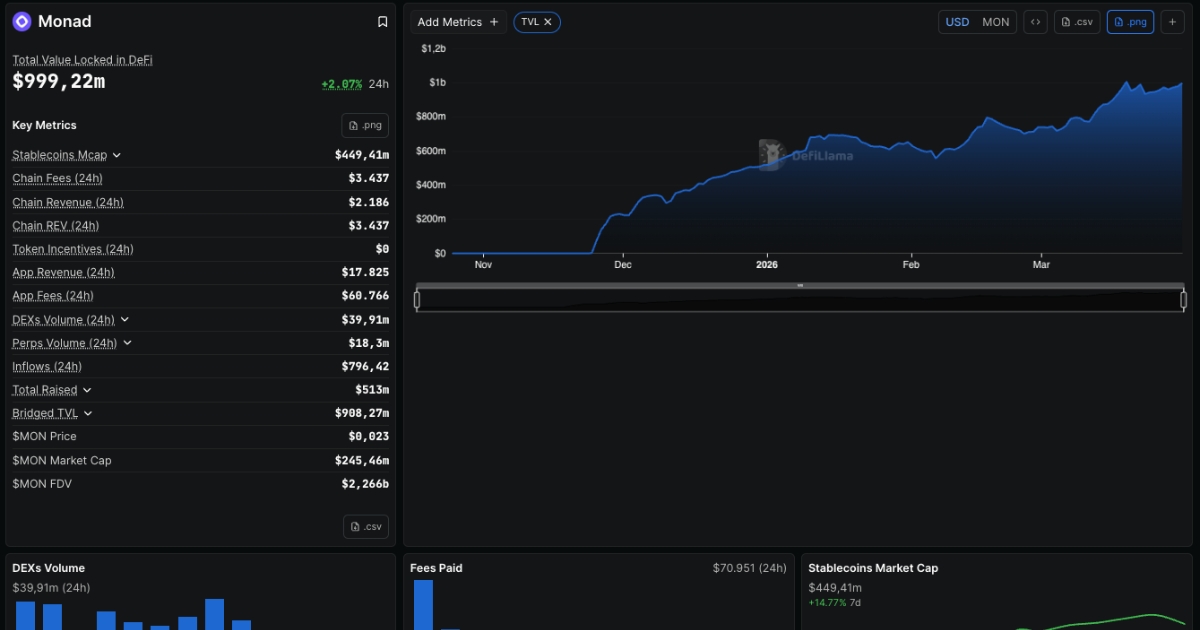
Monad's DeFi TVL sits at about $760 million, with a stablecoin market cap of about $567 million (DefiLlama, as of November 25, 2026). Daily DEX volume has swung between about $30 million and $80 million in late November 2026, around the token unlock (DefiLlama). MON trades around $0.01 (CoinGecko, November 25, 2026), less than half its $0.025 public sale price. The gap between ecosystem activity and token price is something worth paying attention to.
Why the Monad Ecosystem Is Worth Exploring Now
Monad's official App Hub lists 144 apps spanning DeFi, gaming, AI, prediction markets, and NFTs. Blue-chip protocols like Uniswap V4, Curve, and PancakeSwap are live alongside Monad-native projects that were built specifically for the chain's speed advantages.
Another reason the ecosystem gained traction is Monad Momentum — the Monad Foundation's incentive matching program. Unlike traditional grants that just hand money to dev teams, Momentum required teams to invest their own resources into user acquisition first, then matched their spend up to 1:1 with MON tokens. This skin-in-the-game model meant the projects selected for Momentum were the ones most serious about building real traction, not just farming a grant and disappearing.
Wave 1 applications closed in October 2025. Wave 2 applications closed at the end of December 2025, and the program has now ended. Most of the projects below ran Momentum reward campaigns.
If you are still not convinced, just look at the growth of TVL and volume on the chain. Compare to other emerging chains like MegaETH, or Plasma, Monad is definitely outperforming with real onchain activities on native apps, which signals users' interests to the ecosystem.
Gotta say sorry to Monad:I FUDed it after the launch for failing to attract TVL, dapps, and users, especially after such a hyped TGE.I also thought MegaETH’s successful launch would put even more pressure on Monad.Yet MegaETH’s slow growth is a redemption for Monad.It’s fair play for both when the market rebounds. I also think Monad could explore more incentive campaigns.Especially because MegaETH’s points campaign should launch soonish too. Source: DeFi Ignas
The Monad Ecosystem at a Glance
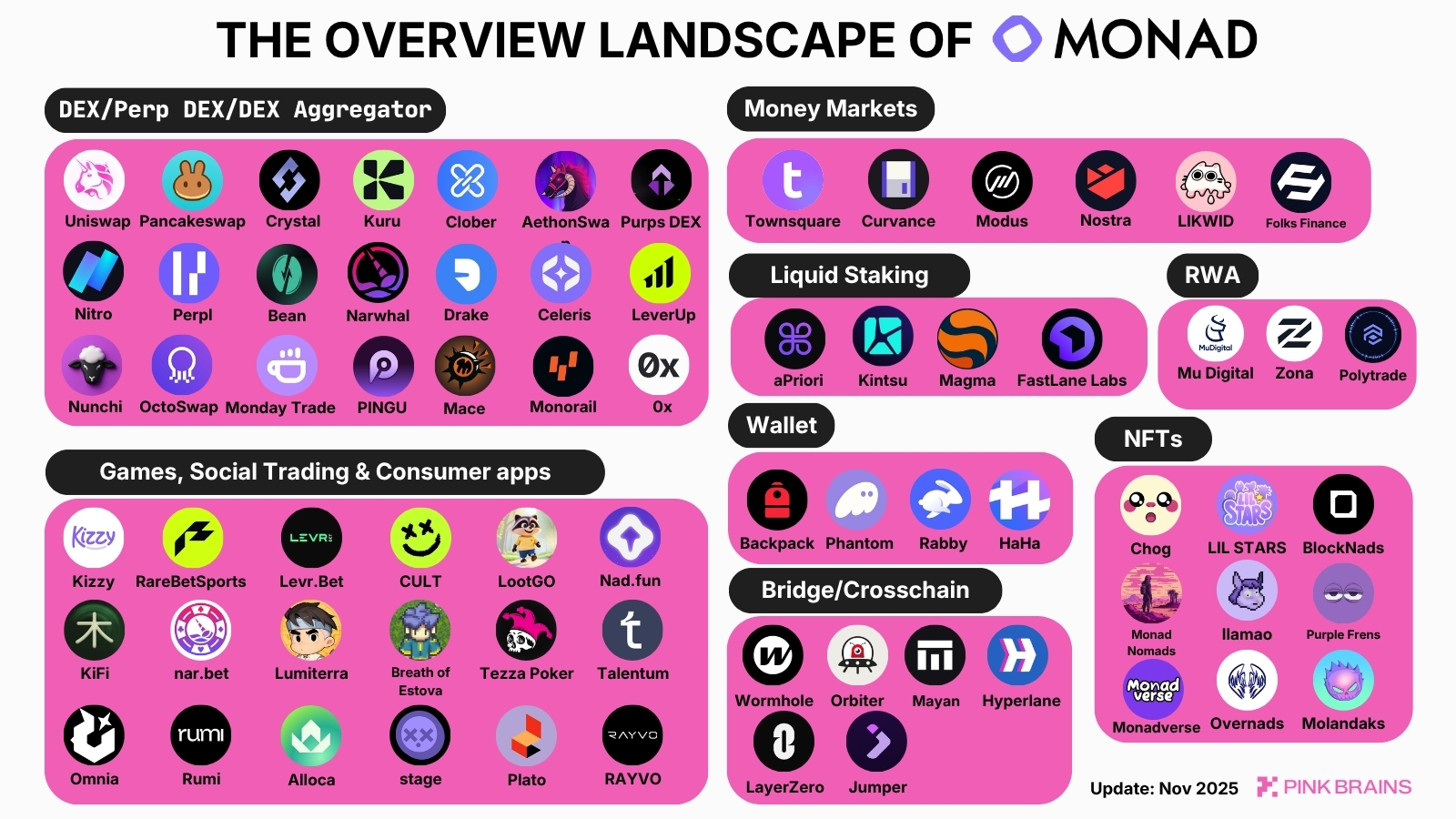
The ecosystem is broader than most people realize. Beyond the Momentum apps, you've got:
Liquid staking through aPriori and Magma. Spot DEXs like Kuru, Clober, and Crystal. Perpetual DEXs including Drake, Monday Trade, Perpl, and LeverUp. Lending through Curvance and TownSquare. DEX aggregators like Monorail. Betting and sports prediction apps like Kizzy and Levr Bet. Plus gaming, NFTs, and early RWA tokenization plays.
It's not a ghost chain — though critics have pointed to low onchain fees (around $2,000 daily at some points) as a concern. That's a fair flag. The tension between impressive TVL numbers and modest fee generation is something worth watching closely. High TVL with low fees could mean a lot of parked capital that isn't actively transacting.
Top 6 Apps to Earn on Monad
These are the projects I've found most worth testing, most of which ran Momentum reward campaigns, and all six are still live on Monad as of November 2026. Momentum itself has ended, so check each app's current promos before you deposit.
1. Kuru Exchange
Kuru is building a fully onchain Central Limit Order Book (CLOB) — essentially trying to replicate the CEX trading experience but decentralized. Backed by Paradigm, it's the most credible spot DEX native to Monad. The order book feels responsive in ways that similar attempts on slower chains never could. Rewards started in the first week of mainnet.
When you place a limit order on Kuru, it is filled within a block. The spread on major pairs was tighter than I expected for a chain this young. The UI is clean but still minimal. But don't expect the Binance dashboard yet, but the execution is legitimately fast.
[Screenshot opportunity: Kuru order book interface showing spread and confirmation time]
2. Drake Exchange
A perpetual trading platform offering up to 50x leverage on crypto markets. If you've used GMX or Hyperliquid, the concept is familiar — but Drake is betting that Monad's speed gives it an edge on execution latency. Connect your wallet, deposit funds, and trade directly for points and rewards.
3. Kizzy
A Monad-native casino and sportsbook that started as a social media betting app (bet on creators' YouTube and X stats). Deposits are in MON. KYC is required, and availability depends on your country. Play at kizzy.io.
4. Lumiterra
An MMO sandbox game with AI-driven agents, plus a separate product called Lumipad for AI agent launching. The gaming angle sets it apart from pure DeFi plays. This is the kind of app that specifically benefits from Monad's speed — in-game transactions need to feel instant, and they do here.
5. Levr Bet
Leveraged sports prediction markets, with 2x–5x on single-game lines across the NFL, NBA, NHL, college sports, soccer and more. The "leveraged" part is what makes it interesting — you're not just predicting, you're sizing positions with varying risk/reward. It's live at levr.bet.
6. Monday Trade
An all-in-one DEX native to Monad for spot, perps and tokenized-stock (RWA) trading, aiming to pair the simplicity of decentralized swaps with centralized-exchange depth. Trade at app.monday.trade.
Other Projects on My Radar
- TeleMafia: a Telegram-based mafia game where you build your family and compete for rewards.
- FluffleWorld: a cozy island-building and habit-forming game where you earn by staying active and consistent.
- Bro.fun: a social engagement platform where completing simple tasks earns points and potential rewards.
- Kinetik AI: a decentralized platform for tracking and monetizing IP data through AI-powered analytics. Users can sign up with their email and wallet to position for early rewards and airdrops.
What I Learned the Hard Way
I wanted to get positioned across Monad's top ecosystem apps early, deposit stablecoins, and start accumulating points and rewards before the crowd showed up.
The Friction: Bridging was my first headache. I used the LayerZero-powered bridge expecting a straightforward transfer, but the initial wave of bridging activity created congestion that slowed things down. The official bridge experience has since improved, but during the first few weeks, a big chunk of bridged assets actually flowed right back out — analysis from Blockworks noted that roughly 75% of assets bridged in during the early weeks rotated back to other chains. That farm-and-rotate behavior made the early liquidity numbers unreliable.
The other friction point is MON's price. If you bought MON at the $0.025 public sale price, you watched it spike to nearly $0.049 two days after launch. It hit an all-time low of about $0.0091 on November 24, 2026 (UTC), the day of the unlock. MON trades around $0.01 (CoinGecko, November 25, 2026), less than half its $0.025 public sale price. That's a reality check for anyone expecting instant returns from the token itself. The ecosystem has held up far better than the token.
So my advice is to stop watching the MON chart and focus on using the apps to maximize rewards. Points, rewards, and positioning for native token airdrops from these apps are where the real upside is right now, instead of trading MON.
For bridging assets to Monad, I switched to using Jumper Exchange for cross-chain swaps and bridging, which aggregates multiple bridge routes and found cheaper, faster paths than going direct.
[Screenshot opportunity: Bridge comparison — official bridge vs. aggregator showing time/cost difference]
How to Get Started on Monad
Setting up on Monad is genuinely straightforward if you've used any EVM chain before.
Getting started with Monad is straightforward, especially since it supports the same tools and wallets that most crypto users are familiar with. Here’s a quick guide to get set up and start earning across Monad's apps.
1. Set Up a Wallet and Connect to Monad
Monad is fully EVM-compatible, so you can use popular crypto wallets such as MetaMask, Rabby, Backpack Wallet, and OKX Web3 Wallet (Phantom dropped Monad in August 2026).
2. Bridge or Transfer Assets to Monad
Transferring cross-chain assets like USDC to Monad will be simple through several major bridges and cross-chain platforms. Supported options include Wormhole, LayerZero, Hyperlane, Mayan Finance, and Orbiter Finance. You can also use Jumper Exchange, which aggregates multiple bridges to help you move tokens across chains seamlessly.
Before bridging, always confirm bridge links from Monad’s official website or verified social channels to stay safe from phishing attempts.
3. Explore Monad Apps and Join Early
After your wallet is set up and funded, you can start exploring Monad apps and their current reward programs:
- Visit featured apps on Monad App Hub
- Connect your wallet and complete any onboarding steps.
- Use access codes where required
- Join the project’s Discord or Telegram group to stay updated on reward activities.
Early participation helps you experience Monad’s fast performance firsthand while earning rewards and points from ecosystem apps.
What to Watch Next
Here's the honest picture. Monad's technology is legitimately impressive — the speed and UX are the best I've experienced on any EVM chain. The ecosystem keeps growing, with 140+ apps on Monad's official App Hub and serious infrastructure partnerships. TVL has roughly doubled since late May 2026, even in a bear market, though it has slipped from its early-October peak.
But there are real risks. MON is trading below the public sale price. A large token unlock began on November 24, 2026, when team and investor allocations (roughly 47% of total supply) started releasing after a one-year cliff. About 16.6 billion MON unlocked that day, more than the roughly 11.8 billion already in circulation, with monthly investor and treasury unlocks and ongoing team vesting continuing through 2029. That overhang will create sustained sell pressure unless ecosystem demand grows fast enough to absorb it. And with only about 200 validators, Monad is less decentralized than Ethereum and hasn't been stress-tested through a major market crisis yet.
I'm keeping my positions active across the top Monad apps. The play right now isn't MON price appreciation — it's earning rewards, points, and positioning for native app token airdrops before the ecosystem matures and the easy opportunities disappear. If the fee switch governance vote or any major ecosystem catalyst changes the thesis, I'll reassess.
The chain is fast, the apps are real, and the early-user incentives won't last forever. That's the window.
FAQ
Is it too late to earn the Monad MON airdrop?
The original MON airdrop for testnet users has ended. However, several Monad apps run points programs that could lead to their own token airdrops, though none are guaranteed. Using those apps is the most direct way to position yourself.
What wallets work with Monad?
Any EVM-compatible wallet works — MetaMask, Rabby, Backpack, and OKX Wallet are all confirmed, while Phantom dropped Monad support on August 26, 2026.
How do I bridge assets to Monad?
You can use Wormhole, LayerZero, Hyperlane, Mayan Finance, Orbiter Finance, or Jumper Exchange. Native USDC is supported from launch through Circle's integration, making stablecoin transfers straightforward.
Is Monad safe to use?
Monad's client is open-source under a GPL-3.0 license and has been audited. The chain uses MonadBFT consensus and has about 200 active validators. That said, it only launched in November 2025 and hasn't been battle-tested through extreme market conditions. Use standard DeFi caution — don't deposit more than you can afford to lose, verify contract addresses, and always check official links.
How fast is Monad compared to Ethereum?
Monad processes up to 10,000 transactions per second with 300-millisecond blocks and finality in about 600 milliseconds, compared to Ethereum's roughly 15 TPS and 12-second block times. In practice, transactions on Monad confirm almost instantly — it feels closer to using a centralized exchange than a blockchain.
What is Monad Momentum?
Monad Momentum was an ecosystem incentive matching program run by the Monad Foundation. It required selected app teams to invest their own resources into user acquisition, then matched their spend with MON tokens up to 1:1, so users of selected apps earned boosted rewards funded by both the project and the Monad Foundation. The program has now concluded.
Disclaimer: This article is for informational and educational purposes only. It is not financial advice. DeFi protocols carry risk including smart contract bugs, liquidity issues, and market volatility. Always do your own research before depositing funds into any protocol.