Best Crypto Wallets in 2026: Top 7 Reviewed and Rated
8 mins

Picking a crypto wallet in 2026 is harder than it should be. Every wallet now wants to be a bank, a brokerage, and a rewards program at the same time - and the marketing makes them all sound identical. Meanwhile, the actual differences that matter (who got exploited last quarter, whose swap quotes hide a spread, whose rewards program is real money rather than points theater) rarely make it into listicles.
We've been tracking this market through the current cycle, reading what users actually say on Reddit, X, and Trustpilot rather than what the wallets say about themselves.
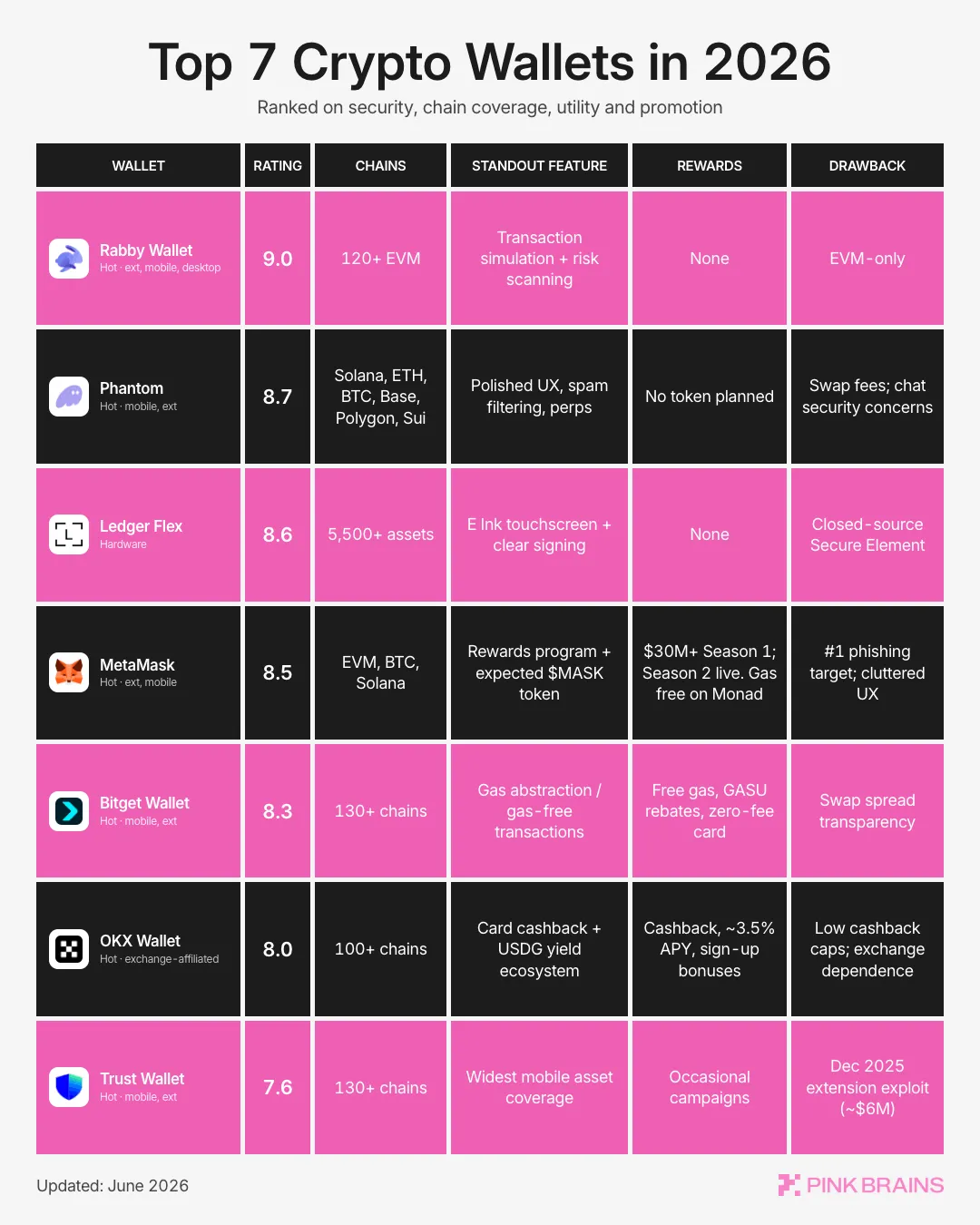
This is our honest ranking of the top 7 crypto wallets in 2026 rated out of 10, with the reasons spelled out.
The Crypto Wallet Market in 2026: What Has Changed
The crypto wallet market in 2026 is defined by three forces: wallets evolving into full financial apps with crypto cards and neobanks, exchange-backed wallets squeezing independent wallets on fees and incentives, and a security arms race against AI-driven phishing and browser-extension exploits.
Choosing a wallet now means choosing an ecosystem, not just a key manager.
The scale is real. Global active wallets passed 820 million in 2025 according to CoinLaw data, and the wallet market itself is projected to grow from roughly $15 billion in 2026 to nearly $99 billion by 2034. Flag those projections as directional - market sizing reports vary wildly - but the trend isn't in dispute: wallets are where crypto users actually live now, and everyone wants that real estate.
Three shifts shaped this list.
1. Wallets became neobanks.
MetaMask shipped a Mastercard-linked card and perps trading. Phantom launched a debit card and integrated Hyperliquid perps. OKX pays stablecoin yield and card cashback. The "wallet" label undersells what these apps do, and expands what can go wrong.
2. The incentive wars went nuclear.
Crypto wallet is a saturated market already. When the features are basically the same among competitors, top companies are fighting for users using promotions, either airdrops, incentives, yields, gas free or cashbacks. Free money is genuinely on the table in 2026, but it comes with strings, mostly in the form of volume requirements and ecosystem lock-in.
3. Security got worse before it got better.
Trust Wallet's browser extension suffered a vulnerability in December 2025 with losses ZachXBT estimated at above $6 million. Ledger disclosed another customer data breach in January 2026. Scammers are now mailing physical letters with QR codes to hardware wallet owners. The wallets that invest in transaction previews and scam detection are visibly pulling ahead in user trust. Surveys show 76% of US crypto owners rank security as their top factor in wallet choice.
So what does this mean for your shortlist? It means the right question isn't "which wallet is best" - it's "best at what, and what's the catch."
Here's the top 7 crypto wallets in 2026 based on our thesis.
How We Rated Crypto Wallets
Each wallet is scored out of 10 across six factors: security track record, product depth, ecosystem and chain support, rewards and incentives, customer support, and real user sentiment pulled from Reddit threads, X discussions, and review platforms. We weighted security and honest user feedback heaviest. A flashy feature set doesn't offset a fresh exploit or a pattern of support tickets going into a void.
One note on method: user counts and download figures below come from public trackers and company disclosures, which don't always agree. Where sources conflict, we've used the more conservative figure or noted the range.
1. Rabby Wallet: The DeFi User's Wallet (9.0/10)
Rabby Wallet is the best crypto wallet for active DeFi users in 2026. Built by the DeBank team, it's open-source, audited, and designed around one insight: most wallet losses come from signing bad transactions, not from broken cryptography. Rabby simulates every transaction before you sign and shows exactly what leaves and enters your wallet.
That pre-signature clarity is why Rabby keeps winning converts on crypto Twitter and r/ethfinance on Reddit. The wallet decodes contract interactions into plain language, flags risky approvals, auto-switches chains based on the dApp you're using, and includes a built-in approval revoker - the single most underrated security tool in DeFi, given that unlimited token approvals remain the top exploit vector. It supports 120+ EVM chains and pairs cleanly with Ledger and Trezor for cold storage signing, which is the setup most serious DeFi users we've observed have converged on.
One of the my most favorite feature on Rabby is Gas Account - a cross-chain gas abstraction feature that lets users pay transaction fees across 100+ EVM networks using a single USDT/USDC balance. It means you don't need to hold native gas tokens like ETH, AVAX, or POL on each chain. Just fund your Gas Account with stablecoins, the wallet will automatically deduct gas fees from it.
Rabby is EVM-only, so Solana, Sui, Bitcoin, and TRON users need a second wallet. There's no rewards program, no card, no points, which some users frame as a feature, not a bug. And its 2022 Rabby Swap contract exploit, while scoped to the swap feature and long since patched, is a reminder that even security-first products have history. Audits from SlowMist and Least Authority (most recently September 2025) back up the current posture.
Best for: EVM DeFi users who sign transactions daily.
Skip if: you live on Solana, hold Bitcoin or want one wallet for everything.
2. Phantom: The Best All-Around Crypto Experience (8.7/10)
Phantom is among the top picks if you're looking for an all-in-one crypto wallet in 2026, serving roughly 17 million monthly active users and holding about 39% of the Solana wallet market per CoinLaw data. It now covers Solana, Ethereum, Bitcoin, Base, Polygon, and Sui, with over $25 billion in self-custodied assets and a $3 billion valuation.
What make Phantom the go-to wallet for onchain activity is that it feel like a consumer app that meet everyday crypto users' needs.
- The token spam filtering quietly hides malicious airdrops before you can fat-finger them.
- The intent-based swap routing finds efficient paths across DEXs automatically.
- Perps trading via the Hyperliquid integration turned the wallet into a trading terminal. Phantom is the leading builder by revenue on Hyperliquid with over $20M in revenue since launch.
- Oobit integration in early 2026 adds one-tap Visa-rail payments straight from self-custody.
- Phantom also offers native staking delegates SOL directly to a validator of your choice. Then there's PSOL, Phantom's liquid staking token: your SOL is pooled across validators, and PSOL shares MEV tips and priority fees on top of base staking rewards, which is why its average yield runs higher than native staking, now at 6.11% APY.
- The newly launched Phantom Terminal - the advanced desktop trading platform - combines pro-grade charts, onchain trading, and native wallet integration in one interface.
- Phantom Prediction Markets powered by Kalshi.
- Phantom doesn't need a card to enable onchain payment. Phantom Cash is a built-in payments and stablecoin feature inside the Phantom wallet that lets users hold, send, receive, and spend a USD-pegged stablecoin (CASH) for everyday transactions. It combines onchain transactions with traditional payment features like bank transfers and a debit card. The revenue speaks itself.
The other side of the coin: Phantom's swap convenience carries fees that power users grumble about, and the announced Phantom Chat messaging feature has already drawn security criticism ahead of its 2026 rollout. When a crypto wallet adds social features, it means expanding the attack surface, and the community has been vocal about it.
Phantom is also fighting a structural war against exchange wallets with deeper incentive budgets; CEO Brandon Millman has publicly ruled out a token in the short term, which removes the airdrop-farming incentive some users want.
Best for: Active users on Solana, Monad, Bitcoin, sometimes on EVM and anyone who wants one clean app for everyday onchain activity.
Skip if: you're optimizing for lowest swap costs or farming token incentives.
3. Ledger Flex: The Standard for Cold Crypto Wallet (8.6/10)
Ledger Flex is the best hardware wallet for most people in 2026. It is Ledger's next-generation hardware wallet positioned between the Nano X and the premium Stax. It combines offline key storage with a larger touchscreen experience for managing crypto and digital identities.
What Ledger Flex can do is impressive:
- The secure E Ink touchscreen is driven directly by the EAL6+ certified Secure Element, creating a trusted display malware can't spoof. You can review and approve transactions directly on a large, highly readable display instead of using small buttons. The screen is driven by Ledger's Secure Element chip for "clear signing."
- Offline private key storage: Your private keys never leave the device, helping protect assets even if your computer or phone is compromised.
- Bluetooth, USB-C, and NFC connectivity: works with desktops, smartphones, and tablets through the Ledger Live app.
- Support for thousands of assets: compatible with 5,500+ cryptocurrencies and tokens, including major assets like BTC, ETH, SOL, and USDT, as well as Ethereum- and Polygon-based NFTs.
- Recovery and backup: Ledger Flex Includes the standard Ledger recovery phrase system, allowing you to restore your wallet if the device is lost or damaged.
- Ledger Security Key / Passkey support: can also function as a secure authentication device for online accounts using modern passkey standards.
The device anchors an ecosystem - now rebranded Ledger Wallet, with new Multisig tooling - that over 8 million sold devices feed into. No Ledger device has been remotely hacked in over a decade.
That device-level record is why Ledger stays on this list. The reason it isn't higher comes down to everything around the device. Ledger suffered another customer data breach in January 2026. No funds or seeds were compromised, but names and contact details of customers were exposed again, following the infamous 2020 leak. Those leaked databases are exactly what's fueling the physical-letter scams now landing in users' mailboxes with fake "mandatory verification" QR codes. The Ledger Recover service also still divides the community; the trust hit among power users from 2023 never fully healed.
On the day-to-day side, user complaints in 2026 cluster around the companion app feeling bloated and slow on large portfolios, and support response times that test patience - neither Ledger nor Trezor offers 24/7 live chat. If full open-source auditability matters more to you than coin coverage, Trezor's Safe 7 with post-quantum readiness is the credible alternative.
Best for: anyone holding more than they'd be comfortable losing from a hot wallet.
Skip if: you expect the company's data handling to match the device's security.
4. MetaMask: The Most-used Crypto Wallets by Users (8.5/10)
MetaMask is the most widely used self-custody wallet in 2026, with over 30 million monthly active users and total accounts reported north of 100 million. It's no longer Ethereum-only: native Bitcoin and Solana support arrived alongside the long-standing EVM coverage, plus perps trading, the mUSD stablecoin, and the Mastercard-linked MetaMask Card.
What MetaMask has shipped through late 2025 and into 2026 is a different product from the one users spent years complaining about.
- The redesigned mobile app is noticeably faster, with network fees baked directly into swap quotes and bridging built into the swap flow instead of bolted on.
- Perps trading, powered by Hyperliquid, runs natively in the wallet with up to 50x leverage across 150+ tokens plus US stocks, commodities, and currencies, funded with any EVM token and no KYC (though notably unavailable in the US and UK).
- MetaMask Card went nationwide in the US this year, letting you spend self-custodied crypto anywhere Mastercard works.
- Transaction Shield, a subscription covering eligible transactions up to $10,000 a month with priority support, is a genuinely novel answer to the "who do I call when something goes wrong" problem that's haunted self-custody forever.
- MetaMask Prediction Markets, powered by Polymarket.
- mUSD is MetaMask’s native stablecoin, built for native spending, swapping, bridging, and low-cost fiat access across the MetaMask Swap, Bridge Card, and Perps.
The big 2026 story is incentives. Rewards Season 1 distributed over $30 million in LINEA tokens between October 2025 and January 2026, points now carry into Season 2, and a MASK token - confirmed by ConsenSys CEO Joseph Lubin - is widely expected in the Q3-Q4 2026 window. For active traders, MetaMask is currently the highest-expected-value wallet to route perps volume through mUSD for more rewards. If you're exploring Monad, the most high-performance EVM layer 1, MetaMask now offers free gas for all transactions on the network.
Now the catch, and it's not small. MetaMask's dominance makes it the single biggest phishing target in crypto: January 2026 alone saw a wave of fake "2FA update" email campaigns designed to harvest seed phrases, and Rewards/airdrop hype has spawned an entire industry of fake claim sites.
Longtime users on Reddit also flag the same frictions they've flagged for years - clunky gas estimation, an interface that's accumulated features faster than coherence, and support that's hard to reach when something breaks. MetaMask works best paired with a hardware signer, and increasingly, users run Rabby alongside it for the transaction clarity MetaMask still lacks.
Best for: Active DeFi users and active multi-chain traders.
Skip if: you're new enough to crypto that a convincing phishing email might catch you on a bad day.
5. Bitget Wallet: The Exchanged-backed Multi-chain Crypto Wallet (8.0/10)
Bitget Wallet's standout feature in 2026 is gas abstraction: pay fees in USDT, USDC, ETH, or BGB across 14 networks via GetGas, with fully gas-free daily transactions on chains including Base, Arbitrum, Solana, TRON, and Polygon. For multi-chain users tired of keeping dust balances of native tokens on eight networks, this is the most genuinely useful promotion in the wallet market.
The numbers behind it are substantial. The wallet claims 80-90 million users, supports 130+ blockchains, and has waived gas on hundreds of thousands of transactions. New users get their first GetGas deposit fee waived entirely, first USDT transfers on TRON are free, and GASU tokens earned through activity reimburse gas after the fact. Add MPC-based keyless recovery, MEV-protected swap routing through its Super DEX, a zero-fee card, and a $700 million protection fund, and the package is legitimately competitive.
Here's where it gets less shiny. The most consistent user complaint - and it shows up repeatedly in reviews and forum threads - is undisclosed spread on some swap quotes, particularly on TRON-to-Ethereum bridge routes, where the received amount lands below what the quote implied. Compare estimated versus actual before confirming, every time. And as an exchange-affiliated wallet, its incentives ultimately serve the Bitget ecosystem; the free gas is an acquisition cost, not charity.
Best for: multi-chain users who hate gas management and want one mobile app for everything.
Skip if: you want maximum quote transparency on every swap.
6. OKX Wallet: The Strongest Exchange-Backed Package (7.9/10)
OKX Wallet is the most complete exchange-affiliated wallet in 2026, pairing a non-custodial multi-chain wallet and DEX aggregator with the broader OKX ecosystem: card cashback paid in USDG, stablecoin yield around 3.5% APY on USDG balances, and an aggressive promotions engine. Money magazine named it best overall this year, and the product depth justifies the attention.
What we've seen pull users in is the full-stack convenience: the DEX aggregator routes well, the wallet connects cleanly to the exchange, and the OKX Card works through Apple Pay and Google Pay anywhere Mastercard is accepted. The referral and rewards machinery is constant - mystery boxes, fee rebates up to 30%, deposit bonuses - and the Web3 referral program pays up to 50% of referee trading fees. You can also plug in OKX Wallet's skills to AI agents like Claude to support analysis, trading and DeFi transactions.
The fine print matters, though. Card cashback is capped monthly, and the gap between tiers is steep. Regular users hit a low cap quickly, while meaningful caps require six-figure VIP balances. The USDG yield dropped from 4.1% to 3.5% in February 2026 following Fed rate cuts and sits slightly below comparable USDC rewards elsewhere.
And the deeper you integrate, the more your "self-custody wallet" functionally orbits a centralized exchange, which is precisely the dynamic that's been squeezing independent wallets all cycle. Whether that bothers you is a personal call; it's worth making consciously.
Best for: users already in the OKX ecosystem who'll actually use the card and yield.
Skip if: you want your wallet fully independent of any exchange.
7. Trust Wallet: The Best Crypto Wallet for Mobile Use (7.6/10)
Trust Wallet remains the most downloaded crypto wallet in the world with over 200 million downloads, roughly 17 million monthly active users, and support for 130+ blockchains with millions of assets. For mobile-first users in emerging markets who need one app covering everything from BNB Chain to obscure long-tail tokens, nothing matches its breadth.
The security story cuts both ways, and we'll give you both sides. Trust Wallet's Security Scanner blocked over $191 million in transactions to known scam addresses in 2025 - real, measurable protection most wallets don't offer.
However, in December 2025, a vulnerability in its browser extension (v2.68) led to losses ZachXBT estimated above $6 million across hundreds of users. The mobile app wasn't affected, and the company responded with an advisory, but an exploit in a flagship product's extension is exactly the kind of event our rating has to price in. It's the second notable flaw in the product's history after the 2022 WebAssembly issue.
User sentiment reflects that split: mobile users are largely happy with the interface, built-in staking, and cash deposit features, while the more technical crowd on Reddit has cooled on it, and customer support complaints - slow responses, templated replies during the December incident - were loud. Trust Wallet is still a defensible default for mobile, but pair it with a hardware wallet for anything substantial, and treat the extension with caution until it rebuilds its track record.
Best for: mobile-first users with diverse, multi-chain portfolios.
Skip if: you primarily work from a desktop browser extension.
Which Crypto Wallet Should You Have?
Our advice for crypto users in 2026 is more than one wallet: a hardware wallet for long-term holding, and probably a few more hot wallets for degen actions like trading meme coins, or testing new apps or farming airdrops. Around 87% of crypto investors already use more than one wallet, and the security data says they're right to.
In practice, the pairings write themselves. EVM DeFi user: Rabby plus a Ledger or Trezor signer. Solana-native: Phantom, with cold storage for the long-term bag. Volume trader chasing incentives: MetaMask routed through a hardware wallet while the $MASK question resolves. Mobile-only and multichain: Bitget Wallet or Trust Wallet, with the caveats above.
What we'd watch from here: whether MetaMask's token actually lands in Q3-Q4 and how generous the allocation is, whether Phantom's payments push gets real traction before exchange wallets out-spend it, and whether the extension exploit pattern - Trust Wallet was the victim this time - repeats elsewhere. Wallet choice in 2026 isn't a one-time decision. It's a position you should re-check every cycle.
FAQ
Which is the safest crypto wallet to store Bitcoin? A hardware wallet is the safest option for storing Bitcoin long-term - the Trezor Safe 7 and Ledger devices keep your keys offline, and no major hardware wallet has ever been remotely hacked. If you need a hot wallet for active Bitcoin use, MetaMask, Phantom, and Trust Wallet all added native BTC support, but anything you wouldn't accept losing belongs in cold storage.
What is the best crypto wallet for DeFi users? Rabby Wallet is the strongest DeFi wallet in 2026. Its transaction simulation shows exactly what enters and leaves your wallet before you sign, and its built-in approval revoker addresses the most common exploit vector in DeFi. Pair it with a hardware signer for the best security-to-usability setup available.
What's the difference between a hot wallet and a cold wallet, and do I need both? A hot wallet stays connected to the internet for daily use; a cold (hardware) wallet keeps keys offline for storage. Most experienced users run both: roughly 87% of crypto investors use more than one wallet. The standard split is a hardware wallet for savings and a hot wallet funded with only what you actively trade.
What is the best crypto wallet for beginners? Phantom is the easiest starting point in 2026 - its interface is the most polished in crypto, spam tokens are filtered automatically, and staking takes one tap. Trust Wallet is the strongest mobile-first alternative if you need broader chain coverage. Whichever you pick, write your seed phrase on paper, never in a screenshot or cloud note.
What happens if I lose my seed phrase? With a standard self-custody wallet, a lost seed phrase means lost funds if you also lose access to the device - no company can recover it for you. That's why it should be stored offline in at least two physical locations. Some wallets now offer alternatives: Bitget Wallet uses MPC-based keyless recovery, and Zengo-style seedless designs are gaining ground, trading some self-sovereignty for forgiveness.
How do you actually market a crypto wallet in 2026? The growth marketing playbooks for crypto wallets in 2026 combine incentive programs, tailored KOL marketing campaigns where credible crypto influencers demonstrate real product use, and content that addresses security questions honestly - because 76% of users rank security as their top wallet factor. Generic hype campaigns underperform; practitioner-led content and influencer programs run by teams who understand crypto Twitter natively.
This article serves informational purposes only and does not constitute financial advice. User counts, rewards terms, and security details change quickly. Verify current terms on official channels before moving funds.

.png)

%201%201.png)