Tokenized Private Credit: Where to Invest in 2026
10 mins


Tokenized private credit, a sector in RWA tokenization is growing at unparalleled speed. What do you actually own when you buy tokenized credit? Where does the yield come from? And what happens if the traditional market comes under stress?
Private credit is lending by investment funds rather than banks. After 15 years of uninterrupted growth, the roughly $2 trillion market is facing its first major stress test, with most of it operating outside the traditional banking system.
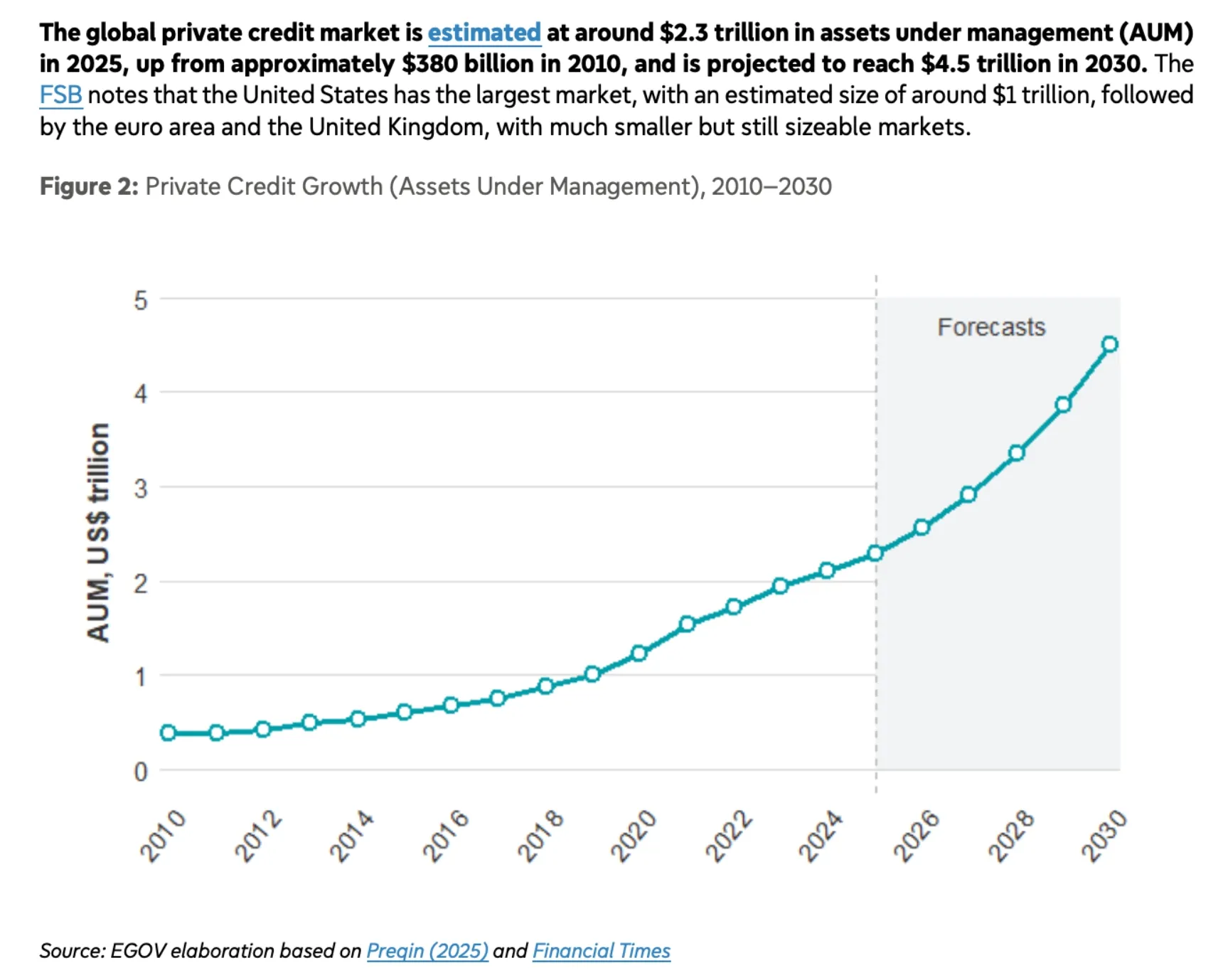
Since September 2025, that market has produced two big bankruptcies, record loan defaults, a 40% drop in new lending, and warnings from the IMF, the ECB, the BIS and the Bank of England. Meanwhile, the tokenized credit kept growing, and it changed shape. The biggest credit token on any blockchain now represents American home loans. The biggest DeFi lender takes Bitcoin as a deposit. And BNY, one of the world's largest banks, now safekeeps a tokenized loan fund whose biggest buyer is a crypto dollar.
If you buy a tokenized credit product today, what exactly do you own, what does it pay you, and what happens to it if the traditional market actually fails?
The traditional private credit market is showing some cracks
The first signal started in Sep 2025, when two borrowers collapsed within 18 days.
- Tricolor, a subprime car lender, went bankrupt amid fraud allegations.
- First Brands, a car parts maker owing over $10 billion, followed.
Investigators think it may have pledged the same collateral to more than one lender, like taking two loans against the same car. Jefferies lost $715 million, UBS around $500 million, Barclays took a £110 million hit, JPMorgan wrote off $170 million. By December, Tricolor executives were facing criminal charges. The industry says these were fraud cases, not a sign the whole market is rotten. Blackstone, Apollo and Ares all testified they had no exposure. That defence matters, because fraud is bad luck, while a credit cycle means many more failures are coming. The problem is that "it's just a few bad apples" is also what gets said at the start of every credit cycle. That is why the Bank of England compared the moment to the early stages of the 2008 crisis and ordered a stress test.
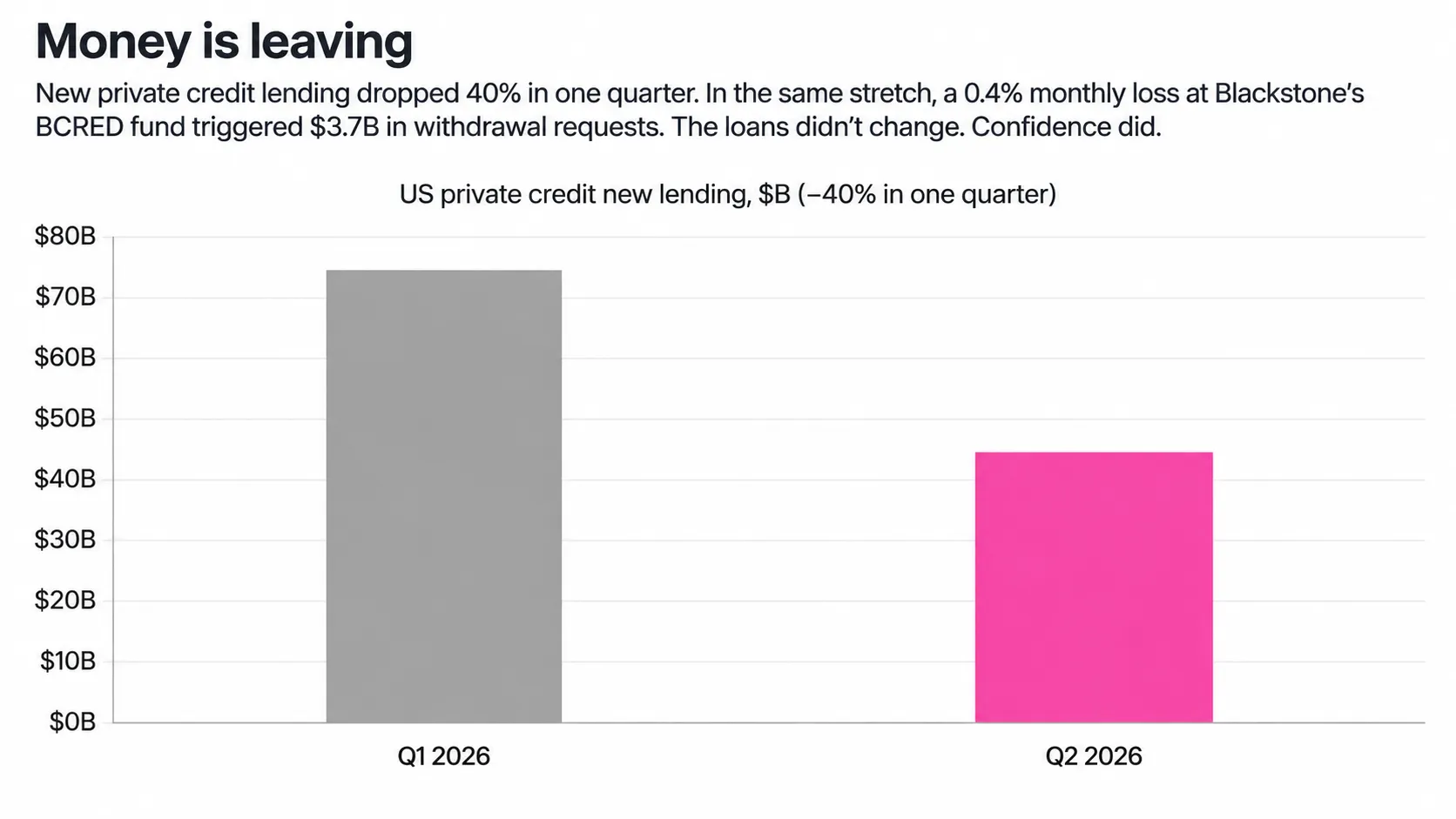
Investors are not waiting for the answer. New lending fell 40% in the second quarter, from $74.6 billion to $44.8 billion. Blackstone's $50 billion BCRED fund gave us its warning shot: a 0.4% monthly loss, its first in 3 years, triggered $3.7 billion in withdrawal requests. Blackstone raised the fund's withdrawal cap, and executives put in personal money to cover the rest.
Most private credit is valued by the funds themselves, quarterly. But one corner of the market trades publicly every day: listed BDCs, the vehicles retail investors use to hold private credit. Their share prices are a live, market-based opinion on whether the funds' stated values are real, and right now the market is voting no. The public BDC index trades at roughly a 17% discount to stated asset value, matching its June 2022 low. FS KKR, one of the big four BDCs, trades near 55% of its stated value after cutting its dividend 31%. Wells Fargo's BDC research argues stated values across the sector are overstated by 8 to 12%, and hedge fund Saba Capital is openly bidding for private credit fund stakes at 20 to 35% below their stated values.
Blue Owl also shows some signals. Redemptions from its non-traded fund accelerated (across the industry, withdrawal requests jumped from 1.6% to 4.8% of assets in one quarter, and these funds saw their first-ever net outflow in early 2026). They tried to fix the liquidity crunch by merging the fund into its listed BDC, but the listed BDC traded at a 20% discount, so the merger would have handed investors an instant 20% paper loss.
Meanwhile, private credit has significant exposure to the software sector, with around $500 billion in SaaS lending by the end of 2025. As AI coding models advance, investors are increasingly concerned that AI-native software could erode demand for traditional SaaS, weakening a key borrower base. At the same time, private credit is expected to finance $800 billion of the $2.9 trillion in AI data center investments through 2028, creating new opportunities but also exposing lenders to infrastructure risks such as power shortages and project delays. Rising stress is already visible, with the U.S. private credit default rate reaching 5.8% in January 2026 and potentially climbing further as AI reshapes the software industry.
Now let's see how the crypto version compares.
Tokenized credit market: who's leading, what each one sells you, risk assessments and the connection
Just like tokenized stocks, tokenized private credit means turning private loans into blockchain-based tokens.
In traditional private credit, investors lend directly to companies or individuals outside public bond markets. Tokenization represents ownership of those loans, or the right to receive their interest and principal repayments, as digital tokens.
For example:
- A lender provides a company with a $10 million loan.
- The loan is divided into 10,000 blockchain tokens.
- Each token represents a small economic interest in the loan.
- Investors holding the tokens may receive a share of interest payments and principal repayments.
Potential benefits include easier fractional ownership, faster settlement, transparent transaction records, and broader investor access. However, tokenization does not eliminate the underlying risks: borrowers can still default, the tokens may be difficult to sell, valuations may be unclear, and access is often restricted to eligible investors.
In simple terms: it puts private loans onchain, but the returns still depend on real borrowers repaying real debt.
1. Figure x Hastra
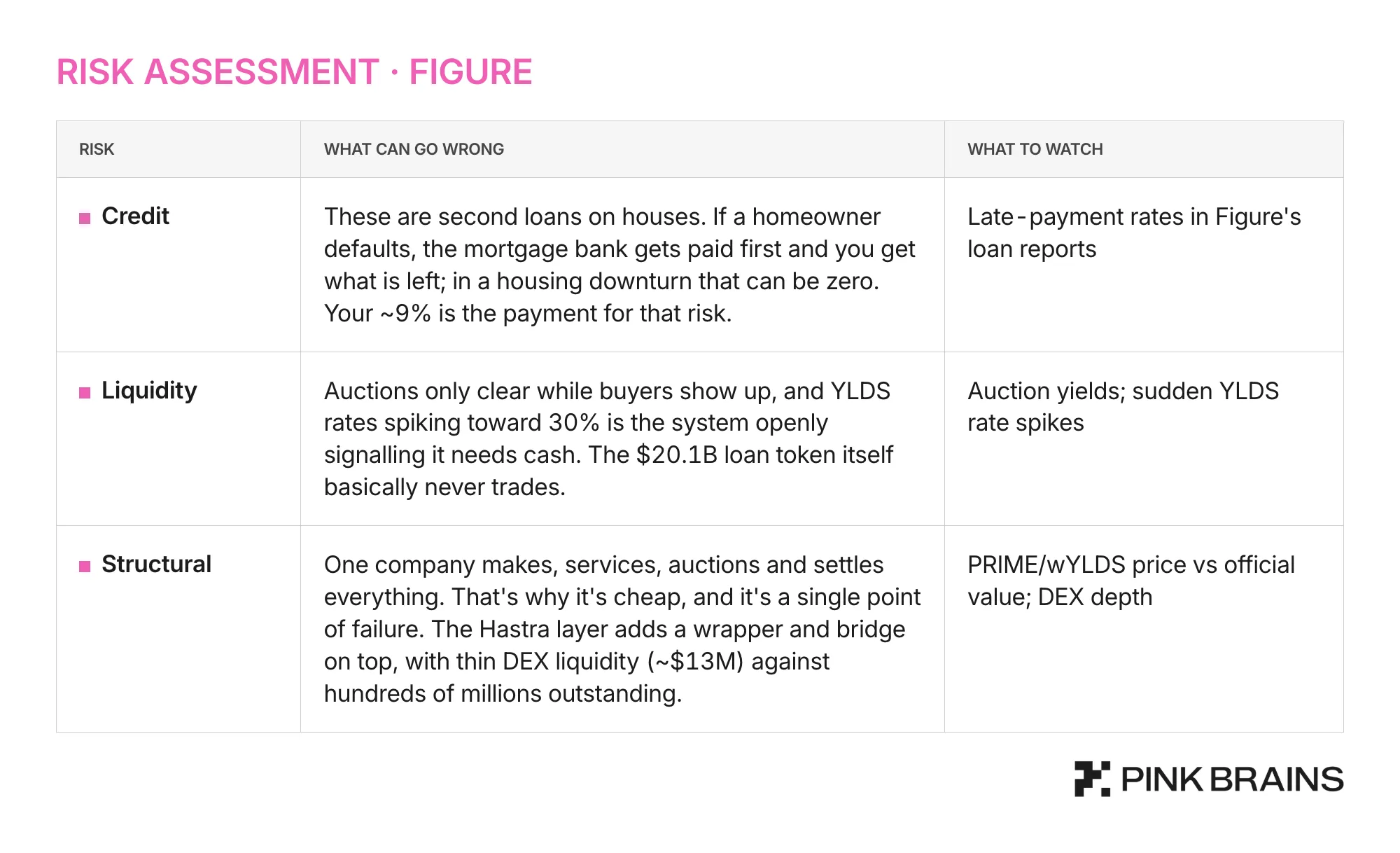
Figure lends Americans money against the value of their homes. Its selling point is speed: approval in about five minutes, cash in about five days. For that speed, borrowers pay around 10% APR, a bit above the 7.4 to 8.2% national average. Figure is not the cheapest lender in America. It is the fastest, and that wins it huge volume.
The blockchain comes in after the loan is made. Every loan is recorded on Figure's own chain, Provenance, which replaces the custodians, trustees and document checks that normally sit between a loan and the investors who fund it. Cutting out those middlemen saves about 1.25% per loan, and Figure splits the saving between cheaper loans and higher investor yields. Over $15 billion in loans have gone through this pipe, with $600 million more each month.
How you earn:
- Figure runs hourly auctions where investors bid to fund the loans. Winners earn about 9% a year, on loans where the homeowner is paying about 9.5%.
- While your cash waits between auctions, it sits in YLDS, Figure's SEC-registered interest-paying stablecoin, earning about 3.8%.
For most of Figure's history, all of this lived on its own rails, closed to open DeFi. That changed with Hastra, a protocol incubated by Figure and Provenance that pipes these yields into Solana and Ethereum through 2 assets:
- wYLDS is a wrapped version of the YLDS stablecoin: hold it in any wallet, no staking, no lock-ups, and it earns about 3.3% from the Treasury-backed stablecoin underneath.
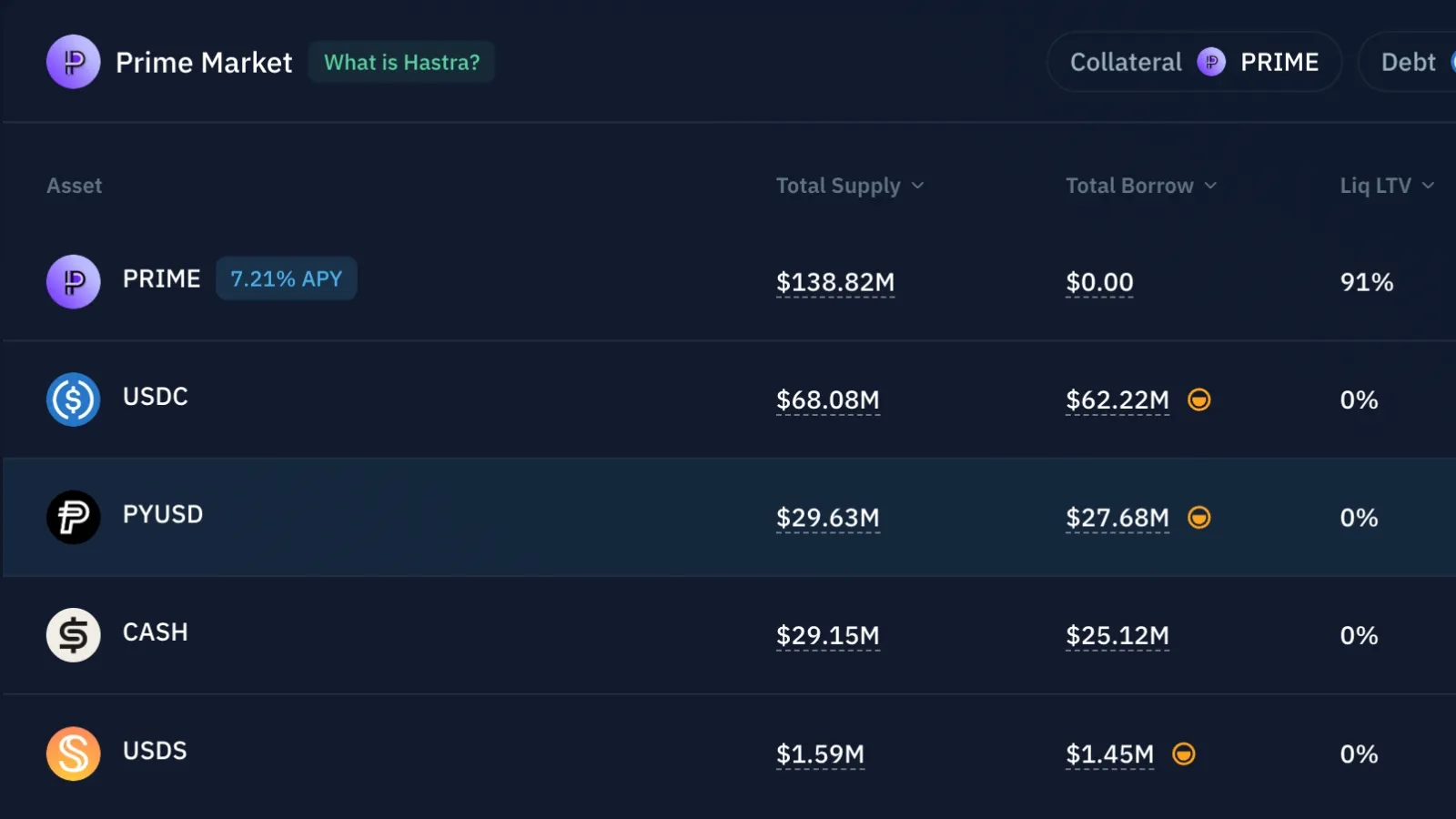
- Stake wYLDS and you mint PRIME, a liquid staking token whose value grows as homeowners pay interest on the Democratized Prime loan pools, currently around 7.2%. The yield is homeowners paying their loans.
The onchain usage is growing fast. Roughly 503M of wYLDS circulates, and around 474 million lPRIME are outstanding across Solana and Ethereum. PRIME lending market on Kamino passed $250 million in TVL this year, making it the biggest lending market on Kamino and one of the largest on all of Solana. PRIME also accounts for 55% of RWA deposits on Morpho and is its fifth-largest borrowing market, with $144 million in PYUSD borrowed.
Risk assessment:
2. Maple Finance
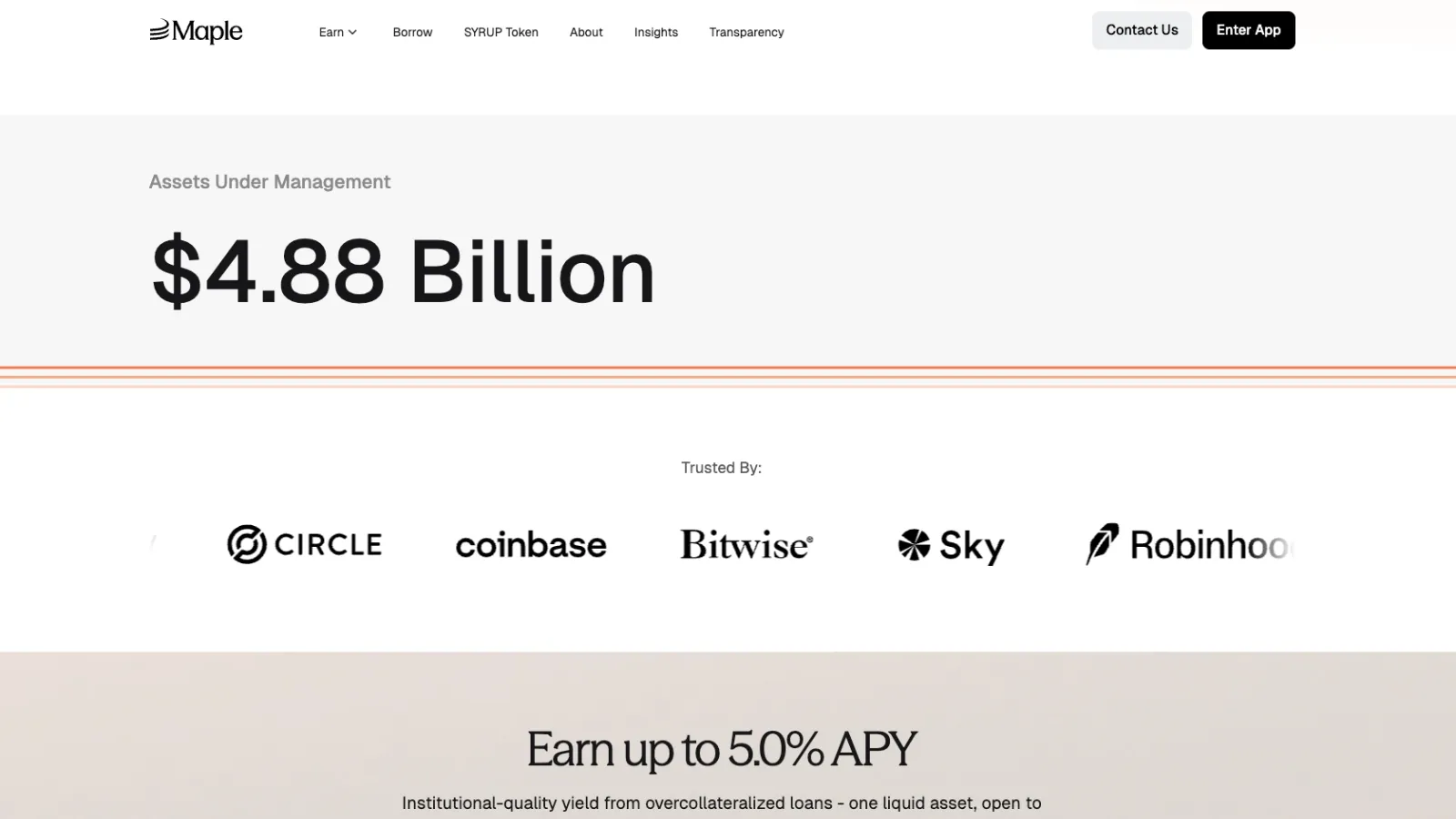
Maple Finance is the largest DeFi-native credit venue, with deposits past $4.3B for 5.1% APY and active loans around $774 million at a 137.1% collateral ratio in BTC and ETH. What it tokenizes is not off-chain paper but its own loan book: fixed-rate loans to vetted institutional borrowers, mostly trading firms and market makers, at rates of 5 to 9%, secured by BTC, ETH, and other liquid staking assets at collateral ratios Maple reports at 125 to 333%, with margin calls enforced within 24 hours.
Maple v1 ran undercollateralized lending and lost LPs over $50 million in the 2022 cycle, including the $36 million of Orthogonal Trading default. The rebuilt, overcollateralized version reports zero lender losses since 2023. The rebuilt model is now compounding fast. Maple closed H1 2026 with $4.6 billion in AUM, up 81% in a year, with Q2 revenue up 47%, and a stated target of $10B AUM. Notably, it grew straight through a period when total DeFi deposits fell roughly 38%.
Depositors access this through syrupUSDC and syrupUSDT, a permissionless yield-bearing token with about $3.52 billion in supply, currently paying a weighted APY around 5%, down from roughly 7% a year ago as rates compressed. It also works as collateral on Aave, Morpho, Kamino, and Euler. The distribution is going mainstream: the new syrupUSDG powers Robinhood Earn, the first DeFi lending product inside the Robinhood app, and hit $200 million in 8 days. A new warehouse facility with Kraken puts Maple's senior loans behind a bankruptcy-remote structure with Kraken as custodian, the first full onchain replication of institutional credit protections.
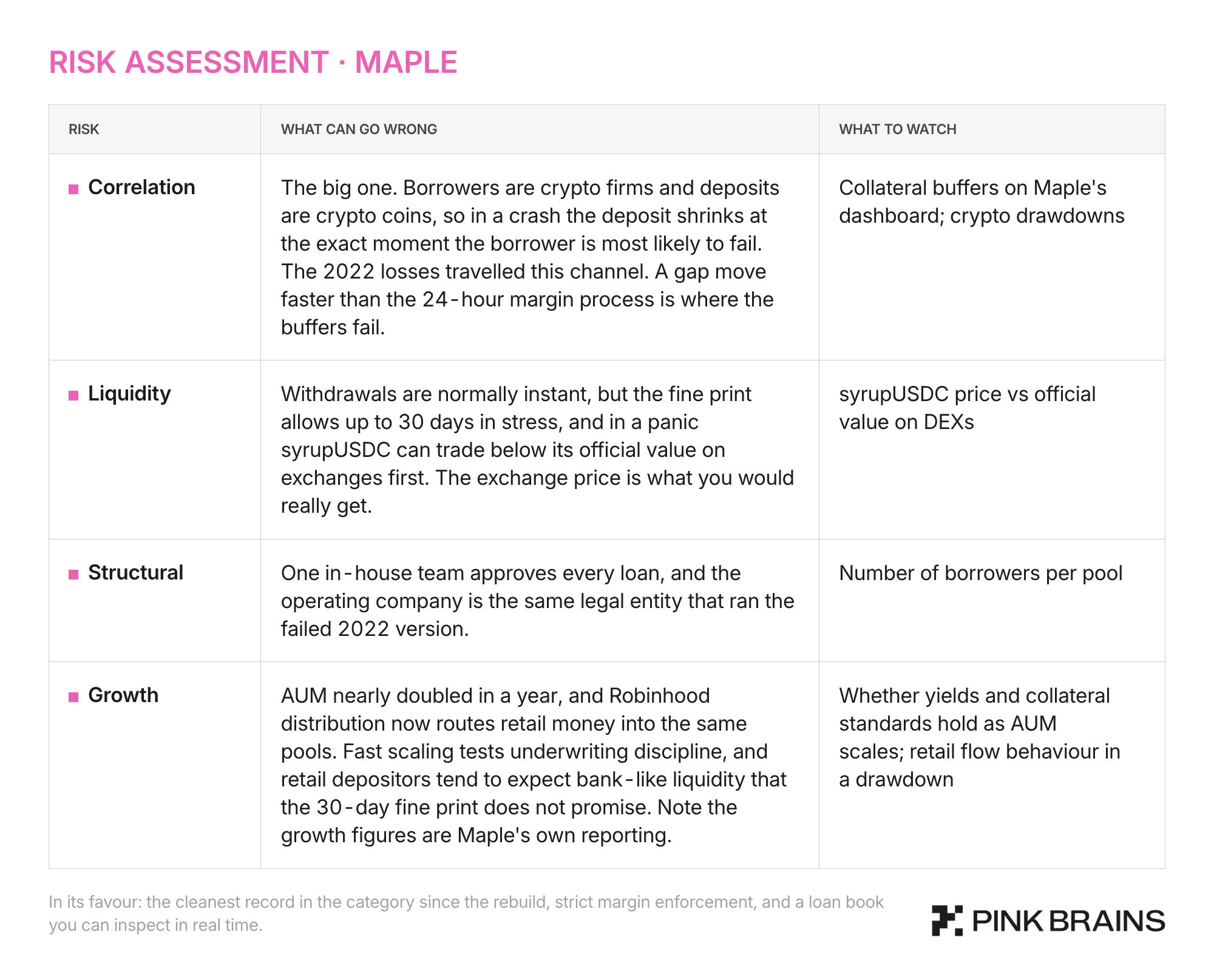
Risk assessment:
3. Centrifuge
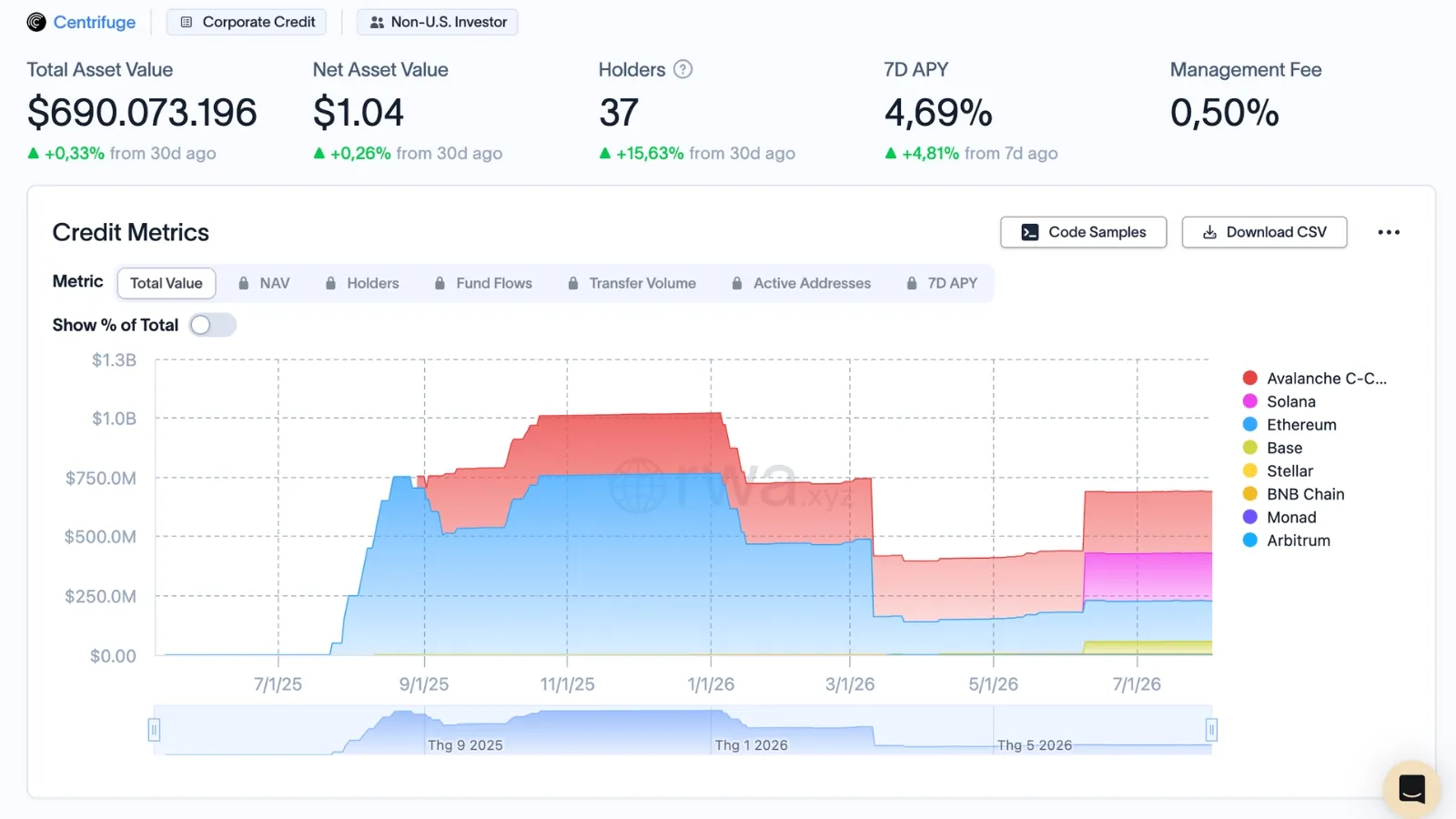
Centrifuge sells crypto users tokens of funds run by actual Wall Street managers. Its flagship today is JAAA, a tokenized AAA-rated CLO strategy run with Janus Henderson, the manager of a $21 billion CLO ETF, seeded with $1 billion from Sky-backed Grove Protocol. CLOs are bundles of corporate loans sliced by seniority, and AAA tranches are the last to take losses. Roughly $200 million of JAAA also sits inside Ethena's USDe reserves, meaning a synthetic dollar is now partially backed by tokenized corporate credit. One number reveals the catch. JAAA's token price rose steadily all year, but the total value dropped 42% in a single month when one big holder left. Very few wallets hold these products. However, JAAA's DeFi footprint is relatively small, with $17M supplied on Aave Horizon and $3.37 million borrowed through Morpho.
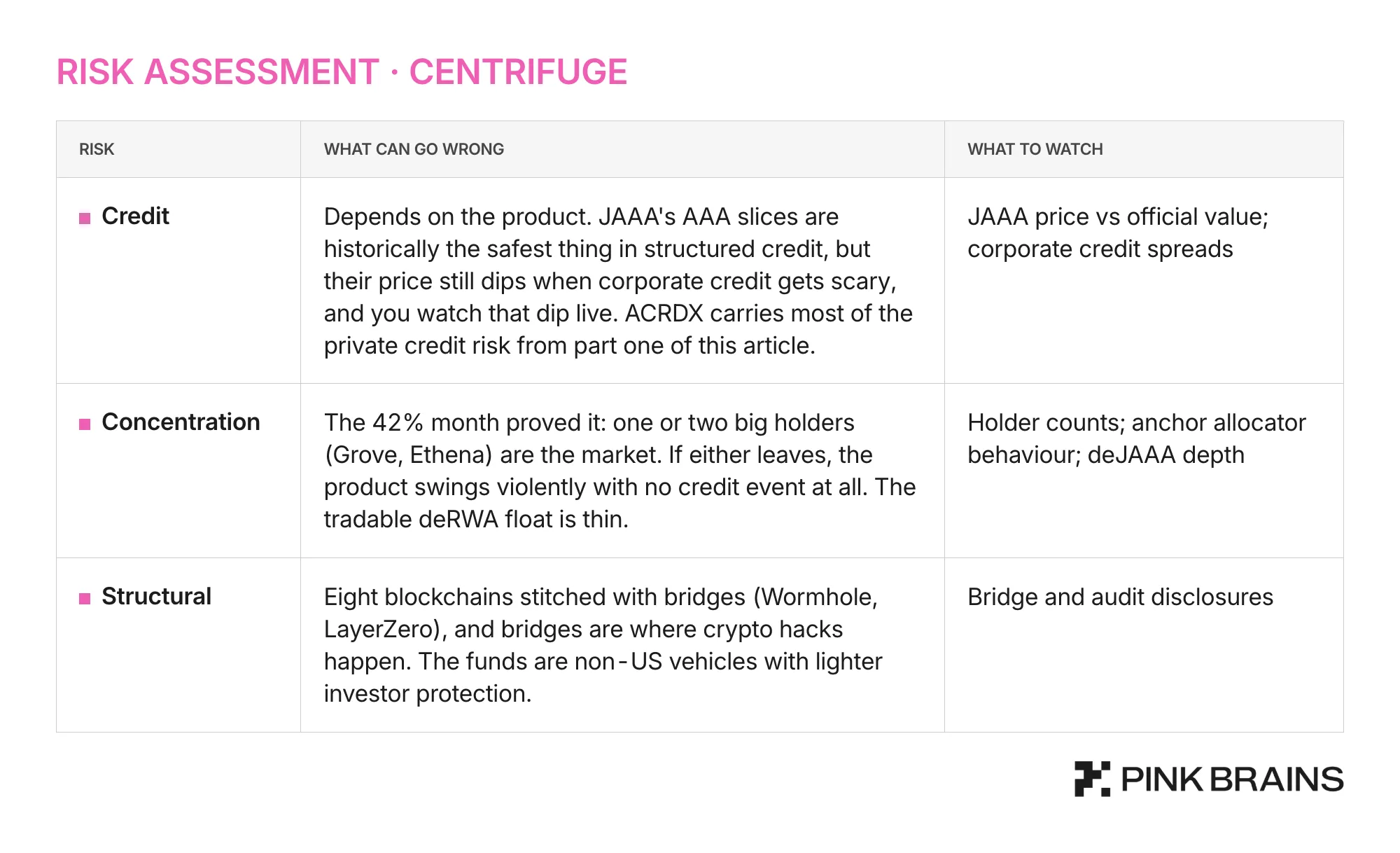
Risk assessment:
4. Securitize
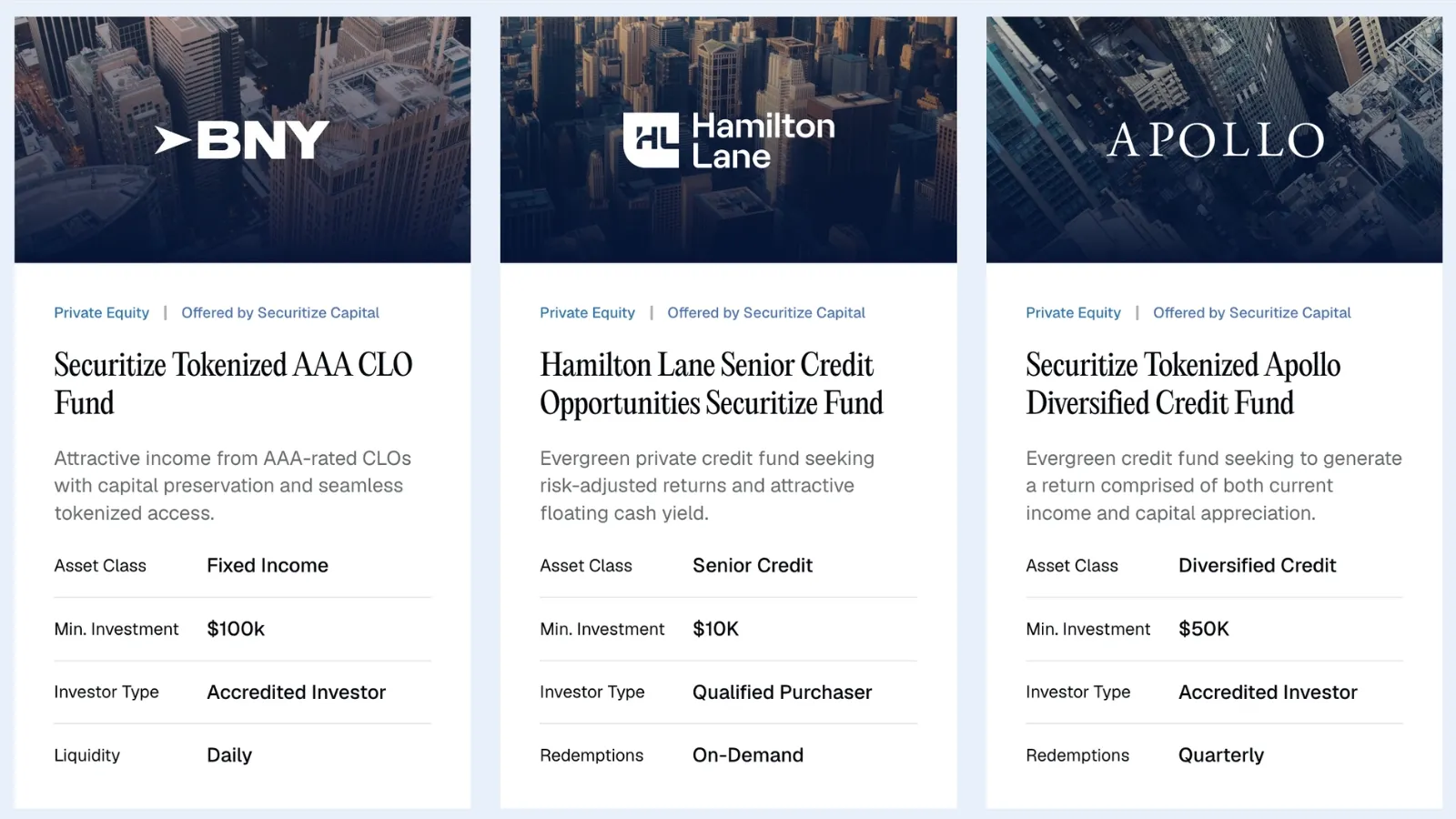
Securitize issues the newest heavyweight, Securitize Tokenized AAA CLO Fund (STAC), launched with BNY and Grove Finance in late 2025. The fund is now managing over $350 million of AUM at 4.26% APY.
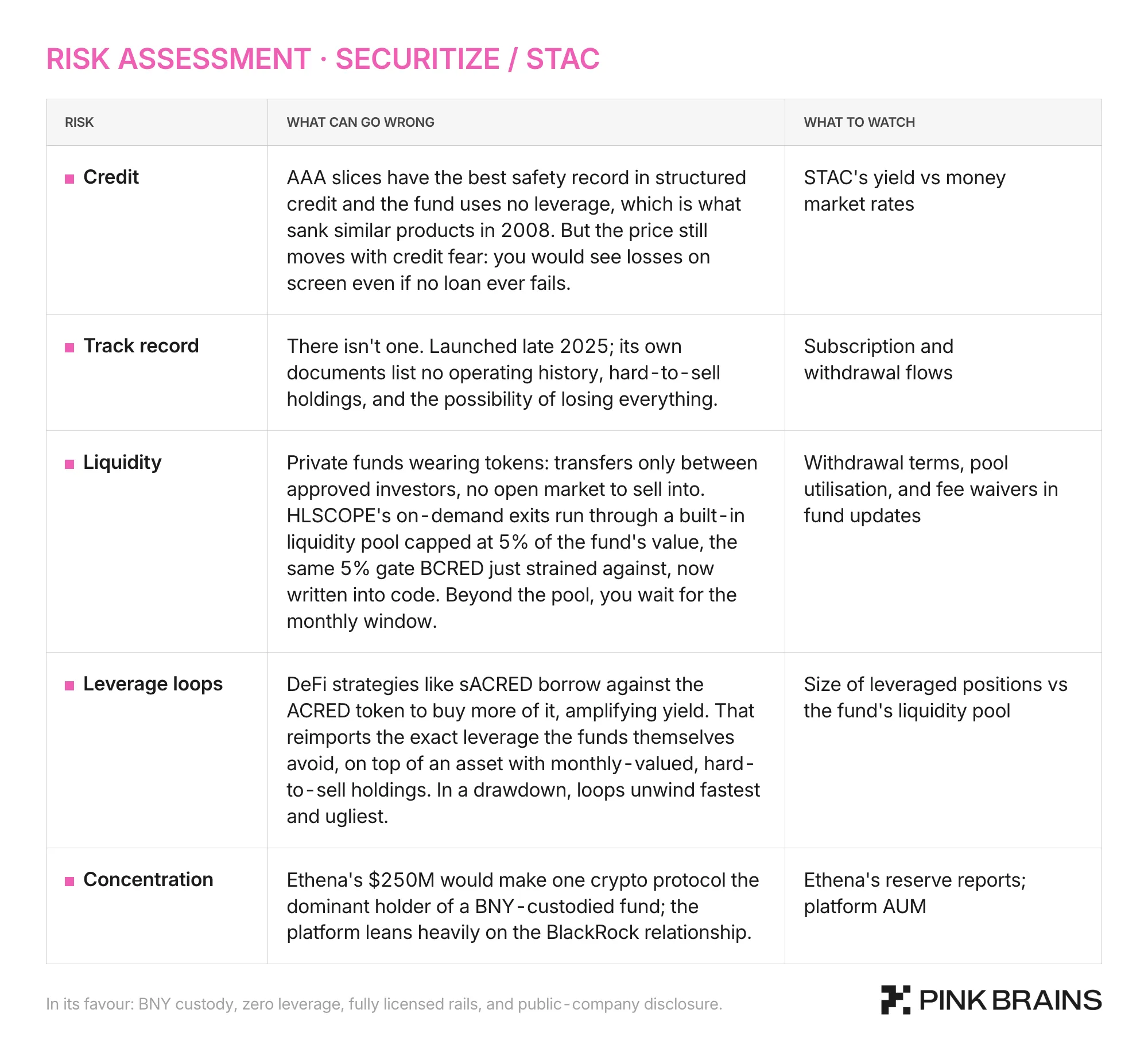
BNY custodies the underlying assets and sub-advises through BNY Investments, a $2.1 trillion manager, and the fund buys US dollar AAA-rated CLO tranches from primary and secondary markets, unleveraged, targeting floating-rate income. Access runs through Securitize's regulated rails: Reg D/Reg S private placement, KYC and accreditation, and shares issued as tokens on Ethereum and, since June, on Solana. Grove anchored it with a planned $100 million, and Ethena plans a $250 million allocation, one of the largest commitments to tokenized structured credit to date.
What STAC tells about the sector's direction: the growth frontier of tokenized private credit is no longer DeFi protocols underwriting loans; it is Wall Street's custodians issuing TradFi credit products in token form. The trade-off is the same fact read the other way. You are not escaping traditional credit by buying it; you are holding it with fewer intermediaries, and its yield and its drawdowns will be TradFi's.
STAC is the safest in the product line. Other private funds carry different risk appetites.
- HLSCOPE sits in the middle: a tokenized feeder into Hamilton Lane's Senior Credit Opportunities Fund, an evergreen vehicle of floating-rate, senior secured loans to companies in recession-resistant sectors like healthcare and business services.
- ACRED carries the most risk: a feeder into the Apollo Diversified Credit Fund, full-fat private credit spanning direct lending and stressed situations. It's also wrapped in leverage strategies (sACRED), looping the fund token on Loopscale to amplify its yield.
Risk assessment:
If TradFi credit breaks, does this tokenized market break too?
The connection is real. But it runs through 4 channels at 4 different speeds, and it does not touch the four venues equally. This is the section to actually remember.
- Direct ownership, same-day. Roughly $1 to 1.5 billion of the $7 billion investable market, 15 to 20%, simply is TradFi credit wearing a token: JAAA, STAC, and the Apollo feeders. When corporate credit fear rises, these token prices mark down the same day, live onchain. This already happened: in March 2026, stress in the broader private credit market visibly fed through to tokenized products, and thin secondary liquidity made it worse.
- The flow's channel and the counterintuitive data point. Through TradFi's worst stretch in years, onchain credit tripled. Money arrived rather than fled because the buyers are not TradFi allocators. They are crypto treasuries: Grove has put over $1 billion into JAAA and STAC, Ethena is wiring in close to half a billion, and their decisions follow crypto reserve strategy. That cuts both ways: the same two or three allocators who carried the growth can reverse it in a week. Today, these products' prices follow allocator decisions more than loan performance.
- The feedback loop. Tokenized credit is becoming stablecoin backing. A TradFi credit shock marks down JAAA and STAC, which dents the reserve ecosystem behind Ethena's synthetic dollar, and a stablecoin confidence wobble moves all of crypto within hours. This route did not exist last cycle: in 2022, crypto credit blew up for crypto reasons (FTX) while TradFi was fine. The next stress could run the opposite direction, through this pipe. The amounts are capped today; the architecture is the point.
- What can stay insulated? Maple, a third of the investable market, has almost no TradFi linkage: crypto borrowers, crypto collateral, crypto cycle. A TradFi crunch reaches it only via a general crypto sell-off. The figure sits in between: home equity transmits only if credit stress becomes a real recession with job losses and falling house prices, which takes quarters, and rate cuts along the way actually make its floating-rate loans easier to service.
What could be opportunities for tokenized credit?
- Transparency: TradFi funds report quarterly, and investors just learned how little they can see inside a $50 billion one. Onchain pools show their books continuously, and money leaving opaque funds is already arriving: on-chain credit grew straight through the stress.
- Capital Efficiency: A TradFi credit investor's money is locked. syrupUSDC and PRIME earn yield while working as collateral or margin elsewhere. This is the one place the tokenized version is genuinely a better instrument, not a copy.
Final thoughts
Private credit has grown into a $1.5 trillion - $2 trillion market by offering flexible financing to companies underserved by traditional banks. But its rapid expansion has also increased complexity, leverage, and interconnectedness across banks, insurers, private equity, and asset managers. Limited transparency, opaque valuations, and scarce data make risks harder to monitor, raising concerns about financial stability as the market continues to expand.
Tokenized private credit is likely to face the same structural risks highlighted in traditional private credit, including high leverage, opaque valuations, and limited liquidity. While tokenization makes these assets easier to access, transfer, and settle, it does not eliminate the underlying credit risk. As regulators increase scrutiny of the private credit market, tokenized credit products may also face higher standards for transparency, disclosures, and risk management.

.png)

%201%201.png)